[ Rusto kaj Verdo kaj Flavo ]

Kolorteorio instruas nin interalie, pri subtraha reflekto.

Jen, verdo manĝas flavon.

~malmiksado~

\eZ

#miksang #dailypic #aphotoaday
#Esperanto #photography #photo
#color #colors #colour #colours
#subtractive #reflection #reflections
#colortheory #yellow #green

#IonicColumn

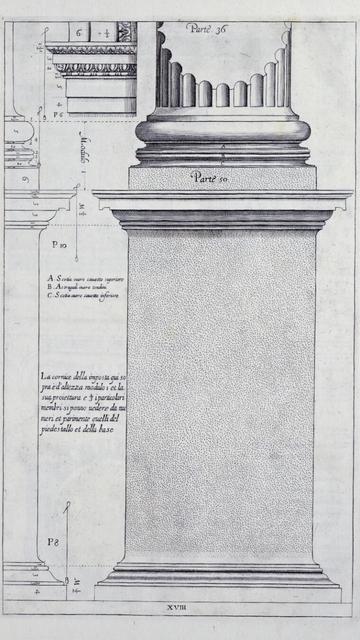
#Flutes have a different configuration in the #IonicOrder than they do in the #DoricOrder. In #Doric, the flutes run right next to each other, dividing the circumference of the column into 24 equal sectors, or 15° each.

In #Ionic, there is a small gap between the flutes. This gap used to vary, but over time, Ionic designers seemed to have settled and standardized the measurements by splitting 15° in 4:1 ratio, giving 12° to a flute and 3° to the gap between flutes.

Because of this standardization, there would seem to be little room for variants, but there is. In his #RegolaArchitettura [see https://archive.org/details/gri_33125008229458/page/n37/mode/2up], #Vignola documented flutes with hemispherical tops but flat bottoms, as shown in the image here.

However, it is acceptable to have hemispheres at both top and bottom as long as they are consistently used within a #colonnade or #arcade.

Flute geometry is interesting. Just like the #IonicColumn #shaft, a flute also gradually tapers as it rises from bottom to top. Additionally, it bends along the shaft surface due to #entasis [see https://pixelfed.social/p/Splines/791794072490907090]. In other words, flutes hug the column shaft.

Unlike other decorative elements like #eggsAndDarts and #3StrandBraids, flutes are #subtractive, not #additive to the rest of the design. In other words, we have to carve the flutes out instead of adding them to the design.
Regola delli cinque ordini d' architettura : Vignola, 1507-1573 : Free Download, Borrow, and Streaming : Internet Archive

48 leaves : 44 cm (fol.)

Internet Archive
#green is the #colour between #cyan and #yellow on the visible spectrum. In #subtractive colour systems, used in painting and colour printing, it is created by a combination of yellow and cyan. By far the largest contributor to green in nature is chlorophyll, the chemical by which plants photosynthesise and convert sunlight into chemical energy. That last bit is what is going on here in this peaceful wood. Sunlight, green leaves and undergrowth with a path through it. Happy New Year!

#MusicProduction

There are 20+ known
#AudioSynthesis types. The most popular being:

#Subtractive
#FM
#Wavetable

Combined with #Sampling, #modulating, #Layering, & #FX, these audio engines cover the majority of sound generation from the majority of #Synthesizer #Plugins created.

Unless a #synth provides a special character, there is no point in having more than a couple of synths.

#OpenSource has most everything you need.

Don’t collect synths for #patches, learn the tools you have.

Simple Mods Turn 3D Printer into Electrochemical Metal Cutter

We're not aware of any authoritative metrics on such things, but it's safe to say that the Ender 3 is among the most hackable commercial 3D printers. There's just something about the machine that lends itself to hacks, most of which are obviously aimed at making it better at 3D printing. Some, though, are aimed in a totally different direction.

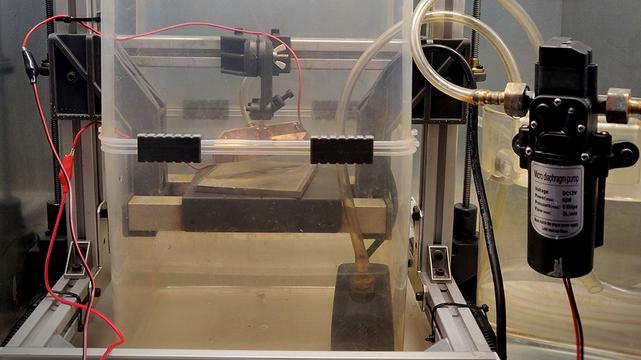
As proof of that, check out this Ender 3 modified for electrochemical machining. ECM is a machining process that uses electrolysis to remove metal from a workpiece. It's somewhat related to electric discharge machining, but isn't anywhere near as energetic. [Cooper Zurad] has been exploring ECM with his Ender, which he lightly modified by replacing the extruder with a hypodermic needle electrode. The electrode is connected to a small pump that circulates electrolyte from a bath on the build platform, while a power supply connects to the needle and the workpiece. As the tool traces over the workpiece, material is electrolytically removed.

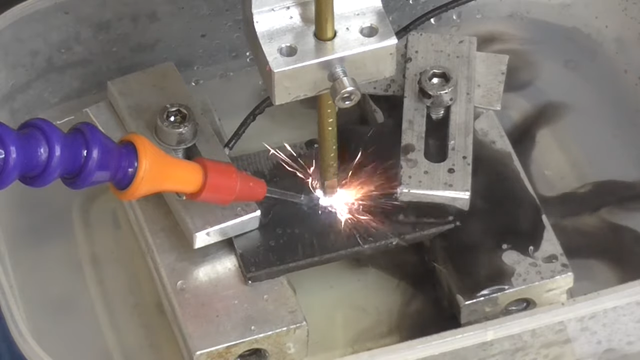
The video below is a refinement of the basic ECM process, which [Cooper] dubs "wire ECM." The tool is modified so that electrolyte flows down the outside of the needle, which allows it to enter the workpiece from the edge. Initial results are encouraging; the machine was able to cut through 6 mm thick stainless steel neatly and quickly. There does appear to be a bit of "flare" to the cut near the bottom of thicker stock, which we'd imagine might be mitigated with a faster electrolyte flow rate.

If you want to build your own Ender ECM, [Cooper] has graciously made the plans available for download, which is great since we'd love to see wire ECM take off. We've covered ECM before, but more for simpler etching jobs. Being able to silently and cleanly cut steel on the desktop would be a game-changer.

#3dprinterhacks #toolhacks #cnc #ecm #edm #electricdischargemachining #electrochemicalmachining #electrolyte #etching #gcode #machining #subtractive #wireecm

Simple Mods Turn 3D Printer Into Electrochemical Metal Cutter

We’re not aware of any authoritative metrics on such things, but it’s safe to say that the Ender 3 is among the most hackable commercial 3D printers. There’s just something about …

Hackaday

3D-Printed Tooling Enables DIY Electrochemical Machining

When it comes to turning a raw block of metal into a useful part, most processes are pretty dramatic. Sharp and tough tools are slammed into raw stock to remove tiny bits at a time, releasing the part trapped within. It doesn't always have to be quite so violent though, as these experiments in electrochemical machining suggest.

Electrochemical machining, or ECM, is not to be confused with electrical discharge machining, or EDM. While similar, ECM is a much tamer process. Where EDM relies on a powerful electric arc between the tool and the work to erode material in a dielectric fluid, ECM is much more like electrolysis in reverse. In ECM, a workpiece and custom tool are placed in an electrolyte bath and wired to a power source; the workpiece is the anode while the tool is the cathode, and the flow of charged electrolyte through the tool ionizes the workpiece, slowly eroding it.

The trick -- and expense -- of ECM is generally in making the tooling, which can be extremely complicated. For his experiments, [Amos] took the shortcut of 3D-printing his tool -- he chose [Suzanne] the Blender monkey -- and then copper plating it, to make it conductive. Attached to the remains of a RepRap for Z-axis control and kitted out with tanks and pumps to keep the electrolyte flowing, the rig worked surprisingly well, leaving a recognizably simian faceprint on a block of steel.

[Amos] admits the setup is far from optimized; the loop controlling the distance between workpiece and tool isn't closed yet, for instance. Still, for initial experiments, the results are very encouraging, and we like the idea of 3D-printing tools for this process. Given his previous success straightening his own teeth or 3D-printing glass, we expect he'll get this fully sorted soon enough.

#cnchacks #mischacks #anode #cathode #ecm #edm #electrochemicalmachining #electrode #electrolysis #electroplating #subtractive

3D-Printed Tooling Enables DIY Electrochemical Machining

When it comes to turning a raw block of metal into a useful part, most processes are pretty dramatic. Sharp and tough tools are slammed into raw stock to remove tiny bits at a time, releasing the p…

Hackaday

Homemade EDM Machine Moves from Prototype to Production

Of all the methods of making big pieces of metal into smaller pieces of metal, perhaps none is more interesting than electrical discharge machining. EDM is also notoriously fussy, what with having to control an arc discharge while precisely positioning the tool relative to the workpiece. Still, some home gamers give it a whirl, and we love to share their successes, like this work-in-progress EDM machine. (Video, embedded below.)

We've linked [Andy]'s first videos below the break, and we'd expect there will be a few more before all is said and done. But really, for being fairly early in the project, [Andy] has made a lot of progress. EDM is basically using an electric arc to remove material from a workpiece, but as anyone who has unintentionally performed EDM on, say, a screwdriver by shorting it across the terminals in a live outlet box, the process needs to be controlled to be useful.

Part 1 shows the start of the build using an old tap burning machine, a 60-volt power supply, and a simple pulse generator. This was enough to experiment with the basics of both the mechanical control of electrode positioning, and the electrical aspects of getting a sustained, useful discharge. Part 2 continues with refinements that led very quickly to the first useful parts, machined quickly and cleanly from thin stock using a custom tool. We'll admit to being impressed -- many EDM builds either never get to the point of making simple holes, or stop when progressing beyond that initial success proves daunting. Of course, when [Andy] drops the fact that he made the buttons for the control panel on his homemade injection molding machine, one gets the feeling that anything is possible.

We're looking forward to more on this build. We've seen a few EDM builds before, but none with this much potential.

#cnchacks #toolhacks #arc #cnc #dielectric #edm #electricaldischargemachining #igbt #subtractive

Homemade EDM Machine Moves From Prototype To Production

Of all the methods of making big pieces of metal into smaller pieces of metal, perhaps none is more interesting than electrical discharge machining. EDM is also notoriously fussy, what with having …

Hackaday