 Kevin Karhan
 rdm
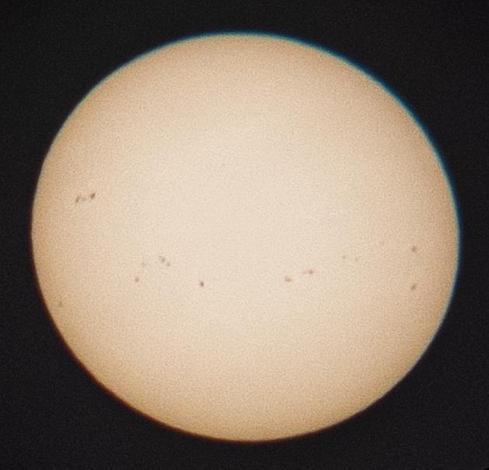
rdmToday's #Sun. A few #Sunspots, but overall things took pretty quiet. Are we past #SolarMax ?
Dwarf3, ND1e6, 10x1/1000@0. Light post in #googlephotos

@swanson but in terms of actual optics that work:
-Pacific Optical made a 25mm f/1.0 (Medium Format 150° Fish-eye lens) that was allegedly used in the Movie #Solarmax.
Personally I have some tiny 2,9mm equivalent C-Mount fisheye that goes like f/2.8 if I'm not mistaken that doesn't even cover m4/3-Sensor but gets that weird 360 surveillance dome camera look.
Today's #Sun. A few #Sunspots, but overall things took pretty quiet. Are we past #SolarMax ?
Dwarf3, ND1e6, 10x1/1000@0. Light post in #googlephotos
Space Weather
Our sun is a just a little more active this weekend. There have been five flares larger than M-level in the past 48 hours or so, compared to only one between 15 and 20 Feb.
Flares and peak times are below in UT.
M3.3 12h10 UT 21 Feb
M1.4 14h30 UT 21 Feb
M4.9 02h12 UT 23 Feb
M1.0 09h56 UT 23 Feb
M1.6 11h56 UT 23 Feb
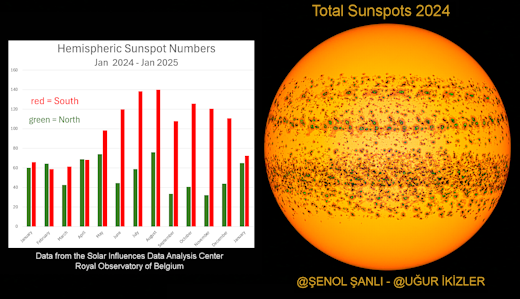
There are suggestions that we may see a second peak for "Solar Max" thanks to the sun's northern hemisphere being slower than the south in flipping its magnetic field.
Read more via the link below.


SOLAR MAX -- IS A SECOND PEAK COMING? Solar Max has arrived, but only half of the sun has been fully participating. Most of the action in the past year, including the geomagnetic superstorm of May 2024, resulted from activity in the sun's southern hemisphere. Now, a second peak might be coming as the sun's northern hemisphere catches up. https://spaceweather.com

SOLAR MAX -- IS A SECOND PEAK COMING? Solar Max has arrived, but only half of the sun has been fully participating. Most of the action in the past year, including the geomagnetic superstorm of May 2024, resulted from activity in the sun's southern hemisphere. Now, a second peak might be coming as the sun's northern hemisphere catches up. https://spaceweather.com
The Sun is a busy place at the moment as we're approaching solar maximum, with plenty of sunspots around 🌞
There was a lot of high thin cloud around this afternoon, but I still managed a peek at the current parade, projected through my binoculars onto a white screen & badly photographed with my phone 🤷♂️📱
Today's H-alpha #Sun in moderate seeing conditions at 17:10 UTC. There was a tremendous loop prominence on the Sun's southwest limb that persisted following a long-duration M5.5 and resulting CME about five hours earlier. Shows up beautifully in the SDO AIA 171Å image too.
#Aurora #Outburst #Sequence
Taken by Alan Dyer on August 11, 2024 @ Grasslands National Park, Saskatchewan
https://spaceweathergallery2.com/indiv_upload.php?upload_id=211852
by James Guilford
The first DSLR image of the night turned out to be the most spectacular.It turned out to be a stronger impact than forecast, and the strongest thus far of this solar activity cycle; the geomagnetic storm of May 10 – 11, 2024 produced auroras (Northern and Southern Lights) visible at night from locations nearly pole to pole.
The Responsible Spot: The morning of the aurora, we photographed Sun, capturing this close-up of AR3664, the source of coronal materials that caused the Northern Lights or Aurora storm. It was a most impressive feature and remained intact and spewing powerful flares as it disappeared over Sun’s western limb!The forecast of possible aurora prompted me to step outside at about 10 PM (EDT), when twilight had faded, to check the skies. At first I saw what I thought might be clouds but knowing auroras can be feeble, I watched. Sure enough, there was movement in those “clouds”.
NOAA Space Weather Prediction Center’s depiction of the expected extent of aurora May 10, 2024.Glancing overhead I saw what I found hard believe — aurora ray features directly overhead … at 41º latitude, a rare sight, indeed! Rushing back indoors, I pulled together camera, fisheye lens, and tripod and headed back out.
What most people saw with their unaided eyes resembled thin clouds. Watching those “clouds” as they ebbed and flowed, and subtle coloration betrayed their true nature to those who knew what to look for. The auroral streaks pictured here were directly overhead in Medina, Ohio — 41º latitude.The aurora still presented itself as cloudy streaks with, perhaps, hints of color. Now also armed with my smartphone, I activated its camera and aimed it at the sky. There on the screen, light amplified by the phone’s electronics, glorious, eye-popping colors filled the sky! I’d never before experienced an aurora like it.
First image of the night came from the iPhone 13 camera, revealing the true extent of the ongoing aurora.Only occasionally, during the time I was out, did the aurora’s color become visible to me; apparently being just below the limits of my, and others’ visual perception. Another local observer noted color was more visible shortly before I stepped outside to check on things — the actual peak of the display must have happened as twilight was ending and before 10 p.m.
During the hour we watched the show in the sky, the event slowly faded, then returned bringing forth another burst of color. The balance of images here are from a Canon EOS 5D Mk. 4 DSLR camera with a Sigma fisheye lens. The DSLR exposures are ISO 400, f/2.8, and 4 to 8 seconds.I observed and photographed the aurora from shortly after 10:00 until about 11:30 EDT and in that hour or so, the intensity faded and then re-surged before fading away again which was my signal to shut down. I might have stayed out longer but had a commitment for the next day — sleep was needed — so, satisfied I’d seen the phenomenon at its best, I put away the camera gear.
Looking very nearly straight up, these rays appear to be emanating from a position in the east-northeastern sky. The extent of the aurora was impressive, visible well into the Deep South of the United States. The aurora australis was widely visible in the southern hemisphere.Knowing it would be all over the news, I submitted my most spectacular shot of the night to the local newspaper — a daily that publishes on Saturday but not Sunday. It was too late for the Saturday edition but the editor gave my photo a three-column, Page 1 spot on Monday.
Colors rain down on a quiet residence, perhaps poured out from the Big Dipper seen here in an inverted position. The north star, Polaris, is a tiny dot near the center of this picture. (Note how two stars of the Dipper’s bowl point toward Polaris.) The short horizontal streak to the right of Polaris is a moving airplane’s navigation lights, captured in the several seconds of the camera’s exposure.Our Sun is still in its peak activity period, by some accounts it won’t hit solar maximum until some time in 2025, so there may be more auroras in our near future but this was one for the history books!
Page 1 of the Medina County Gazette, Monday, May 13, 2024.#astronomy #astrophotography #aurora #auroraBorealis #geomagneticStorm #northernLights #photography #solar #solarMax #sun #sunspots
 𝑮7𝑰𝙕𝑼 𝑹𝙍𝑫
 Westport Observatory
 Mark McCaughrean
 Wild Sown
  Dr. John Barentine FRAS
 mc ☕
mc ☕ Stella-Luna Observatory