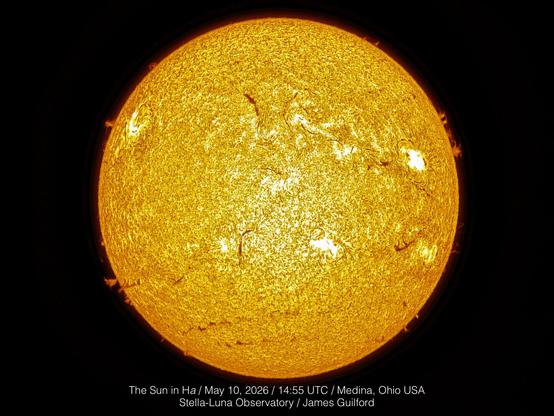
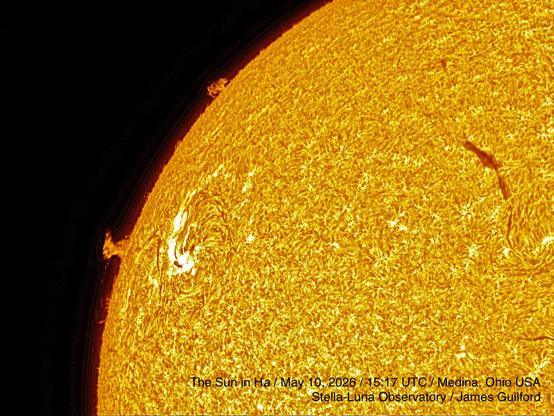
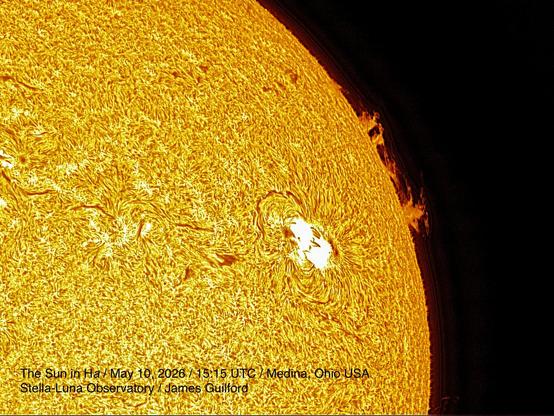
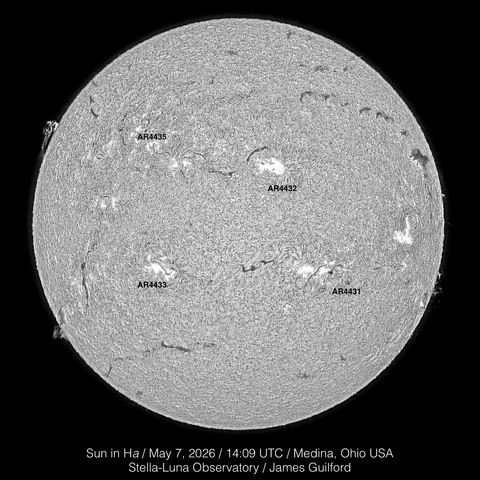
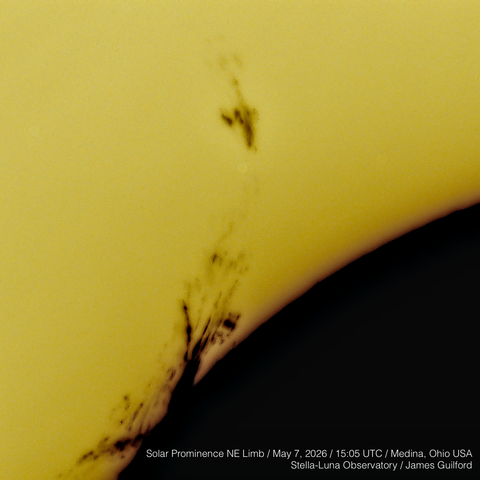
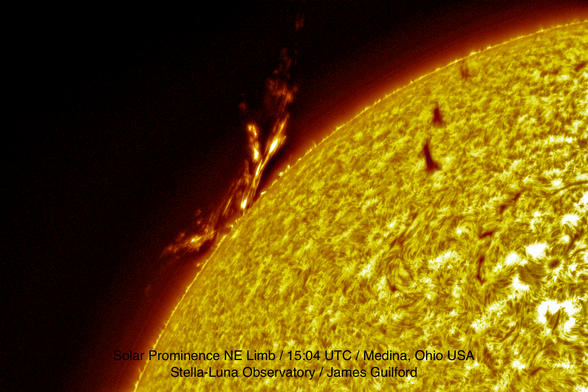
The Sun, on Sunday morning, observed through clear blue skies, via hydrogen-alpha light. Plenty of prominences present around the rim, and several sunspots / Active Regions provided points of interest for observation. In the second image here, the curved, white patch near a prominence is AR4436 which exploded with an M5.7-class flare a couple of hours earlier -- its CME is likely to miss Earth as it passes by on May 13. This AR bears watching. #solarastronomy
A sunny morning let us observe a fine prominence on the northeastern limb of Earth's Sun. We struggled to adjust the telescope and camera to best resolve the feature not realizing, at the time, the plasma "fountain" was changing -- apparently collapsing -- before our eyes! Pretty exciting, when you think about what's happening, and how large those prominences are! Clouds and deteriorating seeing limited further efforts. #solarastronomy #astronomy #sun
My favorite image from this morning’s observing run is actually a screenshot made during processing. It seems every time we attempted to finalize edits, the software essentially threw up! So before finalizing this one, we made a screen capture and I’m glad! Numerous spicules can be seen along the rim, and the prominence itself has an unexpected dynamical look. Three cone-shaped filament segments add to the scene. #solarobserving #solarastronomy #sun

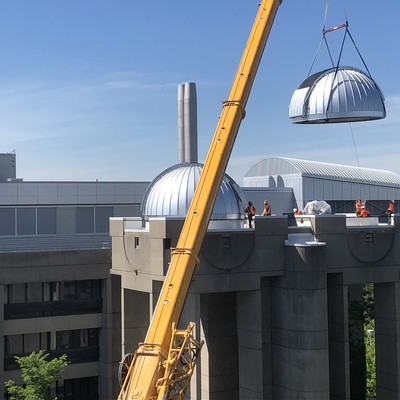
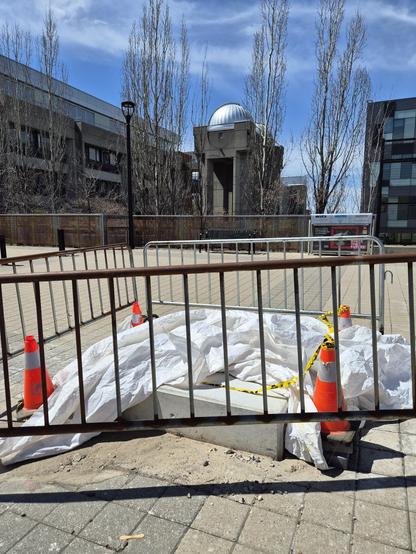
The first step of the new 8m Sundial is piqueing my sunny astronomy interest! Fingers crossed for a finished installation this summer at #yorkuniversity

For enthusiasts it will be based on the Shmoyer Sunquist Sundial design and should be fairly high accuracy! #sundial #solarastronomy #solar #telescope #science #Astrodon #astronomy

A little scare, a quick fix

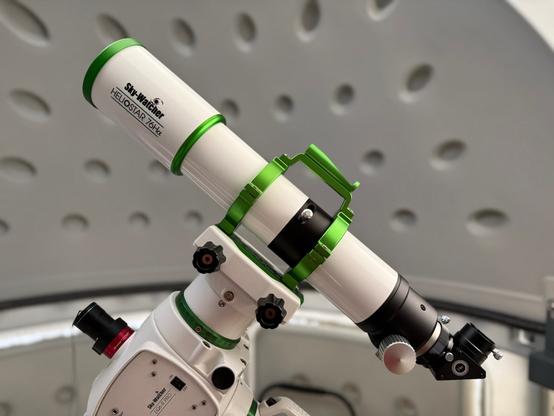
Our Sky-Watcher HelioStar 76Ha Solar telescope mounted on the observatory’s permanent mount. The focuser, for those new to these things, is operated via the silver knob seen at the lower end of the telescope. Photo by James Guilford.

A couple of days ago, during a rather ambitious solar imaging session, the focuser on our Sky-Watcher HelioStar 76Ha telescope failed. And by failure, we mean the specialized diagonal that holds an eyepiece or camera would not stay put! The focuser would barely move the assembly and, once released, the diagonal plus camera would … zzzzzzip! … slide outward as far as it could. As one might expect, that sort of thing makes the telescope worthless. Disappointment? Disaster?

Contacting Agena Astro, the telescope’s seller, their rep. reminded us that the unit was still under warranty and supplied contact information for Sky-Watcher USA’s Support. Sending off an email describing the issue we waited a reply. “Sounds like the focuser might need to be adjusted,” came the reply a short time later. “Don’t worry we have a lot of adjustment with this focuser.” Adjusting three screws on the telescope, as instructed, and within five minutes the system was working good as new!

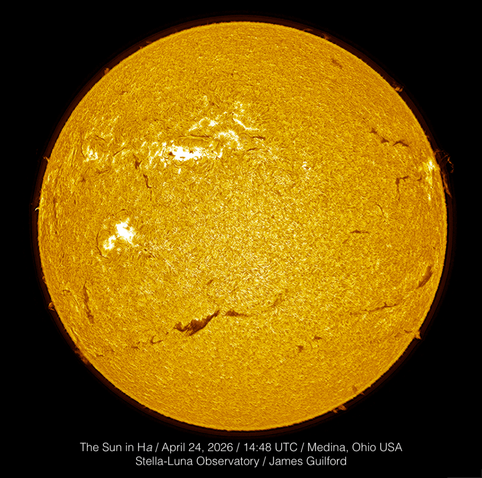
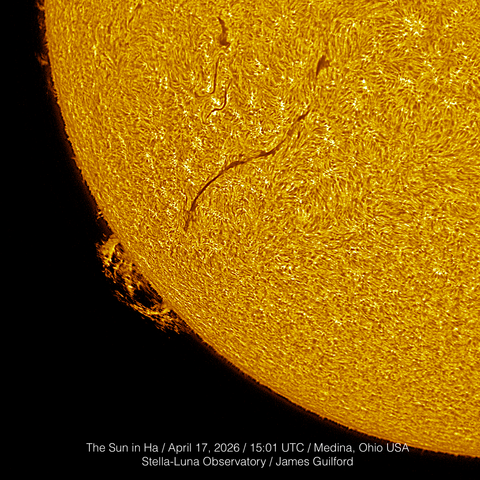
The Sun as it appeared via hydrogen-alpha light on April 24, 2026; as imaged using the Sky-Watcher HelioStar 76Ha Solar telescope, and a ZWO ASI monochrome camera. False color applied. Image by James Guilford.

So there was a little scare. Excellent support provided by the retailer and the manufacturer. A quick fix. And we were able to take advantage of excellent conditions today, making images of our local star! Thanks go out to Agena Astro and Sky-Watcher USA!

#AgenaAstro #astronomy #heliostar #SkyWatcher #solar #solarAstronomy #sun #telescope

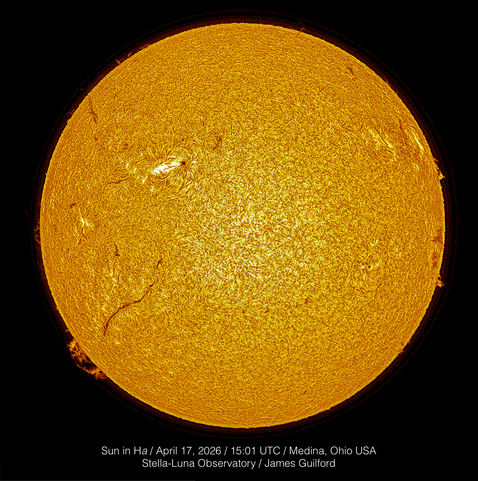
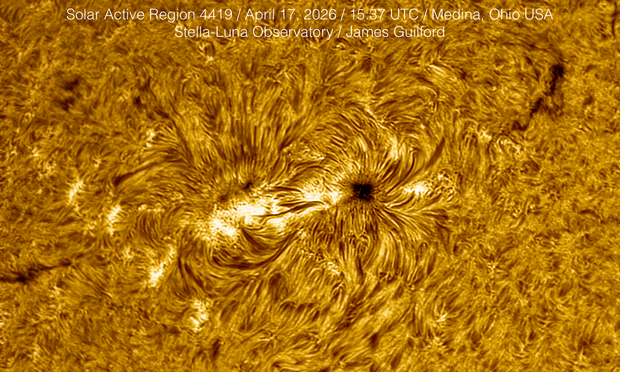
While our Sun has been at low activity levels in general of late, that doesn't mean it has been without interesting features. Active Region 4419 has been providing the majority of flaring activity, according to the SWPC, and its magnetic fields have the potential for M-Class flares. The bright plage patches are caused by intense magnetic fields, also expressed in the web-like shapes seen in the solar plasma. (Monochrome Images with False Color Applied) #solarastronomy
Partly to mostly sunny skies drew us to set up the solar scope this morning and Sun did not disappoint! This large prominence and dynamic filament offered interest and challenge. We will work on another capture that we may actually prefer — a sunspot that is currently the most active and displaying its complex magnetic fields in the medium of solar plasma! #solarastronomy

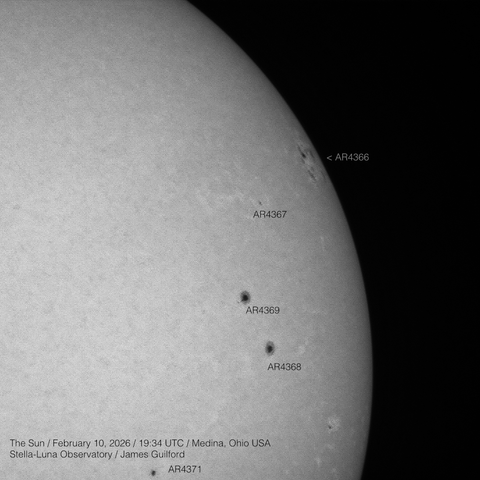
I wasn't going to do it. I was sure the sky would be cloudy and the sunspot gone. Today, however, I could see Sun (sort of) so I had to try. Seeing conditions were not poor, they were bad. The atmosphere was stirred up and clouds were present -- at times blocking the view entirely. So, with all of those qualifiers, here is our best effort recording departing sunspot AR4366 -- weakening but reportedly still issuing flares -- and a couple of its companions.

#sunspots #solarastronomy

APOD: 2026 January 13 – A Solar Eruption from SDO
https://apod.nasa.gov/apod/ap260113.html

#Astronomy #SolarAstronomy #APOD

APOD: 2026 January 13 – A Solar Eruption from SDO

A different astronomy and space science related image is featured each day, along with a brief explanation.

Although seeing conditions weren't the best, today offered the first opportunity in quite some time for us to see Sun! Shooting between passing clouds, with our DSLR rig, we visually observed the expansive train of sunspots in the southern Solar hemisphere. For all of its impressive size, the enormous sunspot complex remains quiescent -- despite its potential for X-Class flares! 1/2

#sunspots #sun #astronomy #solarastronomy #spaceweather