Slipping Ice Streams

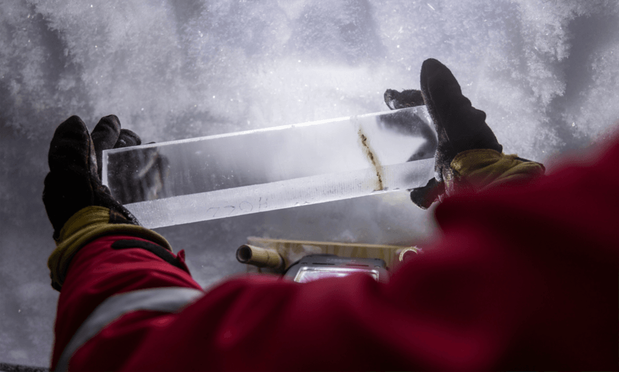
The Northeast Greenland Ice Stream provides about 12% of the island’s annual ice discharge, and so far, models cannot accurately capture just how quickly the ice moves. Researchers deployed a fiber-optic cable into a borehole and set explosive charges on the ice to capture images of its interior through seismology. But in the process, they measured seismic events that didn’t correspond to the team’s charges.

Instead, the researchers identified the signals as small, cascading icequakes that were undetectable from the surface. The quakes were signs of ice locally sticking and slipping — a failure mode that current models don’t capture. Moreover, the team was able to isolate each event to distinct layers of the ice, all of which corresponded to ice strata affected by volcanic ash (note the dark streak in the ice core image above). Whenever a volcanic eruption spread ash on the ice, it created a weaker layer. Even after hundreds more meters of ice have formed atop these weaker layers, the ice still breaks first in those layers, which may account for the ice stream’s higher-than-predicted flow. (Image credit: L. Warzecha/LWimages; research credit: A. Fichtner et al.; via Eos)

#fluidDynamics #geology #geophysics #glacier #glaciology #ice #iceFormation #physics #science #seismicWaves #seismology

A Seismic Warning for the Tongan Eruption

In mid-January 2022, the Hunga Tonga-Hunga Ha’apai (HTHH) volcano had one of the most massive eruptions ever recorded, destroying an island, generating a tsunami, and blanketing Tonga in ash. Volcanologists are accustomed to monitoring nearby seismic equipment for signs of an imminent eruption, but researchers found that the HTHH eruption generated a surface-level seismic wave picked up by detectors 750 kilometers away about 15 minutes before the eruption began. They propose that the seismic wave occurred when the oceanic crust beneath the caldera fractured. That fracture could have allowed seawater and magma to mix above the volcano’s subsurface magma chamber, creating the explosive trigger for the eruption. Their finding suggests that real-time monitoring for these distant signals could provide valuable early warning of future eruptions. (Image credit: NASA Earth Observatory; research credit: T. Horiuchi et al.; via Gizmodo and AGU News)

#eruption #fluidDynamics #physics #science #seismicWaves #seismology #volcano

The surface features of Mars — crossed by river deltas and sedimentary deposits — indicate a watery past. Where that water went after the planet lost its atmosphere 3 – 4 billion years ago is an open question. But a new study suggests that quite a bit of that water moved underground rather than escaping to space.

The research team analyzed seismic data from the Mars InSight Lander. Marsquakes and meteor strikes on the Red Planet send seismic waves through the planet’s interior. The waves’ speed and other characteristics change as they pass through different materials, and by comparing different waves picked up from the same originating source, scientists can back out what the waves passed through on the way to the detector. In this case, the team concluded that the data best fit a layer of water-filled fractured igneous rock 11.5 – 20 kilometers below the surface. They estimate that the water trapped in this subsurface layer is enough to cover the surface of the planet in a 1 – 2 kilometer deep ocean. (Image credit: NASA/JPL-Caltech; research credit: V. Wright et al.; via Physics World)

https://fyfluiddynamics.com/2024/09/water-suspected-beneath-mars/

#fluidDynamics #geology #Mars #physics #planetaryScience #science #seismicWaves

What caused the Mysterious Seismic Waves Recorded in September 2023 
In September 2023, uniform single frequency seismic waves were recorded at centres across the globe which lasted for nine days............
#ClimateChange #Dicksonfjord #Eartquake #Fjord #Globalwarmimg #Greenland #Polarice #Seismicwaves
SCIEU Team

https://www.scientificeuropean.co.uk/sciences/earth-science/what-caused-the-mysterious-seismic-waves-recorded-in-september-2023/

What caused the Mysterious Seismic Waves Recorded in September 2023 

In September 2023, uniform single frequency seismic waves were recorded at centres across the globe which lasted for nine days. These seismic waves were very mu

Scientific European
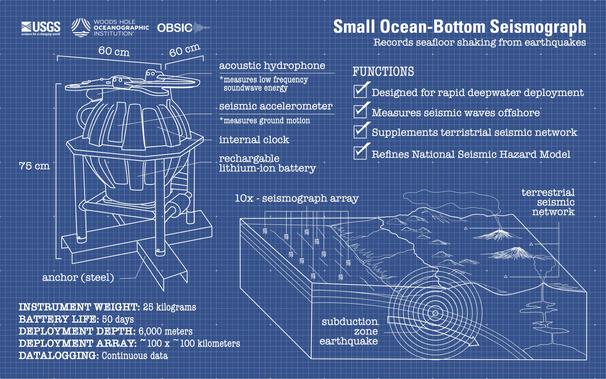
Rapid Response Seafloor Seismology | U.S. Geological Survey

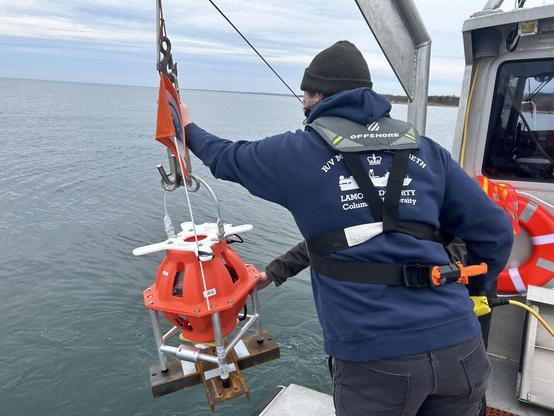
Ocean-bottom seismographs are valuable tools for studying marine geohazards like subduction zone earthquakes. The USGS has partnered with the Woods Hole Oceanographic Institution to operate a small fleet of highly mobile instruments to deploy during periods of seismic unrest.

Mars Has Lots of Water, But It's Out of Reach

There could be a global ocean's worth of water on Mars. But it's out of reach, deep in the planet's crust.

Universe Today
Here's Why We Should Put a Gravitational Wave Observatory on the Moon

The Moon's unique environment makes it a desirable place to build the LGWA, the Lunar Gravitational Wave Array.

Universe Today
The Heart of Mars: Seismic Waves Reveal the Red Planet’s Inner Secrets
Researchers have gained new insights into Mars’ liquid core, discovering that it is slightly denser and smaller than previously believed, and contains a mixture of iron and other elements. The findings, obtained through the first-ever detections of seismic waves on the Martian core, contribute to our understanding of the planet’s formation and evolution.
https://scitechdaily.com/the-heart-of-mars-seismic-waves-reveal-the-red-planets-inner-secrets/ #mars #core #SeismicWaves
The Heart of Mars: Seismic Waves Reveal the Red Planet’s Inner Secrets

Researchers have gained new insights into Mars' liquid core, discovering that it is slightly denser and smaller than previously believed, and contains a mixture of iron and other elements. The findings, obtained through the first-ever detections of seismic waves on the Martian core, contribute to ou

SciTechDaily

🌋 #Earthquakes and #volcanic eruptions reminds us that events on the surface are connected to processes deep within the Earth. @arwendeuss at @UniUtrecht is scanning #seismicwaves to better understand their journey inside the Earth 🌍
More👉 http://bit.ly/3xrRLTK
@CORDIS_EU

🐦🔗: https://n.respublicae.eu/ERC_Research/status/1626869174701264896

Seismic breakthrough reveals world below our feet

Volcanic eruptions and earthquakes are driven by convection deep within the Earth’s mantle. Achieving a better understanding of what is...

CORDIS | European Commission