 Matters of Interpretation
Studying Mark 2 18-28
This week we’re studying Mark 2:18-28. The text includes a couple of criticisms aimed by Pharisees at Jesus’ disciples, along with Jesus’ responses to those criticisms. Jesus’ responses are famous, too. They include the comment about not putting new wine into old wineskins, and the one that “the Sabbath is made for man, not man for the Sabbath.” Or, as we say these days, “humankind.” Arguably, the text provides evidence for some position we might want to take on “the Christian view of recreation.” We’ll have to see how much anyone wants to argue that; in the meantime, here are some notes on the text:
BACKGROUND AND CONTEXT
We’re reading these stories – “the question about fasting” and “plucking grain on the Sabbath” – in Mark’s gospel, although we could read them about just as well in the gospel of Matthew (Matthew 9:14-17 and Matthew 12:1-8) or the gospel of Luke (Luke 5:33-39 and Luke 6:1-5). There are slight differences among the three different synoptic accounts, but the precipitating events and Jesus’ comments are substantially the same. Since we’re reading from Mark, though, we’ll recall that this is thought to be the earliest of the gospels, and to be the literary-theological account of Jesus’ life that provided the plot line for the other synoptics. It’s also the shortest of the gospels. Mark’s narrative speeds along, with event piling upon event “immediately,” as the clueless disciples and Jesus, the Son of Man, draw closer and closer to the revelation of the “messianic secret,” followed by the even bigger revelation of the empty tomb. And then, maybe, with one of the alternative longer endings.
Our text comes very early in the story, though not before Jesus has called disciples and done a spectacular exorcism and some healing that has gotten him immense word-of-mouth publicity, and embarked on a preaching tour of Galilee that has included some more spectacular healings, and then come back to Capernaum for more spectacular standing-room-only healing ministry, along with the kind of theological talk that will get him criticized by the religious experts, i.e., the Pharisees. And then has been sharing meals with “tax collectors and sinners,” publicly enough to get that added to his charge sheet.
The matters in our text, then, just add fuel to the fire of a theological conflict that has already been kindled. And which will keep intensifying through the story.
The question about fasting may have its background in what seems to have been a growing tendency, in Jesus’ day, to treat the practice of private fasting as an expression of personal piety. This would have been, clearly, not the kind of communal, public fasting done on some set days of observance, such as on Yom Kippur. Rather, it would have been a voluntary pious practice. Jesus’ comments suggest that fasting in that way conveys the sentiment of mourning, a reason for fasting also seen in the Old Testament. (For more on this, see Dr. Rabbi Zev Farber and Dr. Malka D. Simkovich on “Why Jews Fast” at TheTorah.com.)
These little stories would be something we most likely wouldn’t know was in the Bible if all we knew were the lectionary. Mark 2:13-22 and Mark 2:23-3:6 DO actually appear in the lectionary, but as the gospel selections for the Eighth and Ninth Sundays after the Epiphany in Year B. Those Sundays don’t even occur in the liturgical year over half the time, and when they do, they’re mostly not in Year B, and when they are, most of the time they’re Transfiguration, so the text only stands a chance to be read in church – if we’re following the lectionary that way – about every 20 years or so. [That’s according to Claude’s calculations, but those looked about right to me.] So, Bible Content Examinees, be warned.
CLOSER READING
Our texts breaks down into three pretty distinct sections: verses 18-20, on fasting; verses 21-22, further commentary on the episode, that changes the subject; verses 23-28, on plucking grain on the Sabbath and Jesus’ commentary on that.
In vv18-20, fasting is clearly the presenting topic; the word shows up six times in these three verses. Moreover, it’s clearly the fasting of disciples that’s in question, as the word “disciples” shows up four times. There are disciples of John and disciples of the Pharisees and disciples of Jesus. Jesus, however, doesn’t call his disciples “disciples,” but rather “sons of the bridal chamber” or, as our translation would have it, “wedding attendants.” Moreover, the bridegroom is with them.
What might that mean, should we suppose, about the character of discipleship, and specifically discipleship to Jesus, at least at that very specific time and place? It certainly seems to mean that there is more than a small element of celebration involved. It’s probably no coincidence that this question about fasting comes up, in the first place, immediately after the “scribes of the Pharisees” have observed Jesus eating and drinking at Levi’s house, with tax collectors and sinners. [As in, “Here I am! The kingdom of God has come near! Let’s get this party started!”]
Jesus does, of course, predict that when the bridegroom will have been taken away from them they will fast in those days. At that point, it will be a time for expressing the sadness of loss, and fasting will be appropriate.
In vv21-22 Jesus extends his commentary on the practice of fasting with his comments about unshrunk cloth and new wine. On one hand the message is practical: that unshrunk patch – literally, the “filling” – will (as it shrinks) tear away from the pre-shrunk old clothing. The tear will be worse than before. When it comes to that new wine, which is still effervescent with fermentation, it will burst the [old] wineskins, and all will be lost. New wine into fresh wineskins.
Surely this means, at a minimum, that Jesus has brought something new into the world of teaching and learning, leading and following, the life of the spirit and the practices of religion. And that new and fresh thing requires new and fresh vestments, containers; by extension, new and fresh spiritual practices. Fasting, by contrast, is one of the old spiritual practices.
It might be less obvious what Jesus’ choice of examples is supposed to mean to us. Is Jesus implying that the existing religious “garment” is torn? And doesn’t just need mending, but replacing? Or is that going too far?
Is Jesus implying that the existing spiritual wine is old? [Although, normally older wine is better, isn’t it?] Maybe the wine Jesus is making is like nouveau Beaujolais? [Always in high demand, but people have to make haste to get a share of the limited supply?] Or is all of that reading too much in to what are simply convenient, vivid examples of how new ideas, new insights, demand new behavior? [I have more questions than answers about this.]
Then Jesus and the disciples happen on the Sabbath to be passing through grain fields and the disciples began to make a way, plucking ears [of the grain]. The image of the text is these disciples walking, clearing a path through, rather than around, this particular grain field, “harvesting” and eating as they walk along.
“The Pharisees” ask Jesus “why are they doing what is not lawful on the sabbath?” The Pharisees seem to have come out of the blue, unless we are meant to think that they are all walking along together. Maybe coming home from that party the night before. We can maybe imagine the scene: a group of folks following Jesus, some of whom criticize the others. Perhaps we’ve been involved in a scene or two like that ourselves once or twice. Why the Pharisees don’t ask their critical question directly of the disciples is also, maybe, a mystery. [Unless it reminds us of feuding siblings: “Daa-aad, Johnny’s doing something baa-aad!”]
Jesus, in the disciples’ defense, pulls out a story from 1 Samuel 21, about David – on the run from Saul, in the story – commandeering the ritually prescribed “bread of the Presence” (Leviticus 24:5-9) for himself (along with Goliath’s sword, which just happens to be there behind the altar, as a weapon). Mark records Jesus as saying that Abiathar is the high priest in the story, although in our Bibles the relevant priest is Ahimelech. Abiathar is the sole survivor of Saul’s massacre of the priests at Nob, after Saul hears about how Ahimelech helped David (1 Samuel 22:6-23).
The point seems to be that David didn’t get in trouble for eating that bread, which was obviously not his to eat, if everyone were following all the rules. Which they weren’t. And not getting in trouble for it, either. [Unless, of course, we think of getting killed as getting in trouble. But then again, Saul – the killer – is not the good guy in that part of the story. So maybe Jesus’ intent in bringing that example could be to pose the question to these Pharisees: whose side are you going to be on, in this moment? The side of the old authority figure, or the new, rising one?]
Then, in v27, Jesus says [in clunky translation] “the sabbath because of man/humankind came to be, and not man/humankind because of the sabbath.” That statement seems to point most clearly to the rationale given for the sabbath in Deuteronomy 5:14, that “your male and female slave may rest as well as you.” Unless – as is perhaps also possible – we are meant to think here of God’s own sabbath rest on the seventh day of creation as a celebration of the culmination of the creation with humankind. (See Genesis 1:27-2:3.)
Jesus concludes the lesson with the assertion “So then, Lord is the Son of Man, also of the Sabbath.” Once again, the meaning of that assertion may be less than entirely obvious. It does not seem to mean that the Sabbath is unimportant, certainly not to Jesus. Nevertheless, that has been, practically speaking, what lots of Christians have taken it to mean, especially in recent years. It may mean that Jesus [the Son of Man, right?] has authority to say what it means to observe the Sabbath. At least as much authority as, and arguably more than, the Pharisees who have interpreted the prohibition of work on the Sabbath to include whatever the disciples are doing in v23. Because that is an interpretation, of course, difficult as it might be to remember that, rather than something that is simply and immediately obvious from sacred text itself.
What Jesus’ lordship of the Sabbath implies for contemporary Christians’ understanding of and observance of the Sabbath, however, seems like it could be a more open question than we often think. Hopefully, that thinking will not entail the kind of work we were supposed to have been resting from on the Sabbath all this time.
Some questions on the text are here.
Image: “Feuchtwangen Pfarrkirche – Vorhalle Fresko Evangelist Markus” (cropped), Wolfgang Sauber, CC BY-SA 4.0, via Wikimedia Commons
#BibleStudy #commentary #exegesis #Mark21828 #meaning #readingTheBible #Sabbath #textsThatArenTInTheLectionary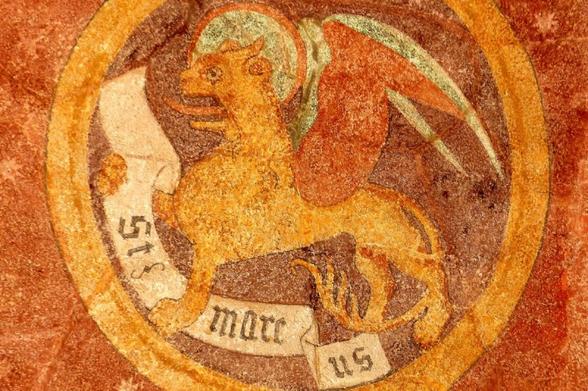
 Slow Mover

 Pathway to Paradise Ministries
 דער קערפער פֿון השם
 Reverend Elvis


 M. Grégoire
 Spirituality & Religious Studies
 Don Hornsby

 Greg Johnson