Music Photographers Up in Arms Over 'Rights Grab' Contracts

It's an outrageous contract.

PetaPixel

#IndieAuthors @romancelandia

I urge you to subscribe to @victoriastrauss's Writer Beware blog, so that you can keep abreast of all sort of maters essential to your careers. Primer example: the recent TOS changes at FindwayVoices/Spotify:

#RightsGrab #Audiobooks #Spotify #FindawayVoices #ArtificialIntelligence #AI #Writing

https://writerbeware.blog/2024/02/19/outrage-over-new-terms-of-use-at-findaway-voices-forces-change/

Outrage Over New Terms of Use at Findaway Voices Forces Change - Writer Beware

Note: This post has been corrected to reflect that the TOU change was made on February 16 (not February 18 as originally stated). A little over a year ago, controversy arose over a provision of Findaway Voices’ distribution agreement that granted Apple a license to use rights holders’ audiobook files for “machine learning”, aka AIRead More

Writer Beware

Delta the Latest to Overreach With Photo Rights Grab Via a Hashtag

Delta Airlines is the latest in a long line of companies who have egregious overreaching rights grabs baked into a program that uses Instagram hashtags. The company claims massive rights to any images that are tagged using #SkyMilesLife.

Corporate overreach into the rights of photographers is not uncommon and has occurred numerous times over the past decade. In 2015, the New York Times published an article that brought awareness to the situation where brands will publish this kind of user-generated content without explicit permission by hiding detailed and complicated terms behind fine print and leveraging social media hashtags to do so.

In 2019, Hilton Hotels was caught in a similar situation. The Museum of Modern Art (MoMA) likewise recently solicited photographers to share photos on Instagram under monthly themes, but claimed significantly more rights than it appeared at first glance.

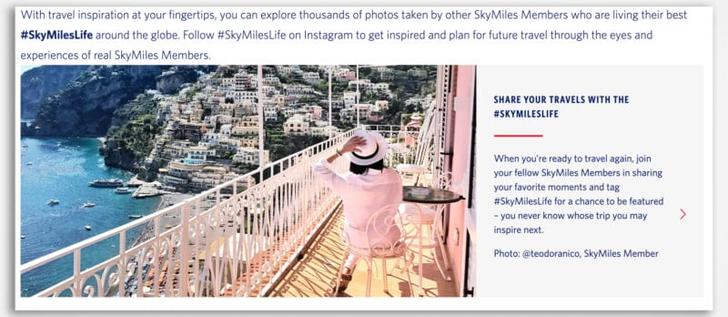
This time, Delta Airlines has asked its customers to share photos of their favorite moments and tag #SkyMilesLife for a chance to be featured by the company's social media presence and "inspire" others to take trips around the world.

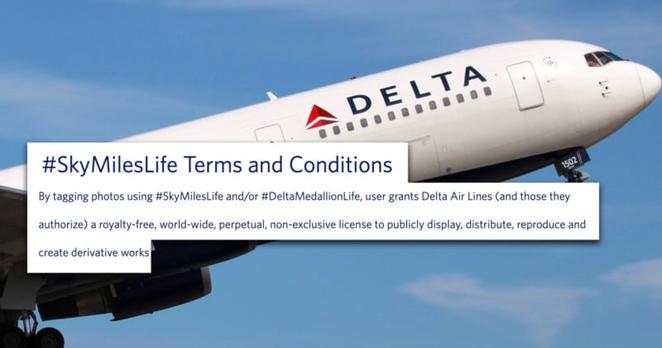
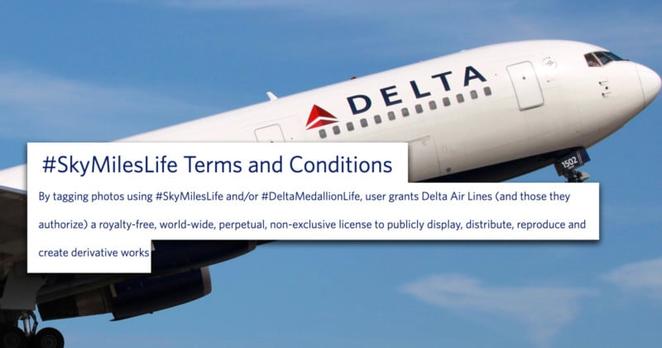
On the surface, this is a pleasant and harmless gesture, but Delta -- who has advertised this program on billboards in airports as seen by David Bergman via an Instagram Story -- backloaded the call to share with fine print that says Delta would gain substantial rights to those images:

By tagging photos using #SkyMilesLife and/or #DeltaMedallionLife, user grants Delta Air Lines (and those they authorize) a royalty-free, world-wide, perpetual, non-exclusive license to publicly display, distribute, reproduce and create derivative works of the submissions (“Submissions”), in whole or in part, in any media now existing or later developed, for any purpose, including, but not limited to, advertising and promotion on Delta websites, commercial products and any other Delta channels, including but not limited to #SkyMilesLife or #DeltaMedallionLife publications. Delta reserves the right to use or not use content tagged #Skymileslife and/or #DeltaMedallionLife and user will not be entitled to compensation if photo is used.

User grants to Delta (and those they authorize), the irrevocable and unrestricted right to use, re-use, publish and re-publish, and copyright his or her performance, likeness, picture, portrait, photograph, in any media format, in whole or part and/or composite representations, in conjunction with my name, including alterations, modifications, derivations and composites thereof, throughout the world and universe for advertising, promotion, trade, or any lawful purposes.

The above are just two sections from a rather detailed set of paragraphs that hand over rights to photos in a way that most photographers who don't read or don't see the fine print will not expect. At the time of publication, 107,185 photos were listed under the #SkyMilesLife hashtag.

Screenshot from Delta's #SkyMilesLife Terms and Conditions page.

In the past, PetaPixel has sought the input of NPPA General Counsel Mickey Osterreicher regarding hashtag rights overreach, who said that photographers who see this kind of language have every right to be alarmed. The terms grant unlimited permission to use the photo in any way the company chooses without any remuneration, and also place all the liability for any improper use on the photographer and shifts it away from the company.

“Unfortunately, this is the typical overreach that we see far too much use of online," Osterreicher has said. "It is a rights grab that is often not read or understood. It not only harms those who submit their work for free and then makes them liable for the possible misuse of that work but also undermines those who do value their work by licensing it.

“In a supply and demand economy, this virtually destroys the market with a glut of free images. The contract could certainly be written differently but that will only happen when people stop agreeing to these unfair and onerous terms.”

The company might argue that it is simply trying to protect itself, but the key point here is that Delta does not need to phrase the "contract" to have such overarching rights to images, but unless the company and those like it are repeatedly called out for the overreach, none of the entities have any incentive to change policy. Additionally, Delta's fine print says the photographer is not entitled to any compensation if the photo is ever used.

“Clearly if there wasn’t value to these images, why would they be asking for them and these rights?” Osterreicher has told PetaPixel.

Delta Airlines did not respond to PetaPixel 's request for comment.

“Just as people would not agree to buy a car, lease an apartment, or purchase a house without understanding the terms of those written contracts, so too should they read and understand these online agreements,” Osterreicher said. “If the car payments are too much, the lease too long, or the price of the house too high, commonsense dictates that you try to negotiate better terms or walk away. These online uploading or #hashtag ‘opportunities’ are no different.”

Image credits: Header image uses elements licensed via Depositphotos.

#culture #law #news #delta #deltaairlines #hashtags #instagramhashtags #legal #mickeyosterreicher #photographerrights #photorights #rights #rightsgrab

Delta the Latest to Overreach With Photo Rights Grab Via a Hashtag

Share a photo, share all the rights forever.

Sonoma Raceway Under Fire for Rights Grabbing Photo Policy

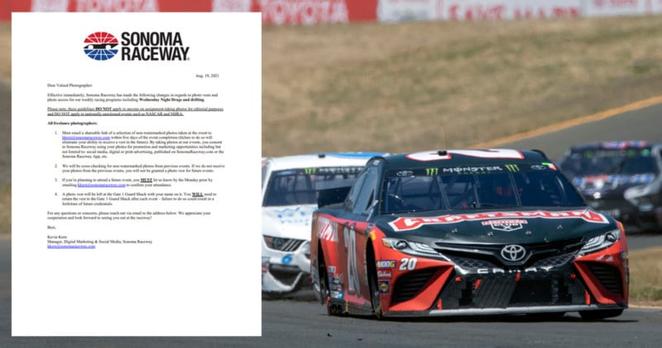
Sonoma Raceway has sparked a backlash from photographers after issuing new photography guidelines yesterday that many are calling an egregious case of a photography rights grab.

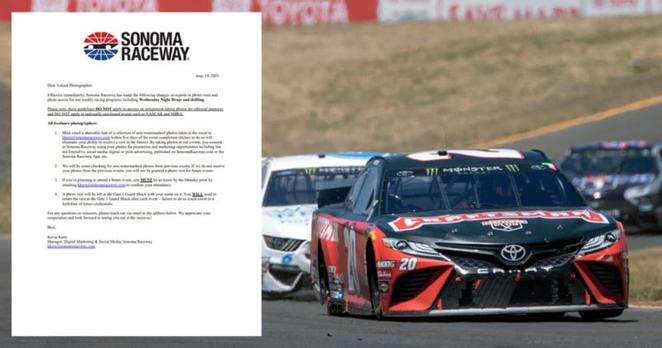
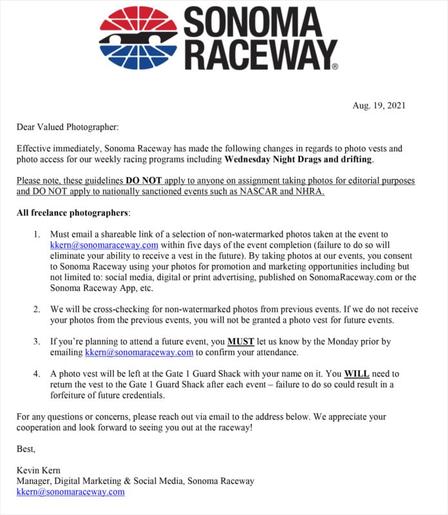
The famous racetrack in Sonoma, California, which is host to one of the seven annual NASCAR Cup Series road course races, put out this document (coincidentally on World Photography Day) for photographers:

Uh, what photographer on earth is going to agree to this, willingly? pic.twitter.com/Gb8FkwpUCk

-- Zerin Dube (@SpeedSportLife) August 19, 2021

The document states that photographers who obtain a vest and photo access must:

1. Share all non-watermarked photos shot at an event to the raceway within 48-72 hours or risk not getting access as a photographer in the future.

2. Allow their photos to be used by the raceway for any advertising purposes without photo credit.

Needless to say, photographers who read the letter reacted strongly and began calling out Sonoma Raceway on social media, here the letter has been widely circulated. Here are some of the reactions (and clever ideas):

Be better @RaceSonoma and anyone else with this "policy". You will find that actually working with photographers and giving them credit/compensation for work will lead to better working relationships and better quality work willingly submitted. https://t.co/1dHUCtxv1t

-- Patrick Davis (@pe_davis1) August 19, 2021

It does say ALL photos, and within 72 hours. Clearly the best solution is to send all 15,000 unprocessed photos.
"Here, you sort this out, since you're not paying me to"

-- Former Instants Photography (@formerinstants) August 19, 2021

Then on top of that you get stuff like this where a photographer not only has to do all their work but now has to give it up for free to a track to use as they wish. Just seems incredibly backwards.https://t.co/aC7tib4Kaa

-- Bozi Tatarevic (@BoziTatarevic) August 19, 2021

What an encrypted photo looks like. Randomized pixels. pic.twitter.com/6ukQ3BTJTx

-- Acer Rubrum (@AcerRubrum) August 19, 2021

Freelancers of any kind, including photographers, have been hit hard during the pandemic. So, as people face evictions and grave concerns over paying their bills, @RaceSonoma decides it's the right time to demand their work for free in order to survive. It's cruel and sick. https://t.co/wXsgs3tzxs

-- Marshall Pruett (@marshallpruett) August 19, 2021

I smell some outraged shooters sending 10,000 TIFF images at 100mb each of random garbage cans, tire stacks, and crash fences via WeTransfer and crashing Sonoma's servers.

-- Mark Rechtin (@MarkRechtin) August 19, 2021

After seeing the letter, NPPA General Counsel Mickey Osterreicher contacted Sonoma Raceway marketing manager Kevin Kern with his concerns.

As general counsel for the National Press Photographers Association (NPPA) and a photojournalist with over forty years of experience in both print and broadcast, I am appalled after reading your letter (attached) regarding new terms and conditions for photo access to your events. It is truly ironic that your begin with “dear valued photographer” and then [go] on to demand that photographers covering your events consent to the use of their images, without credit for a variety of commercial, promotional and social media uses. Not only that, but you further require them to provide those images to you within “48-72 hours after the event completion.” Such required consent is accompanied by a threat that “failure to do so will eliminate your ability to receive a vest in the future.”

This is nothing more than a blatant rights grab of the intellectual property of those photographers covering your events. NPPA strenuously objects to such overreaching and onerous agreements. Fortunately, some performers who made similar demands quickly realized the error of their ways (see: <https://petapixel.com/2015/07/22/taylor-swifts-concert-photo-contract-changed-to-be-more-photographer-friendly/>).

If you truly value photographers, we hope you will change this policy immediately.

As photographers began speaking out, Sonoma Raceway responded with a clarification, stating that the letter was only directed at a subset of photographers who shoot at the track rather than all motorsports photographers.

It does NOT apply to editorial coverage, NASCAR or NHRA events, and our original correspondence should have specified further details. 2/2

-- Sonoma Raceway (@RaceSonoma) August 19, 2021

"We apologize for the earlier miscommunication regarding our photography vest policy," a Sonoma Raceway spokesperson said in an email to PetaPixel. "The policy applies to our Wednesday Night Drags and drifting, and fulfills the need for us to screen photographers that are requesting vests for access to dangerous areas on a weekly basis."

"It does NOT apply to editorial coverage, NASCAR or NHRA events, and our original correspondence should have specified further details."

The letter on Sonoma Raceway's website has been changed from the one originally given to photographers to specifically mention "weekly racing programs including Wednesday Night Drags and drifting." Other sections of the guidelines have been toned down as well (e.g. the policy now demands a "selection" of non-watermarked photos instead of all of them).

When asked about the rights of the photographers these new guidelines do apply to, the spokesperson replied: "I would be more than happy to handle each of those cases individually, but this policy is very consistent, if not more accommodating, with most major sports venues."

"While I am a bit relieved that it does not apply to editorial photography, I also think it a bit disingenuous for them to use this type of rights grab to 'screen photographers that are requesting vests for access to dangerous areas on a weekly basis,'" Osterreicher tells PetaPixel. "They could ask them to sign a waiver and release from liability. They could have asked to review or see their images or they could have asked who they are shooting for, but requesting the right to use images without credit no matter who shoots them devalues photography as a form of visual expression and creative work."

Image credits: Header photo licensed from Depositphotos

#miscellaneous #controversy #motorsports #motorsportsphotography #nascar #outrage #photographersrights #photoguidelines #photopolicy #racetrack #rightsgrab #sonomaraceway

Sonoma Raceway Under Fire for Rights Grabbing Photo Policy

Sonoma Raceway has angered photographers with a new photo policy that demands all unwatermarked photos and unlimited usage.

Ancestry.com’s New Terms Allow it to Use Your Family Photos for Anything

On August 3, Ancestry.com -- the largest for-profit genealogy company in the world -- updated its terms and conditions to include new language that gives it the right to use any family photos uploaded to its system for anything it likes, forever and without limits.

Ancestry's updates to its terms and conditions focus mainly on changes to the rights it has as a company to use photos that are uploaded by users into its system:

[B]y submitting User Provided Content through any of the Services, you grant Ancestry a perpetual, sublicensable, worldwide, non-revocable, royalty-free license to host, store, copy, publish, distribute, provide access to, create derivative works of, and otherwise use such User Provided Content to the extent and in the form or context we deem appropriate on or through any media or medium and with any technology or devices now known or hereafter developed or discovered. This includes the right for Ancestry to copy, display, and index your User Provided Content. Ancestry will own the indexes it creates.

PetaPixel spoke with Mickey Osterreicher, General Counsel for the National Press Photographers Association (NPAA) regarding the change and if he believed that such a broad set of terms was reasonable.

"It always concerns me when the rights that are being sought are overly broad. I certainly understand when lawyers write these things up that they do it for the benefit of their client or their company, but sometimes I don't think they think about the fact that what they ask for is much greater than what they actually need," Osterreicher says. "Until someone questions it or pushes back, it's there. it's one of the things that I and the NPAA stress all the time. People really need to read and understand terms of service and conditions: it's a contract."

"This change to the Ancestry Terms and Conditions is consistent with the manner in which other genealogy research platforms handle user-provided content," the company writes in a blog that PetaPixel was pointed to when the company was reached for comment. "It was never intended to enable Ancestry to do anything with our users’ content other than facilitate a vibrant family history community that brings the value of personal discoveries to all."

Ancestry says that the change was only meant to encompass the expected services of the genealogy company. It says that its goal is to connect its users by allowing them to share discoveries about their family histories with each other, and sharing photos, documents, and stories are part of that. Should a user want to make its photos private, Ancestry says it respects that.

This might be the case in spirit, but the overly broad language tells a different story.

"Even though Ancestry doesn't take your copyright, they pretty much take everything you get by owning the copyright. You can still use the photos elsewhere, but the display rights, the right to copy, pretty much everything is given to Ancestry. You can't revoke the sublicense or get paid for it," Osterreicher says.

He explains that to the extent that Ancestry would like to use the images for the purposes that the company was created for, that would be all that they would really need in an updated set of terms. But instead, the company only barely stops short of claiming the copyright but is essentially covered to do everything that owning the copyright to the image would grant. Even where the company was not specific, it has covered itself by saying that it still has rights to technologies that may not even be discovered or developed yet.

Ancestry admits that it received feedback about the update and explains that users can still revoke the rights given to Ancestry should they desire.

Notwithstanding the non-revocable and perpetual nature of this license, it terminates when your User Provided Content is deleted from our systems. Be aware that to the extent you elected to make your User Provided Content “public” and other users copied or saved it to the Services, this license continues until the content has been deleted both by you and the other users.

While it is true that deleting any photos from Ancestry's server would remove the company's rights to them, the second section says that specifically deleting something doesn't necessarily complete the process.

"Even if you took the photo down or terminated [your Ancestry subscription], if somebody else posted the photo, Ancestry continues to own it," Osterreicher says.

Another point that Osterreicher raises is that family photos taken by a hired portrait photographer or a photo studio are likely commonly uploaded. In those cases, he says that most of the time the user doesn't own the rights to that copyright -- the photographer does.

"There are two things going on here," he says. "One, a discussion about your own images and whether you want to grant those rights. Or the second, if you're posting images someone else owns rights to and if you may be violating their copyright."

Regardless of the intent of terms and conditions changes, Osterreicher says it's important for people to look at user agreements the same way they would look at the contract to buy a car. It is unlikely that someone would just buy a car without reading the fine print about the interest rates, for example. He says that in the rush for instant gratification, many people overlook important aspects of terms and conditions. In this case, Ancestry asked for much more than it needed, and the only way that it would get changed is if enough people called for it.

"The analogy that I normally make is that copyright is very much like owning a home as opposed to renting or leasing. There are many things you can do with that home when you have the deed, and that is the same with copyright. So in a way, even if you own the copyright and grant the license, it's like someone can come into your house and do whatever they want," he explains. "You can still live there, and own it, but they are free to do whatever they want, whenever they want. I don't think most people think of it that way when it comes to pictures."

Image credits: Background of header photo licensed via Depositphotos.

#law #news #copyright #imagerights #legal #mickeyosterreicher #nationalpressphotographersassociation #nppa #rightsgrab #termsandconditions

Ancestry.com’s New Terms Allow it to Use Your Family Photos for Anything

The claimed rights to your family photos are overly broad.