@NaraMoore
Thank you. I studied folklore and mythology at university and the story came up a lot. I did have to look up the details.

The Odyssey is an example of epic poetry that could be chunked down so that the facts of the story, the plot, and the characters could be memorized such that a bard could use formulas to generate the poetry for the retelling the story to an audience, maybe with musical accompaniment. It was a living. If you ask then wasn't the story different at each retelling? Yes. The poetry was. The Odyssey we consider canon now is essentially a snapshot taken of a living oral tradition that existed solely in the minds of generations of live storytellers. Like a bear mounted in a natural history museum, the Odyssey in print is now equally as dead and immutable as that bear.

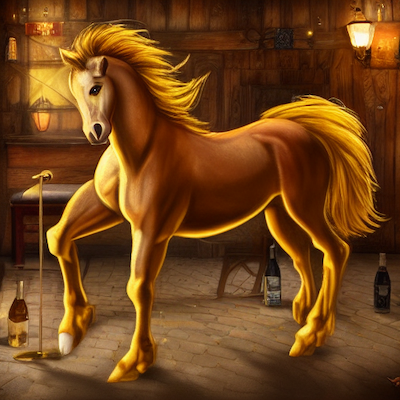
#fantasy #writers should take heed and provide that level of verisimilitude when depicting a night at the inn.

#writer #author #writingCommunity #WritersOfMastodon #RSessay

#WordWeavers 2026.03.22 —Is there a subject that’s represented poorly in media that you’d like to cover in your work?

Indoctrination.

I am a gender fiction writer well aware that gender roles are indoctrinated into every one of us. Even myself. I struggle. Daily. However, the word indoctrination is practically never explained or used properly. I'm taking the word "poorly" in this question as meaning both "rarely done" as well as "without proper understanding."

Indoctrination means to be taught to accept something without evidence as unquestionably true.

What's represented poorly in the media is that those most guilty of indoctrination are those who employ it themselves and have themselves been indoctrinated, arguably unwittingly, but that doesn't stop them from being hypocritical. Use of any form of the word belief instead of "I am convinced," or "I understand," or "I deduced," goes hand in hand with indoctrination, as does ignoring contrary evidence even to the point of self-harm. Journalists, pundits, even educators misuse or misapprehend the meaning; I see it wielded as a political weapon daily to tear down public schools and higher education, but it also leads to wars, the oppression of women, and most the ills of the world. I am tempted here to point fingers and use the phrase, "Forgive them lord, they know not of what they speak," in complete irony with sarcastic miscapitalization.

Well… I guess I did.

Though indoctrination isn't a focus of my works, my characters often slam face first into the walls of their cultural indoctrination to bloody their noses, but sometimes end up searching for the door out.

Here is a great article defining the word, though it is heavy on definition and light on fixing problems: https://bigthink.com/mini-philosophy/the-philosophy-of-indoctrination-and-how-to-fix-it

[Author retains copyright (c)2026 R.S.]

#BoostingIsSharing

#gender #fiction #writer #author #essay
#writing #writingcommunity #writersOfMastodon #writers
#RSdiscussion #RSEssay
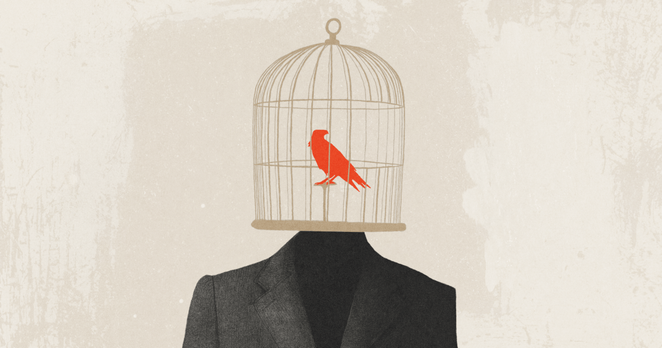
The philosophy of indoctrination and how to fix it

Indoctrination is not about intelligence or the belief itself. It's about seeing any alternative as an enemy or as a a test of faith.

Big Think

@patcharcana

People including fish in the pile of "not meat" foods [makes a lot of sense] in terms of "was allowed during Lent"

I never thought about that. What we learn growing up definitely affects how we do things. Thanks for this observation.

Food is an issue I should not have targeted in my stories as a peripheral issue for thoughtful ick moments and a differentiator between various people, but I have. My characters are pescatarians and lactoovo-vegatarians.Only. Except ick carnivorous exceptions.

Animals eat whatever seems like food. Humans turn everything into symbols. We eat symbols. We turn nature into symbols, or representations of our inner thoughts and what we think consciousness is. We posit universal consciousness not even agreeing we understand what conscious really is. Perhaps we're innate animists because of this fault, but because of this fault we empathize with the non-human world much like we do the subset of fellow humans in our in-group.

But we want to eat, need to. We like to like what we eat, but empathy reflects ourselves in others. They say we are reflected in their eyes. Cows and goats are a lot more like us than fish. Fish are mostly unreadable (unless you keep goldfish), so pescatarianism makes sense. They're "not-meat" is more like "I can't empathize with being a fish." Though, maybe, there's the fact that fish spoils quicker, so Lent dietary rules to preserve a scarce important resource? Makes sense, too. Are humans logica!? Or simply good at excuses?

The symbology and empathy of and for food sources goes further. We're stealing eggs from chickens who work hard to produce them, and honey from hard working bees, and milk from cows who feed their calves. Symbology combined with empathy generates philosophy as a byproduct, which is why veganism goes further than vegetarianism. We don't like to be forced to work. We don't like being enslaved, so…

Humans being humans, were our technology such that we could live without eating at least plants, some people would go that far. Technophagism anyone?

And. Yet. We have wars.

#philosophy A spontaneous little essay on food and consciousness. #BoostingIsSharing

#vegan #vegetarian #pescatarian #consciousness #empathy #RSEssay #author #writer #writersOfMastodon #writingCommunity

#WritersCoffeeClub Ch 7 Nbr 12 — Do you agree with Ray Bradbury, who said, "Quantity produces quality. If you only write a few things you're doomed"?

Short answer: Yes! (YMMV)

TD;LR answer: When I began writing in a different millennium, I was convinced that story ideas were precious, that there were only so many that I could come up with. This was likely my insecurity of matching the greats in the field like Andre Norton, Frank Herbert, Sprague de Camp, Poul Anderson... As a result, I wrote novels to fully utilize each idea, and bring in the big bucks. (As if.) Those were the days of the mid-list and there was always a thirst for more pulp to read. There were gatekeepers to overcome, however. Which I overcame, but I didn't take proper advantage of that. Don't let that be you.

I wrote short stories, too. Not many, and then stopped. Why? I couldn't sell them. The magazines weren't interested in what amounted to my practice stories in Bradbury's terms. I'm rejection adverse, and after a few tries, I learned my lesson.

The wrong lesson.

For lack of even getting my agent interested in my work, not to mention the publishers who hide behind that gatekeeper, I burnt out in 2001. Too many completed novels. Nobody reading them. Writing is primarily about communicating. What the heck was I doing with my free time? One life to live. Ought to enjoy it. Yada, yada...

When I started writing again in 2015, I decided what I needed was practice.

"Quantity produces quality. If you only write a few things you're doomed."

I actually had Bradbury in mind when I concluded I needed lots of practice. It allowed me to invest time. I started with essays, then moved on to short stories. I set a goal of writing 1st person, and went for it. That I could post, for free, what I wrote and have people actually read it, helped.

I quickly realized that ideas are a dime a dozen. Nobody has a copyright on any idea. It's the story you create from an idea that people copyright. It's what you do with your characters and what you choose to communicate with you words that make your stories special. Well, as special as they can get. Sturgeon's Law🗡️ applies, which is why writing story, after story, after story, after story, etm., is the only way to improve.

As a result, I've written approaching a million words in the last nine years. Most of them read by at least a few readers. I think I have a pretty good 1st person patter going on, and lots of stock characters I can fall into point of view with no difficulty. I can bring up a blank page without any negative emotion and fill it, because I know if the story doesn't work, I'll just write something else.

This is one of the reasons I love Mastodon. It doesn't take much to find a writing prompt, and at least a few readers. Using hashtag Writever and others, I've created dozens of stories with two to four hours effort. Each allows me to experiment, to level up my craft while working to eliminate my flaws—specifically lack of concision and ellipsis. (Okay, this essay is neither concise nor featuring ellipsis, but, well, um...)

So, /yes,/ Bradbury and Asimov were both geniuses. Both had diarrhea of the typewriter, and became brilliant after an amazing number of failures. How much did you practice to ride a bike? How many tries did it take you to conquer that video game? How many years writing did it take you to create a story somebody liked? (Oops, that one's the point of this essay, innit?)

🗡️https://en.wikipedia.org/wiki/Sturgeon%27s_law

[Author retains copyright (c)2024 RS.]

#BoostingIsSharing and #CommentingIsCool

#fiction #fantasy #sf #sff #sciencefiction #writing #writer #writers #author #writingcommunity #writersOfMastodon
#RSdiscussion
#RSessay

Sturgeon's law - Wikipedia