Typed "I'm delighted" in a text to a friend -- and stopped short, looking at the word "delighted."

I used "delighted" to mean that I am pleased, joyful, content, happy.

But delighted. De-lighted.
Wouldn't that mean "darkened"? Illumination removed?

If "de-" indicates that "light" is removed, how does that jive with the emotions of pleased, happy, or content?

Looked up the #etymology.

And voilà.

"light" <-- leoht (#MiddleEnglish) <-- lēoht (#OldEnglish) <-- *leuhtą (#ProtoGermanic)

1/

I am ready to reveal groundbreaking news that I'm sure all have been awaiting breathlessly. /hyperbole After nearly three years on this platform, I have finally updated my About section again! Two primary factors motivated the change. I originally based much of it on a #ProtoGermanic persona that I have since used only minimally, largely because I don't really know the language or culture and have to do extensive research if I ever want to post in character.

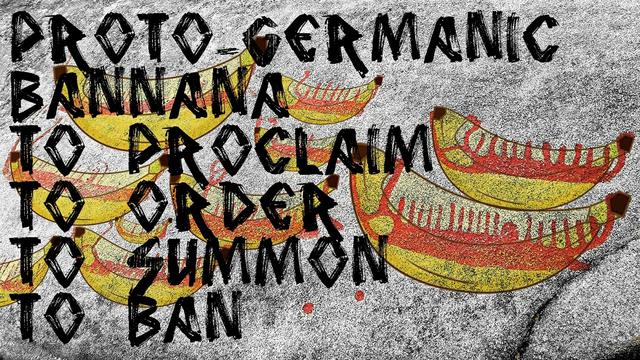
It's an urban myth that the largest per capita producer of bananas in Europe is Iceland, but their ancestors in the Nordic Bronze Age were no stranger to bannaną.

https://en.wiktionary.org/wiki/Reconstruction:Proto-Germanic/bannaną

#ProtoGermanic #NordicBronzeAge #IndoEuropeanLanguages #Puns #BananaBoats #VikingShips #StoneInscription #Linguistics

Reconstruction:Proto-Germanic/bannaną - Wiktionary, the free dictionary

Wiktionary

From Middle English store, stoure, storre, from Anglo-Norman stor, estore, estorr, estoer, and Old French estour, estor, from Latin īnstaurō.
From in- +‎ *staurō, from Proto-Indo-European *steh₂u-ro-, from *steh₂-.

From Middle English shoppe, schoppe, from Old English sċoppa (“shed; booth; stall; shop”), from Proto-Germanic *skupp-, *skup- (“barn, shed”), from Proto-Indo-European *skub-, *skup- (“to bend, bow, curve, vault”).

From Proto-Italic *tendō, from Proto-Indo-European *ténd-e-ti, from Proto-Indo-European *tend-, extension of Proto-Indo-European *ten- (“to stretch, draw”).

#etymology
#Spanish
#English
#OldEnglish
#ProtoIndoEuropean
#ProtoGermanic

@yvanspijk I’m not sure the as-stems were that productive in the earliest loans at all. Neither trisyllables (trisyllabic stem types were rare in Pre-Finnic).
A Finnic word like ”kuningas” is hardly from #ProtoGermanic, at least not early #PGmc. NW-Germanic yes. In fact I don’t think it even occurs in Gothic (it was reiks!) so NW-Germanic is the probable age of this loan (despite the misinformation in all the handbooks).
By and large #WestNorse preserves more of #ProtoGermanic than #EastNorse. An exception is the verbal stem gā/*ga- ’go’, which in #OldSwedish was used in the present tense and at times in the infinitive. Else its inflection was suppleted by forms of the verb ”ganga”.
In West Norse ”gá” is attested very sparsely indeed, and instead ”ganga” is used throughout the paradigm.
In past research there was an idea that gā could have been borrowed from #LowGerman, but today this is not deemed probable. 🧵👇🏻

Etymology of "Propagate"

pro "forth" (see pro-), extended form of PIE root *per- "forward," hence "in front of, before, toward, near," etc.

PIE root *pag- "to fasten," source of pangere "to fasten"

Why did "peg" skip from proto-Germanic to Middle English,without any stops in Old English?

#etymology
#ProtoIndoEuropean
#English
#Latin
#ProtoGermanic
#OldEnglish
#MiddleEnglish

I hope that at some point we get more #linguistics folks focusing on #ProtoIndoEuropean and #ProtoGermanic for me to follow.