📢 A gentle REMINDER from the #SPAAM Steering Committee! 🚨 The deadline for the #Blog Post #Competition is approaching (16 March) 📝. We are looking forward to receiving your submissions! :)
https://www.spaam-community.org/news/2025/11/25/blog-post-competition/
#ancientDNA #metagenomics #palaeogenomics #science #communication
SPAAM Blog Post Competition · SPAAM Community

🚨 New release of AncientMetagenomeDir! (v25.12.0, Historic Centre of Sighişoara)
https://github.com/SPAAM-community/AncientMetagenomeDir/releases/tag/v25.12.0
It's a community resource of #metadata of >2K shotgun-sequenced #AncientMetagenome or ancient microbial genome enriched samples & >5K libraries. Stats below:

📈 Release v25.12.0:
📚 216 (+5) publications
🧬 1733 (+28) ancient host-associated metagenome samples
🦠 813 (+3) ancient microbial genomes
🌅 803 (+0) ancient environmental samples

#AncientDNA #palaeogenomics #aDNA #metagenomics(🧵 1/2)

🚨 New release of AncientMetagenomeDir! (v25.09.0, Site of Palmyra)
https://github.com/SPAAM-community/AncientMetagenomeDir/releases/tag/v25.09.0
It is a community resource of #metadata of >2K shotgun-sequenced #AncientMetagenome or ancient microbial genome enriched samples & >5K libraries. Stats below:

📈 Release v25.09.0:
📚 211 (+5) publications
🧬 1705 (+33) ancient host-associated metagenome samples
🦠 810 (+40) ancient microbial genomes
🌅 803 (+90) ancient environmental samples

#AncientDNA #palaeogenomics #aDNA #metagenomics(🧵 1/2)

Release v25.09: Site of Palmyra · SPAAM-community/AncientMetagenomeDir

Release v25.09.0 includes 5 new publications, representing 33 new ancient host-associated metagenome samples, 40 new ancient microbial genomes, and 90 new ancient environmental samples. This brings...

GitHub

Even more intriguing -- how #Indigenous First #Americans got their #mucous variant (MUC19), from #Denisovan and then #Neanderthal heritage

'This haplotype features multiple Denisovan variants, although it likely entered human populations through a Neanderthal intermediate. The patterns of positive selection indicate that this introgression occurred in Indigenous Americans during their migration to the Americas. How this change was adaptive for these populations has yet to be determined, but this work does disentangle a complex selection signal in these understudied groups.'

#palaeogenomics

https://www.science.org/content/article/dna-ancient-bones-reveals-how-indigenous-americans-got-their-mucus

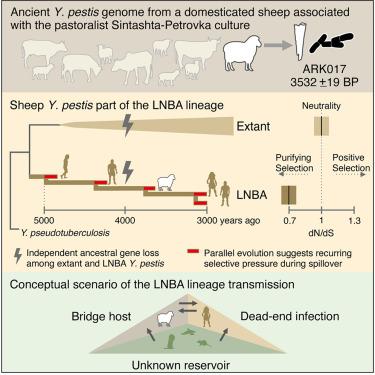
Ancient Yersinia pestis genome discovered in 4,000-year-old sheep tooth sheds new light on a mysterious infectious disease that plagued prehistoric Eurasia.

#Palaeogenomics #bioarchaeology #zoonosis

https://www.cell.com/cell/fulltext/S0092-8674(25)00851-7

Princeton study maps 200,000 years of Human–Neanderthal interbreeding

For centuries, we’ve imagined Neanderthals as distant cousins — a separate species that vanished long ago. But thanks to AI-powered genetic research, scientists have revealed a far more entangled history. Modern humans and Neanderthals didn’t just cross paths; they repeatedly interbred, shared genes, and even merged populations over nearly 250,000 years. These revelations suggest that Neanderthals never truly disappeared — they were absorbed. Their legacy lives on in our DNA, reshaping our understanding of what it means to be human.

ScienceDaily

Some dispute over dating of early entry to Sahul (#Pleistocene Greater #Australia) where the site of #Madjedbebe could be 64 Kya. How can this be consistent with a tight window of 50-55 Kya for the major ancestral migration of #Homosapiens from #Africa? Constraining those dates comes from the Neanderthal admixed sequences found today in all outofAfrican descendants.
BUT
Isn't it possible that the people who were in Sahul by 65 Kya (Madjedbebe etc) just don't happen to be ancestors for people today who got there a bit later? Can't both be right?

#archaeology #Palaeogenomics #OutofAfrica #migration

https://onlinelibrary.wiley.com/doi/10.1002/arco.70005

@ochrewatts

Major paper on kinship and burial practices at #Çatalhöyük

The study fused 'rich archaeological data with a paleogenomic dataset of 131 individuals buried in 35 houses...

'Comparing genetic ties within and between buildings, we found that the maternal lineage had a key role in connecting Çatalhöyük household members, as represented by burials within each building. We estimated that 70 to 100% of the time, female offspring remained connected to buildings, whereas adult male offspring may have moved away. We also discovered preferential treatment of female infant and child burials, with five times more grave goods offered to females than to males.'

'...Through time, the genetic composition of house burials became less homogeneous. In later periods, we found groups of neonates who were genetically unrelated but buried in the same house.'

#Neolithic #archaeology #palaeogenomics

https://www.science.org/doi/10.1126/science.adr2915

Face to face with a #Mesolithic woman from the #Meuse Valley, 10,500 years ago. She was one of the Western European hunter-gatherers with a slightly lighter skin than Cheddar Man (the Indigenous Briton).

#fossils #bioarchaeology #reconstruction #anthropology #palaeogenomics

https://www.ugent.be/en/news-events/womanofmargaux.htm

Researchers bring you face to face with a 10,500-year-old woman

Ghent University researchers have reconstructed the face and life of a prehistoric Belgian woman who lived in the Meuse Valley around 10,500 years ago.

Universiteit Gent

#Matriliny in Neolithic E #China over 4500 years ago among millet farmers on the coast, with dual organisation of matrilineal clans.

'Fujia inhabitants engaged in millet-based farming and animal husbandry, with probable access to marine and/or freshwater resources.'
Pigs, not large livestock...were LH Morgan and Engels right on matrilineal priority then?

#anthropology #kinship #palaeogenomics

https://www.nature.com/articles/s41586-025-09103-x

Ancient DNA reveals a two-clanned matrilineal community in Neolithic China - Nature

Analysis of ancient DNA, stable isotope data and archaeological evidence from the Fujia archaeological site in eastern China suggests it was populated by a matrilineal Neolithic community between 2750 and 2500 bc.

Nature