“Can you see Orion?” Sermon for Trinity Sunday, 4 June 2023

Scripture Readings: Psalm 8 and Matthew 28:16-20

In the name of God, Father, Son and Holy Spirit, Amen.

When I was in my early twenties, I began to realise that my eyes were not what they should be. I wasn’t seeing distances clearly any longer, and if I was ever to take a driving test, I realised I would fail at the first hurdle- my distance wasn’t good enough. So I made an appointment with the optician, and got my first pair of glasses.

I saw a difference at once. Fuzzy objects on the horizon were suddenly noticeably clearer. The degeneration of my eyesight had been very slow, and so I hadn’t realised what I was missing. It was wonderful!

But the I remember most about my new glasses was the first time I wore them at night. It was a clear, frosty night- there were no clouds in the sky. And there, above me, was something I had almost forgotten about- I could see thousands of stars in the night sky, far more than I could before I got my glasses. And I realised that in the last few years, I had been seeing stars, not as sharp pinpricks of light, but as fuzzy blobs of light.

For me, the night sky is one of the greatest natural phenomena. Over the years, I tried to learn some of the constellations- my children got fed up with me telling them ‘Look! There’s Orion!’ ‘Can you see the Milky Way tonight?’ ‘The Great Bear is just over that house!’ With a small telescope or binoculars, it’s even more amazing, as you spot thousands more starts, and look at craters on the moon.

The night sky has always been a source of endless fascination for we humans. We see it in the Psalm which we have heard today. Psalm 8 is a beautiful poem- a song of praise to God. It starts and ends with the words ‘O Lord, our Lord, your greatness is seen in all the world!’- it is a hymn of praise- praise ‘sung by children and babies’. And then the Psalm goes on to sing of the sky, the moon and the stars, of human beings, of animals and birds and fish- it’s a celebration of creation, and a thanksgiving to the Creator!

In verses 3 and 4, the Psalmist makes an interesting move when he speaks about the sky:

When I look at the sky, which you have made,
at the moon and the stars, which you set in their places-
what are human beings, that you think of them;
mere mortals, that you care for them?

That captures something of the fascination of the night sky. When we look at the stars, its awesomeness puts us in our place. The Psalmist wonders why the Creator who did all this would take any notice of mere humans.

Today, we know that the night sky is even more wonderful than the Psalmist knew- writing over two and a half thousand years ago. We’ve sent spacecraft to the moon and even beyond our own solar system. Telescopes, and radio receivers, on earth and sent into space, have sent back incredible images of stars and galaxies which are unimaginably far away from us.

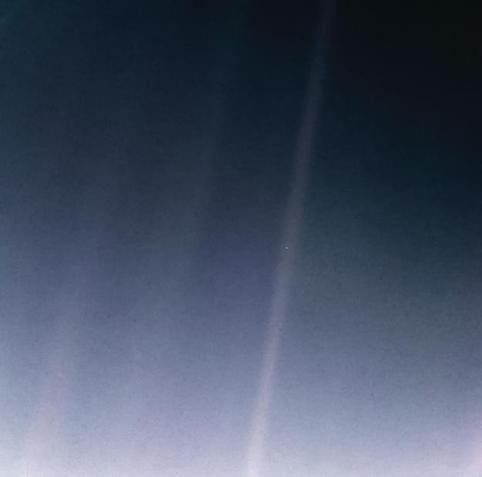
Earth – Pale Blue Dot – 6 Billion km away – Voyager-1 – original February 14, 1990; updated February 12. Nasa

In 1990, the Voyager 1 spacecraft- which had been sent to explore the outer planets of our solar system- turned its camera on our own planet earth. At the time, Voyager was 6 billion kilometres from earth, and had already passed Jupiter and Saturn. The photograph it took of earth became known as ‘the pale blue dot’ photograph, for at that distance, earth showed up as a tiny, tiny speck against the darkness of space[1]. It looks a bit like a faint star. And as the photo makes very clear, earth is not the centre of the universe. Why, indeed, should the ‘mere mortals’ who inhabit that speck be especially important?

Two and a half thousand years ago, the Psalmist looked at the sky from the earth, and was awed by it. He would never have imagined that we would ever be able to do the opposite, and look at the earth from space- which is something which has only been possible in the last 50 years. The chance to look at the earth in that has given us a new perspective- and for many people, they have concluded that human beings, living on our blue dot, are not really very important. For as we now know, our sun is just one of millions of stars, and our earth one of millions of planets. Who knows- one of those other planets might be like our planet earth, and there may be people like us living on another planet. Our little island in space may not be unique.

But there is another way to think about our little blue dot. It is our home, and so, for us, it is unique. It may be tiny, but it is vitally important, for it is all we have got. We know we are damaging our earth, because we exploit it and pollute it as if there was no tomorrow. Put it in the perspective of the vastness of space, and it seems mad we should ignore the warnings of scientists about climate change, animal extinction, and pollution. These photographs of earth from space are awesome, because they actually remind us how important our planet is.

And that, I suggest to you, is not that different from the insight of the Psalmist. He couldn’t go into space, but he could look at space and be profoundly moved:

When I look at the sky, which you have made,
at the moon and the stars, which you set in their places-
what are human beings, that you think of them;
mere mortals, that you care for them?

We shouldn’t have needed photos of earth from space to make us wonder about our smallness and insignificance. The Psalmist did it two and a half thousand years ago, as he looked at the sky and was awed by what we now call ‘outer space’. And he wondered if humans were all that significant. Gazing at the sky, he thought ‘Does the Creator of all this really care for mere mortals?’

Yet you made them inferior only to yourself;
you crowned them with glory and honour.

The faith of the Psalmist is that, yes, God does indeed care for mere mortals. Each of us is ‘crowned with glory and honour’- we are all special. We tend to think that ‘human rights’ is a modern concept, but here in- in the Jewish scriptures of the Old Testament- is the origins of concept. For the teaching of the Bible is that human beings are infinitely important. That’s why we are commanded not to kill one another- for each human life is precious, as each of us have something of God within us. Since every person is created by God, who has crowned each of us with glory and honour, every human life is worthy of our respect.

The Psalmist then goes on to say that humans are ‘rulers over everything [God] has made’. That’s an old idea- the idea that we humans have some sort of ‘dominion’ (Psalm 8.6 NRSV) over creation. Perhaps stewardship would be a better word. For today we have it our ability to destroy all life on earth, either very quickly (for example by nuclear war) or a slow, poisoning suffocation of the land, air and sea. No other species has caused so much destruction to the planet, and no other species can stop it. To many people, the idea that God would put humanity in charge of nature seems absurd- but in fact, we now have the power to decide the future of all life on our planet. We actually have a relationship with nature, and, unfortunately, it’s not been a good relationship. But we can’t keep damaging the earth, for it’s the only planet we have.

Psalm 8 is full of relationships. It speaks of the relationship which we humans have to our Creator- a God who loves and honours humanity. It speaks of God’s relationship to creation- God is the origin and sustainer of all that exists. It speaks of the human relationship to creation- when we look at the skies, or when we look at our planet from space- it should excite wonder and awe within us, and remind us of our responsibilities to nature, to the earth- and to each other. It speaks of God’s relationship with humanity- God honours and loves us all.

Christian faith is all about relationships. Jesus had his special friends, his disciples, and at the very end of Matthew’s Gospel, he told them to go and spread the good news- to the ends of the earth- that the Creator of the Universe is a God who loves us. And we continue to have that relationship with Jesus as we take his message into the world- to invite others into a relationship with the Creator. As the theologian Dietrich Bonhoeffer wrote,

[Christ’s] life on earth is not finished yet, for he continues to live in the lives of his followers. Indeed it is wrong to speak of the Christian life: we should rather speak of Christ living in us.

Dietrich Bonhoeffer, The Cost of Discipleship, p274

And all this is symbolised as we celebrate the Sacrament of Holy Communion today- a sacrament that’s also all about relationships and connections. As we share the bread and wine, we are reminded of our connection to our fellow believers- men and women, rich and poor, children and adults and elders. And the bread and wine are symbols of the sacrifice of the Son so that we might have a relationship with the Creator of the night sky, of our little planet, and of all living things.

At this table, the Creator of the stars stoops to welcome us. For in Jesus Christ, God has come among us and assured us anew of God’s love for mere mortals. In this vast universe, we matter to God. And as God in Christ has loved us, let us go from the table to love and respect other people, and the beautiful world God has given us to live on.

Ascription of Praise

Glory to the Father, and to the Son,
and to the Holy Spirit:
as it was in the beginning, is now,
and shall be forever, Amen.

BCO 1994, p586

Biblical references from the Good News Bible, unless otherwise stated

© 2023 Peter W Nimmo

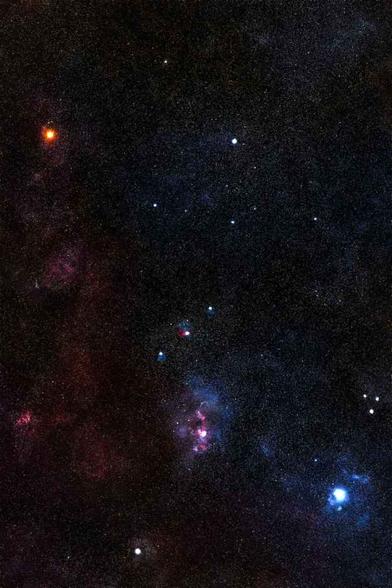
Featured image: the constelation Orion; stock photograph from WordPress

#ClimateChange #Lectionary #Psalms #Science #Trinity
Psalm 23 presents a poetic vision in which trust in divine guidance replaces fear, portraying God as a shepherd who protects, provides, and leads believers through life’s uncertainties.
#Psalms #Psalm23 #wolink #freebiblestudyhub
https://www.freebiblestudyhub.com/book-of-psalms

Out a little late, but here is another edition in the "Psalms Project", my latest Blog Post This is my riff on the Psalms from the Bible-part essay, part homage, and part reflection. Enjoy, subscribe, and play along! New post in my series on suggested Approaches to Life coming Monday-Have a great weekend all~

http://align-with-love.com/2026/02/27/psalms-project-continued-2/?utm_source=mastodon&utm_medium=jetpack_social
#AlignWithLove
#writing
#Psalms
#Weekend

Psalms Project (continued)

The Psalms Project is my attempt to take the spirit of the Psalms and re-apply them and write new ones for today. I am NOT trying to replace the amazing Psalms already in the Bible! I am in no way …

Align With Love
My latest post on my blog: Align-with-love.com. I am
Doing my own riff on the Biblical Psalms-check it out! #AlignWithLove #Lent #Faith #Psalms

Exposed and Naked: We are Not in Control

“‘Dear Lord God, I wish to preach in your honor. I wish to speak about you, glorify you, praise your name. Although I can’t do this well of myself, I pray that you may make it good.’”[i]

Introduction

Today is about being reminded of death—death in general and death in specific. Ash Wednesday is our sacred and religious memento mori (remember to die); Ash Wednesday brings to the fore the very thing we push back: the reality that all life streams toward death even for those of us who feel very far above and beyond death’s long, cold, bony reach. with the application of ashes on our vulnerable skin, we not only hear with our ears but see with our eyes and feel with our senses the command to remember that we will die. Dying is part of our life in this world where death is not only around us in fits and spurts, but is very much a part of our life cycle.

But it seems that lately we are held hostage by death. We are powerless to the death caused by human beings who have long forgotten that power must be wielded rightly and mercy is more potent than fear. Through the barrage and onslaught of headlines streaming in from around the globe, the national ones decorating our minds like billboards on a highway, and the local ones hitting too close to home, we are made very aware of how much death seems to accompany global and national leaders who are curved in on themselves consumed with their own ego. And even if we turned off televisions, radios, computers, podcasts, and phones, we would not be able to escape the approach and encroach of death. Over the past few months, death has taken loved ones from us (both family and friend) and if not death, then death’s best friends, fear and rage, have stolen people from us in their own way. And if that wasn’t enough, our own bodies remind us about the cool shadow of death lurking closer; whether through the onset of age or by our own hands, things fall apart, breakdown, and come to naught. We are held captive by death; we have do not have access to the keys to this prison we are in.

Thus, we are brought to the only confession we have, we are not in control. We are hurt, we are guilty, we are lost, we are fragile, and we are unsafe. Is there any hope for such as these?

Psalm 103:8-14

Yes, there is hope for such as we. Our psalmist writes,

Abba God is full of compassion and mercy,
slow to anger and of great kindness.

Our Psalm is a hymn celebrating God’s steadfast posture towards God’s people and is a commentary on portions of Exodus and Isaiah.[ii] Specifically in our short portion, verse 8, just quoted, is asking the reader to remember Ex. 33:13, “Now, If I have truly gained Your favor, pray let me know Your ways, that I may know You and continue in Your favor.” And if they are to remember Exodus 33, then 32 and 34 must be recalled, too. Exodus 33 marks Moses’s pleading on behalf of the people before and to God in the Tent of Meeting. Why is Moses pleading on behalf of the people? In Exodus 32 he broke the tablets upon his return from communing with God on the mountain when he saw the people worshiping the golden calf that Aaron crafted. Thus, in Ex. 33, is eager to plead to God for God to relent of God’s anger. So, Moses goes to God in the Tent of Meeting carrying the sin of Israel and wondering what God will do with the people whom God has called “stiffnecked.” (33:5). Thus, In Exodus 33:13, Moses wants to know God’s own way in dealing with the sin of his people;[iii] how does God deal with the fault and guilt, the hurt and being lost, the fragility and unsafety of God’s people? Reference to Exodus 34 gives us the answer: God does not abandon Moses nor the people; God is present. This God who is present is a God who is compassionate and forgiving, steadfast and patient, “The Lord passed before him and proclaimed: ‘The Lord! The Lord! A God compassionate and gracious, slow to anger, abounding in kindness and faithfulness, extending kindness to the thousandth generation, forgiving iniquity, transgression, and sin…” (34:6-7a). God does not abandon God’s people. God is faithful to the covenant even when God’s people are not; God is magnanimous and just even when the people are not.[iv] Our psalmist is intentional here in v. 8 (and v.7) in calling to mind the God of Israel who is faithful and just while the people are unfaithful and unjust.

Thus, why the psalmist can go on, singing the praises of God further elaborating on God’s character and posture towards God’s people:[v]

Abba God will not always accuse us,
nor will Abba God keep anger for ever.
Abba God has not dealt with us according to our sins,
nor rewarded us according to our wickedness.
For as the heavens are high above the earth,
so is God’s mercy great upon those who fear God.
As far as the east is from the west,
so far has Abba God removed our sins from us.
As a parent cares for their children,
so does the Abba God care for those who fear God.

Both Exodus 34:7b ff and Isaiah 55:16 (hinted at by Psalm 103:9) are in view here. In the second part of Ex 34:7 God promises that God will visit the punishments of the iniquities of the people on their children and grandchildren, etc. But Moses intervenes in 34:8-9, “‘If I have gained Your favor, O Lord, pray, let the Lord go in our midst, even though this is a stiffnecked people. Pardon our iniquity and our sin, and take us for Your own!’” And Isaiah 57:16 reads,

“For I will not always contend,
I will not be angry forever:
Nay, I who make spirits flag,
Also create the breath of life.”

Moses’s plea from Exodus 34 is met in Isaiah’s prophecy and promise that divine anger and displeasure have a time limit; even in spite of the way the people have acted—insatiable for debauchery and injustice—God will be unselfish and just.[vi] And as the prophet speaks from God’s own pathos toward and for God’s people, these words are as good as done. God’s words are like rain watering parched soil, turning it from a place of death into a source of life, just like God’s own being and breath.[vii] Under and with and by God’s Word, the people will come alive again and will be liberated from death and in justice, from their self-imposed notions of being in control, from their hurt, guilt, lostness, fragility, and unsafety; they will participate with God in God’s mission of the divine revolution of love, life, and liberation. God will condescend and transcend God’s self to bring God’s ways to the people so that their ways reflect their divine genetic inheritance (like parent, like child).[viii] Where they used to bring injustice they will bring justice, where they were self-consumed they will be consumed by divine passion for their neighbor, God’s beloved.

The psalmist concludes,

For Abba God themself knows whereof we are made;
Abba God remembers that we are but dust.

God knows God’s people. God does not hold them to a standard that is beyond their fleshiness, their fragility, their creatureliness but, rather, holds them to be such creatures who are fragile and fleshy, those who must hold each other gently and kindly as God does.[ix] According to the psalmist, God knows not only where we are and what we are, but of what we are made. This is surely good news and every reason to have hope that God is for God’s people even when things look bleak and is coming for them to liberate them to life by God’s love.

Conclusion

Thus, even as God’s people are trapped and held captive in their sin, iniquity, and transgressions, God knows just how vulnerable and susceptible they are and none of that knowledge dissuades God from God’s covenant. But first the people must come to terms with their own situation and status before God: for they are not in control, they are hurt, they are guilty, they are lost, they are fragile, and they are unsafe. If they continue forward without acknowledging who and what they are before God, they will continue to participate in and perpetuate the rampant injustices of the kingdom of humanity, forsaking the justice of the reign of God and being harbingers of death and not life, of indifferent and not love, of captivity and not liberation.

As it was for the Israelites, so it is for us.

Ash Wednesday marks the beginning of our determined and slow descent into the tomb of Good Friday. This movement from Ash Wednesday to Good Friday is the season of Lent, and it demands an honesty and exposure that will peel back our facades and remove our masks, bringing us to a very naked state that will feel like a complete and total death. We are brought to our most dreaded confession: we are not in control; we are hurt, we are guilty, we are lost, we are fragile, and we are unsafe. But it’s out of this death, this confession, out of this naked and vulnerable place, where God’s word will liberate us out of death into life by God’s love. And not back into your old life, but caused to be new creatures who have new eyes and ears to see and hear the pain around them, brining love where there is indifference, life where there is death, and liberation where there is captivity.

[i] LW 54:157-158; Table Talk 1590.

[ii] Adele Berlin and marc Zvi Brettler, “Psalm 103,” The Jewish Study Bible Jewish Publication Society Tanakh Translation, eds. Adele Berlin and Marc Zvi Brettler (Oxford: OUP, 2004), 1396. “A hymn of praise for God’s nature (divine attributes) and for His acts on behalf of Israel; it contains quotations from and allusions to Exodus and Isaiah.”

[iii] Jeffrey H. Tigay, “Exodus,” The Jewish Study Bible Jewish Publication Society Tanakh Translation, eds. Adele Berlin and Marc Zvi Brettler (Oxford: OUP, 2004), 187-188. “Your ways in dealing with humankind, meaning…the principles by which you deal with human sin. God had said that the angel would be unforgiving…What is God’s own way?…What is Your way, considering that Israel is Your own people?”

[iv] Tigay, “Exodus,” 189. “God grants both of Moses’ requests, passing His presence before him …and proclaiming His ways (33.13). The name Lord [YHVH], that is the attributes it represents. These attributes include both magnanimity (vv. 6-7a) and justice (v. 7b…)…extending Himself to those in covenant with Him…”

[v] Berlin and Brettler, “Psalm 103,” 1396. “Interpreting or elaborating on the meaning and current application of Exod. 34.6, quoted in v. 8.”

[vi] Benjamin D. Sommer, “Isaiah,” The Jewish Study Bible Jewish Publication Society Tanakh Translation, eds. Adele Berlin and Marc Zvi Brettler (Oxford: OUP, 2004), 794. “The second complaint: parties instead of piety. Appropriately, the people whose appetite is insatiable will feed the insatiable appetite of Sheol, the underworld…”

[vii] Sommer, “Isaiah,” 895. “Deutero-Isaiah pics up the metaphor of water … in a new way to emphasize a favorite theme: God’s promises and the prophesies God issued through the prophets never fail to come true…The metaphor is significant: God sends rain, which inevitably falls to the ground; then it is absorbed by soil and nourishes vegetation. Humans in turn harvest the vegetation and transform it into food. Similarly, God’s word is sure to have series of effects, the most important of which are indirect and involve human input.”

[viii] Berlin and Brettler, “Psalm 103,” 1396. “The relationship between God and his worshippers is here portrayed as that between a father and a son…The compassionate father also figures in Jer. 31.20.”

[ix] Berlin and Brettler, “Psalm 103,” 1396. “The creaturely and ephemeral status of humanity…and the permanence of God’s covenant with those who fear Him.”

#Beloved #BenjaminDSommer #BerlinAndBrettler #DeathToLife #DivineLiberation #DivineLife #DivineLove #Exodus #Hope #JeffreyTigay #JPSStudyBible #Liberation #Life #Love #NewCreation #NewLife #Psalm103 #Psalms #ThePsalms

Ramadan

This Islamic holiday is observed in the 9th month of the Islamic calendar. It’s observed by Muslims worldwide. It’s a month of fasting, prayer, reflection, & community. It celebrates Muhammad’s (PBUH) first revelation. The annual observance is regarded as 1 of 5 pillars of Islam. This holiday lasts 29-30 days, from 1 crescent moon to the next 1. This year it happens from February 17-March 19.

Fasting from dawn to sunset is mandatory for ALL Muslim adults. There are exceptions: Being acutely/chronically I’ll, traveling, being elderly, breastfeeding, are a diabetic, are pregnant, or are on your monthly cycle.

The predawn meal is referred to as suhur. The nightly feast that breaks the fast is called iftar. Muslims who live in areas with midnight sun or polar night should follow Mecca’s schedule. But common practice to follow schedule of the closest country with a day & night.

Spiritual rewards are believed to be multiplied during Ramadan. During fasting hours, Muslims refrain from not only food & drink but also tobacco products, adult spicy activities, & sinful behavior. Devoting oneself to prayer & study of the Quran instead.

Muslims believe that all scripture was revealed during Ramadan. The scrolls of Abraham, Torah, the Psalms, the Gospel, & Quran have been handed on the 1st, 6th, 12th, 13th (or in some sources, 18th), & 24th Ramadans.

It’s believed to have gotten 1st Quranic revelation on Laylat al-Qadr. This is 1 of 5 odd-numbered nights that fall during the last 10 days of Ramadan. This is the holiest night of the year.

The end of Ramadan is called Eid al-Fitr. This celebrates the return to normalcy (eating, drinking, spicy adult time with your spouse).

Although Muslims were 1st commanded to fast in the 2nd year of Hijra (624 CE), they believe that the practice isn’t fact an innovation of monotheism. But rather has always been necessary for believers to attain for God (taqwa).

The Laylat al-Qadr (“Night of Power”) is the night that Muslims believe the Quran was 1st sent down to the world. Muhammad received his 1st Quranic revelation from it. The Dawoodi Bohra believe that Laylat al-Qadr was the 23rd night of Ramadan.

The common practice is to fast from dawn to sunset. The pre-dawn meal before the fast is called the suhur. While the meal at sunset that breaks the fast is called iftar.

At sunset, families break the fast with the iftar. Traditionally, opening the meal by eating dates to commemorate Muhammad’s practice of breaking the fast with 3 dates. Then they adjourn for Maghrib (the 4th of the 5 required daily prayers) after which the main meal is served.

Over time, the practice of iftar has evolved into banquets that may accommodate hundreds of thousands of diners. The Sheikh Zayed Grand Mosque in Abu Dhabi (the largest mosque in the UAE), feeds up to 30,000 people every night.

Zakat (often translated as “the poor-rate”) is the fixed percentage of income a believer is required to give to the poor. This practice is obligatory as 1 of the pillars of Islam. Muslims believe that good works/deeds are rewarded more generously during Ramadan than at any other time of the year.

Consequently, many Muslims donate a larger portion (or even all) of their yearly zakat during this month. Tarawih are extra nightly prayers performed during the month of Ramadan. These extra prayers aren’t mandatory.

Muslims are encouraged to read the entire Quran (which encompasses 30 juz’ (sections)) over the 30 days of Ramadan.

In some countries, the Ramadan observance has been restricted by governments. In the USSR, the Ramadan practices were suppressed by officials. In Albania, Ramadan festivities were banned during the communist period. Many Albanians continued to fast in secret during this period.

If anyone has health problems, they’re exempt from Ramadan fasting activities. Additionally, the elderly, pre-pubertal kids, & pregnant/lactating women are exempt.

One-Time Monthly Yearly

Make a one-time donation

Make a monthly donation

Make a yearly donation

Choose an amount

$1.00 $5.00 $10.00 $1.00 $5.00 $10.00 $5.00 $10.00 $15.00

Or enter a custom amount

$

Your contribution is appreciated.

Your contribution is appreciated.

Your contribution is appreciated.

DonateDonate monthlyDonate yearly #624CE #Abraham #AbuDhabi #Albania #EidAlFitr #FivePillarsOfIslam #Gospel #Hijra #Iftar #Islam #IslamicCalendar #LaylatAlQadr #Maghrib #Mecca #monotheism #Muhammad #Muslims #NightOfPower #Psalms #Quran #Ramadan #SheikhZayedGrandMosque #Suhur #Taqwa #Tarawih #Torah #UAE #USSR #Zakat
Memberships

Visit the post for more.

Psalm 23 teaches enduring truths about trust, provision, courage, dignity, and hope. Through the shepherd metaphor, it presents a vision of faith grounded in relationship and presence rather than fear or self-reliance.
#Psalms #wolink #freebiblestudyhub
https://www.freebiblestudyhub.com/book-of-psalms

I think I finally understand faith

In my life, I’ve struggled with spirituality. I grew up in a religious household. My grandparents lived piously and my parents lead a pious life.

As a child, I never questioned faith. It was a blissful acceptance that this is what life is. With the trait for authority pleasing, I absorbed the tantras and the mantras associated with religious and spiritual living. I performed my daily rites – the sandhyavandanams (literally translates to a very pleasing hymns of twilight). I consumed every Amar Chitra Katha and Hindu mythology building these mental statues of heroes with feats beyond compare. They were never human or mortal.

Over time, the relationship with Gods transformed from blind acceptance to be more transactional. It was closely tied to outcomes. I had my list of Gods I called upon when I wanted an outcome: It’s Ganesha for no impediments; Saraswati for education and learning and then Hanuman for victory in the endeavor.

I realize in hindsight that this was a self reinforcing loop. If something went well (I wanted the outcome), I thanked the Gods. If something didn’t go well, I blamed the Gods. Insidiously, I didn’t realize that this was a rejection of agency.

This relationship with faith kept on until a couple years into college. In college, I started questioning this. Certain outcomes didn’t happen as I wanted so then as a religious human I asked – why not? What did I do wrongwhy did you not give me the outcome I wanted?

Anyway, when more things didn’t go according to plan, I did what any young person would do – a total and utter rejection of faith. I stopped believing. I embraced agnosticism. It never led to atheism as I still believed in a higher power. However, the gumption of youth is good. I started believing in myself, I believed that I started achieving things because of my merit and the effort that I put in. However, this also led to some painful learnings – including the onset of impostor syndrome.

I never paused to reflect on what I was doing. If you reject faith and insist outcomes are fully under your control, then every miss becomes a referendum on your worth. When you do not get what you want, you start questioning your ability, and your identity.

A memory sticks. I remember thoroughly enjoying C++ during a semester in college. I understood it well. I enjoyed coding in it and was good at leveraging pointers and writing code that managed memory really well. However, the results of the finals of C++ were that I graded a 60/100.

I remember the sinking feeling to this day. I jumped to the conclusion that I wasn’t good at C++ and decided that was not what I wanted to ever pursue in my life. This was wrong. Ironically, my first job was writing Visual C++ code to do graphical visualizations and calculations of human heart and lungs, for which I won rave reviews and won awards. I was lucky I got an opportunity to correct my self evaluation. However, at the time in college, my ego was butt hurt.

Over the 20 years since I’ve learned more about the brain, the mind, the ego, the self etc. However, my young mind couldn’t take the responsibility easily.

So, I flipped to faith after college.

Then I flopped to agnosticism.

Upon reflection, and only recently, did I figure out the pattern. My faith flipped on outcomes. When something didn’t go according to plan, I switch modes. When that mode fails (based on another outcome), I flip and then I flop.

The irony is that Hindu faith is chockfull of life lessons that suggest what I was doing was a fool’s errand. The most famous of them

कर्मण्येवाधिकारस्ते मा फलेषु कदाचन।
मा कर्मफलहेतुर्भूर्मा ते सङ्गोऽस्त्वकर्मणि॥ २-४७

Transliterated, it reads

Karmanye vadhikaraste Ma Phaleshu Kadachana,
Ma Karmaphalaheturbhurma Te Sangostvakarmani

Translated it means

Karmanyevadhikarasthe: You have the right to work

Ma Phaleshu Kadachana: But, never to its fruits.
Ma karmaphalaheturbhurma: Let not the fruits of action be your motive
Te Sangostavakarmani: Nor let your attachment be to inaction.

Upon re-reading this verse from the Gita a couple years ago, finally

I had been working on the wrong problem. I had tied faith to outcomes, when faith is really intended to survive outcomes. Agency determines effort. Outcomes depend on many factors I do not control. Faith helps me accept whatever happens without collapsing into blame, shame, or grand stories.

Now a rational person should question if it’s being delusional. I did.

That question sent me down a rabbit hole about ego and the mind: what the mind does, why it lies, and how it protects identity. In that process, I ran into Depressive Realism

Although depressed individuals are thought to have a negative cognitive bias that results in recurrent, negative automatic thoughts, maladaptive behaviors, and dysfunctional world beliefs, depressive realism argues not only that this negativity may reflect a more accurate appraisal of the world but also that non-depressed individuals’ appraisals are positively biased. (emphasis mine)

This one is a doozy.

The claim is uncomfortable: depressed people may judge some parts of reality more accurately, while non-depressed people often hold a positive bias.

My takeaway is simple. Positive bias is not just a flaw. It can be a tool for staying functional. It can support joy. Depression is brutal. I have no interest in “accurate” thinking that destroys my will to act.

This is the role that faith plays for mem now. Faith is my chosen positive cognitive bias. It helps me accept bad outcomes without quitting. It helps me put in my next rep without turning a loss into an identity.

There is a line between helpful bias and delusion. I try to watch that line. But if the choice is between a bias that keeps me moving and a “clear-eyed” view that sinks me, I will take the bias and keep going.

Here’s an awkward question: Taken to its absurd simplicity, does this mean I will choose the blue pill?

The choice is yours…

#bhagvadGita #ego #faith #gita #hinduism #India #Life #mind #mythology #neuroscience #philosophy #psalms #psychology #religion #spirituality
Depressive realism - Wikipedia

The Winter, 2026 issue of Forgotten Ground Regained is now live on the theme:

PSALMS AND MEDITATIONS

#alliterative #poetry #poetrylovers #poetrycommunity #writingcommunity #psalms #meditations

alliteration.net/current-issue/

“Kilmarnock”. Psalm 16: 8–9
from SALM vol. 1 – Gaelic Psalms from the Hebrides of Scotland. Ridge Records, 2003

https://www.youtube.com/watch?v=_belSyGmVFk&list=OLAK5uy_koAuFlIbZeSiXh24WmWK5-7tnrntk-Y6s&index=2

#Scotland #Gaidhlig #Gaelic #song #singing #spalmsinging #psalms #psalm16 #minoritylanguages

Kilmarnock. Psalm 16: 8-9 (Live)

YouTube