SENEDD ELECTION: Labour suffers dramatic collapse in new Wales poll — here’s what it means for your constituency

Welsh Labour has suffered its worst polling result yet with just three days to go until Thursday’s Senedd election – with a new survey putting the party on just 16% of the vote and projecting its most humiliating result since devolution began.

The poll, by More in Common, puts Plaid Cymru ahead on 30% with Reform UK close behind on 27%. Labour trails in third on 16%, with the Conservatives on 12%, the Greens on 9% and the Liberal Democrats on 4%.

The significance of the More in Common poll is that it has consistently been the most favourable for Labour of all the polling firms covering the Senedd election. Previous polls had already shown a knife-edge race between Plaid and Reform – but Labour had been holding on to the More in Common numbers as a relative comfort. That comfort has now gone.

Translated into seats under the new proportional system, the poll projects Plaid Cymru and Reform UK level on 34 seats each, with Labour on 14 – down ten from the last projection – the Conservatives on nine and the Greens on five. The new Senedd has 96 seats, meaning a majority requires 49. Under these projections, no single party or obvious coalition can reach that threshold.

One of the most striking individual findings is the projection for First Minister Eluned Morgan’s own seat in Ceredigion Penfro. Under the previous More in Common MRP, Morgan was narrowly projected to hold on as Labour’s sole representative in the constituency. With Labour now down a further five points nationally, that margin is under even greater pressure. Analysts caution that local projections carry significant uncertainty – but the direction of travel is clear.

Luke Tryl, Executive Director of More in Common UK, said the race had tightened significantly. “With less than a week to go, the race has tightened. Plaid Cymru now leads on vote share, but in terms of seats it all looks set to come down to the sixth seat in each constituency which will likely be decided by handfuls of votes,” he said.

The poll also underlines how the new closed list system benefits the larger parties at the expense of smaller ones. Plaid and Reform are each projected to win around 35% of seats despite winning 30% and 27% of the vote respectively, while the Liberal Democrats on 4% are projected to win no seats at all nationally. Two-thirds of Welsh voters still don’t understand how the new system works, according to research published at the weekend.

The new More in Common poll has not yet published full constituency-level breakdowns. The projections below are based on the April More in Common MRP model, adjusted in light of the new national figures – particularly Labour’s further five-point fall. They should be read as indicative rather than definitive.

In Sir Gaerfyrddin – covering the whole of Carmarthenshire – Plaid Cymru are dominant, polling at around 37%. Under the April MRP, Plaid were projected to take three seats – Cefin Campbell, Nerys Evans and Adam Price – with Reform UK’s Gareth Beer and Carmelo Colasanto taking two. Labour’s Calum Higgins held the sixth seat by a narrow margin. With Labour down further nationally, that sixth seat is now under serious threat.

In Gŵyr Abertawe – covering Swansea – the April MRP projected a dead heat, with Reform UK’s Francesca O’Brien and Steven Rodaway, Plaid Cymru’s Gwyn Williams and Safa Elhassan, and Labour’s Mike Hedges and Swansea Council leader Rob Stewart each winning two seats. Labour’s national collapse makes both of those Labour seats harder to hold under the new figures.

In Brycheiniog Tawe Nedd – covering Neath Port Talbot and the Brecon area – the April MRP projected the most fragmented result of any constituency in south-west Wales, with one seat each for six different parties: Reform UK’s James Evans and Iain McIntosh; Labour’s Dr Mahaboob Basha; Plaid Cymru’s Sioned Williams; the Liberal Democrats’ Jane Dodds; and Conservative Tyler John Chambers. With Labour on 16% nationally, Dr Basha’s seat is the most exposed of the six.

In Ceredigion Penfro – covering Pembrokeshire and Ceredigion – Plaid Cymru dominate on around 38%. The April MRP projected Elin Jones, Kerry Ferguson and Anna Nicholl taking three seats for Plaid, with Reform UK’s Susan Claire Archibald taking one and Conservative Paul Windsor Davies another. First Minister Eluned Morgan was projected to narrowly hold the sixth seat for Labour – but that projection is now in serious doubt given Labour’s further national decline.

In Pen-y-bont Bro Morgannwg – covering Bridgend – the April MRP projected a three-way tie with two seats each for Reform UK’s Sarah Cooper-Lesadd and Gareth Thomas, Plaid Cymru’s Mark Hooper and Sarah Rees, and Labour’s Sarah Murphy and Huw John David. Labour’s second seat here is under pressure under the new polling figures.

A second major poll from YouGov is expected on Tuesday – which will give a further picture of where Wales stands heading into polling day on Thursday. We will bring you the full breakdown as soon as it is published.

Our Senedd election coverage

Plaid on course to make history — but here’s who’s set to represent YOU on 7 May
Seat-by-seat projections for every constituency across south-west Wales under the new system.

Race between Plaid and Reform on a knife-edge as two major polls show Wales heading for historic result
The polling picture before the More in Common survey.

Two-thirds of Welsh voters don’t understand the new voting system
New research from Aberystwyth and Swansea universities on voter knowledge ahead of Thursday.

Reform UK targets Sir Gaerfyrddin seats with nine days to go
How the campaign has been playing out across south-west Wales.

#MoreInCommon #PlaidCymru #ReformUK #SeneddElection2026 #WelshLabour

SENEDD ELECTION: Race between Plaid and Reform on a knife-edge as two major new polls show Wales is heading for historic result

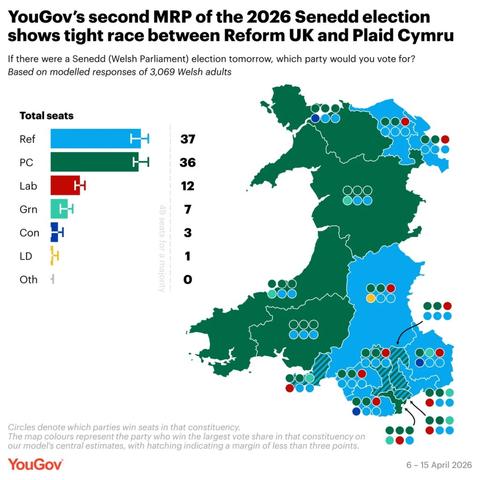
YouGov’s second MRP of the 2026 Senedd election shows a tight race between Reform UK and Plaid Cymru
(Image: YouGov / ITV Cymru Wales, 6–15 April 2026)

Two major polls published this week have painted a remarkably consistent picture of where Wales stands with two weeks to go until the Senedd election: a historic race between Plaid Cymru and Reform UK, Labour in third place, and an outcome that nobody can predict with confidence.

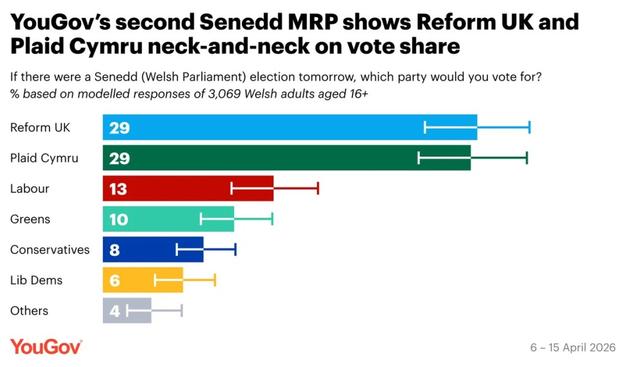
The most detailed of the two is YouGov’s second MRP for ITV Cymru Wales, produced in partnership with Cardiff University’s Wales Governance Centre on a sample of 2,387 Welsh adults between April 6 and 15. It projects Reform UK on 37 seats and Plaid Cymru on 36 — a significant tightening since YouGov’s first MRP last month, when Plaid led by a wider margin. Both parties are tied on 29% of the vote in the latest YouGov model, with Labour on 13%, the Greens on 10%, Conservatives on 8%, and the Liberal Democrats on 6%.

YouGov’s second Senedd MRP shows Reform UK and Plaid Cymru neck-and-neck on vote share
(Image: YouGov / ITV Cymru Wales, 6–15 April 2026)

The Ipsos poll, published today and conducted between April 2 and 8 on a sample of 747 Welsh adults, puts Plaid Cymru at 30% and Reform UK at 25%, with Labour on 15%. Half of Welsh voters say they may yet change their minds — 52% — while Reform voters are the most committed, with just 32% saying they could switch compared to 53% of Plaid supporters.

That commitment gap is significant. Reform UK has been particularly effective at converting those who consider voting for them into firm intenders, with a conversion rate of 81%, while the Green Party has struggled to convert interest into voting intention at just 27%.

What it means for coalition arithmetic

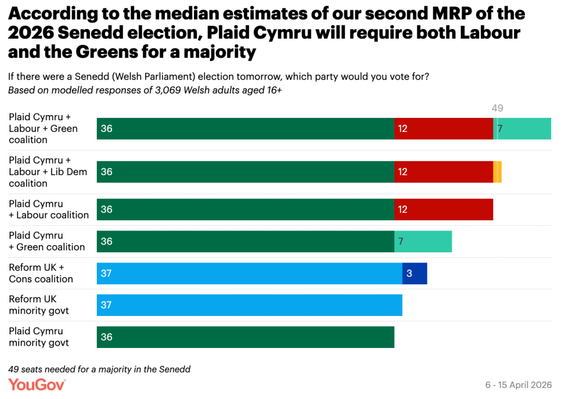
Neither party is close to the 49 seats needed for a majority in the 96-member Senedd, meaning some form of co-operation between parties would be required to elect a First Minister.

According to YouGov’s second MRP, Plaid Cymru will require both Labour and the Greens for a majority
(Image: YouGov / ITV Cymru Wales, 6–15 April 2026)

Dr Jac Larner of Cardiff University’s Welsh Governance Centre offered a telling observation about the race, saying that finishing first may matter less than it appears. “Whichever party leads on seats will face the same coalition arithmetic, and that arithmetic is far more favourable to Plaid than to Reform,” he said.

Plaid leader Rhun ap Iorwerth has expressed a preference for forming a minority Plaid government, but would still need the assistance of Labour and either the Greens or the Lib Dems for a majority. Plaid and Labour together hold a majority in 47% of YouGov’s simulations.

Eluned Morgan’s seat

One of the most closely watched individual outcomes remains that of First Minister Eluned Morgan. The YouGov MRP projects that Morgan would not be returned to the Senedd — because on these figures Labour win no seats at all in Ceredigion Penfro, the constituency she is standing in. This directly contradicts the More in Common MRP we reported earlier this week, which suggested she would narrowly survive with Labour taking one of the six seats in Ceredigion Penfro. The two models agree that the outcome is on a knife-edge, but disagree on which side of the line she falls.

What the data says for our area

The raw constituency data from the YouGov MRP reveals some significant differences from the More in Common projections we reported earlier this week — particularly for Labour across south and west Wales.

In Gŵyr Abertawe (Swansea), YouGov projects Reform UK winning on 29%, ahead of Plaid on 27% and Labour on 16%. The seat breakdown gives Reform 2, Plaid 2, Labour 1 and the Greens 1 — a notable difference from More in Common, which projected Labour taking 2 seats. On YouGov’s figures, a Green candidate would take the sixth seat at Labour’s expense.

In Sir Gaerfyrddin (Carmarthenshire), the picture is even starker for Labour. Plaid lead on 37% with Reform on 31% and Labour on just 10%. YouGov projects Plaid 3 and Reform 3 — with Labour taking no seats at all. More in Common had given Labour one seat in the constituency, which would have returned Calum Higgins as Labour’s lead candidate.

In Brycheiniog Tawe Nedd, YouGov projects Reform winning on 30%, with Plaid on 25%, Labour 12% and the Lib Dems also on 12%. The seat split is Reform 2, Plaid 2, Labour 1, Lib Dems 1 — with the Conservatives projected to win no seats, in contrast to the More in Common MRP which gave them one.

In Ceredigion Penfro (Pembrokeshire), Plaid dominate on 38% with Reform on 27%. YouGov projects Plaid 3, Reform 2, Greens 1 — and no Labour seat, meaning Eluned Morgan would not be returned on these figures.

In Pen-y-bont Bro Morgannwg (Bridgend), Reform lead on 31%, Plaid on 25%, Labour on 15%. YouGov projects Reform 2, Plaid 2, Labour 1, Conservatives 1 — again one fewer Labour seat than More in Common projected.

In Afan Ogwr Rhondda (Neath Port Talbot), Reform lead strongly on 36%, Plaid on 29%, Labour on 17%. Both models agree here: Reform 3, Plaid 2, Labour 1 — meaning Huw Irranca-Davies as Deputy First Minister would narrowly hold his seat as Labour’s sole representative.

Lower and higher end seat estimates projected by YouGov’s second MRP of the 2026 Senedd election
(Image: YouGov / ITV Cymru Wales, 6–15 April 2026)

The Conservatives and smaller parties

The Welsh Conservatives are on 8% in the YouGov model and projected to return three members — but not including their leader Darren Millar on this round of results. The Greens are forecast to elect seven MSs, while the Lib Dems win only a single seat on the median projection — Jane Dodds in Brycheiniog Tawe Nedd — leaving the party short of the five seats needed to form a political group in the Senedd.

The bigger picture

Both polls point to a result that would have been unthinkable at the last Senedd election in 2021. Had that election been conducted under the new electoral system, Plaid Cymru would have won 24 seats and Reform UK would have won none.

Reform UK, Plaid Cymru and the Greens set for gains in the 2026 Senedd election compared to notional 2021 results.
(Image: YouGov / ITV Cymru Wales, 6–15 April 2026)

The Ipsos research also highlights the wider public mood. Around 62% of Welsh adults disagree that the Welsh Labour Government deserves to be re-elected, and high dissatisfaction ratings attach to both Keir Starmer and Eluned Morgan. Rhun ap Iorwerth is the only party leader in Wales with a positive net satisfaction rating, though 59% of Welsh adults disagree that Reform UK is ready to form a government.

The picture across all recent polling is of a country that wants change but hasn’t yet settled on what form that change should take. The Wales-wide five-poll moving average currently puts Plaid Cymru on 28.6%, Reform UK on 26.8%, and Labour on 16.8%.

The Senedd election takes place on Thursday, May 7, 2026. For our full coverage of what the polls mean for every constituency in our area, see our More in Common MRP analysis.

Related stories from Swansea Bay News

SENEDD ELECTION: Plaid on course to make history — who’s set to represent YOU on May 7?
Our More in Common MRP analysis with candidate-by-candidate projections for every constituency in our area.

Senedd Election 2026 — all our coverage
Full archive of Swansea Bay News reporting on the May 7 election.

Polling — all our coverage
Every poll we’ve reported on ahead of the Senedd election.

#ElunedMorganMS #MoreInCommon #PlaidCymru #polling #ReformUK #SeneddElection2026

SENEDD ELECTION: Plaid on course to make history as largest party — but here’s who’s actually set to represent YOU on May 7

Wales is heading for a political earthquake on May 7, according to the most detailed poll yet published ahead of the Senedd election.

Research group More in Common has released its first MRP — a sophisticated seat-by-seat modelling technique that goes far beyond standard polling — and the findings represent a dramatic moment in Welsh politics.

Plaid Cymru is projected to win 30 seats, making it the largest party in the 96-seat Senedd for the first time since devolution in 1999. Reform UK is close behind on 28, with Labour falling to just 24 — a historic collapse for a party that has governed Wales continuously for 27 years.

The Conservatives are forecast to hold seven seats, the Greens four, and the Liberal Democrats three.

Luke Tryl, Executive Director of More in Common UK, said the scale of the shift was extraordinary. “Looking at Wales today, it’s hard to believe that the 2024 general election was less than two years ago — the political map has changed so dramatically since Labour won decisively in Wales,” he said.

“Having governed in Wales for 28 years, Labour is set to be pushed into third place — and for the first time we could see Wales led by a non-Labour First Minister. Plaid Cymru are the clear beneficiaries of a country ready for change, and could be on course to lead a Welsh government for the first time.”

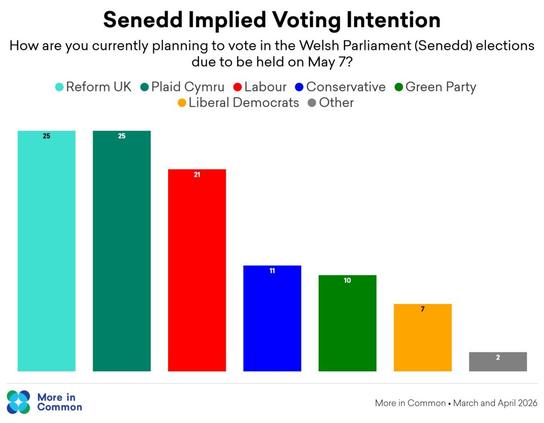
The polling, carried out between January 30 and April 10 with a sample of 2,519 Welsh adults aged 16 and over, shows implied vote shares of 25% each for Plaid Cymru and Reform UK, 21% for Labour, 11% for the Conservatives, 10% for the Greens, and 7% for the Liberal Democrats. Independents and other candidates are polling at under 2% in most constituencies and are not projected to win any seats under this model.

Image: Senedd Implied Voting Intention bar chart — Source: More in Common, March and April 2026

It is the more conservative of two recent MRPs: a JL Partners poll for the Telegraph, published last week, put Plaid on 37 seats — a more commanding lead still.

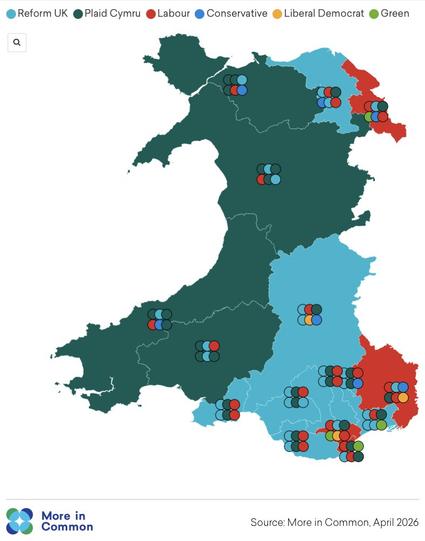
Image: Wales constituency map showing projected winners — Source: More in Common, April 2026

What it means for your area — and who you’ll be voting for

Wales is using a closed list proportional representation system for the first time in this election, meaning voters choose a party rather than an individual candidate. Seats are then allocated in order from each party’s published list. That means we can say not just which parties are likely to win seats — but exactly who those winners are likely to be.

Gŵyr Abertawe (Swansea)

Reform UK’s Francesca O’BrienSwansea Council leader, Rob Stewart (Photo: Adam Davies)Plaid Cymru’s Gwyn Williams

The Swansea constituency is projected as a dead heat, with each of the top three parties taking two seats apiece on virtually identical vote shares.

Reform UK lead on 25%, ahead of Plaid Cymru on 24% and Labour on 22%. Both Reform UK candidates Francesca O’Brien — the Mumbles ward councillor who defected from the Welsh Conservatives to Reform UK last August, having previously served as the party’s deputy leader in Swansea — and Steven Rodaway would be elected. Labour’s two seats would go to former MS Mike Hedges and Swansea council leader Rob Stewart. Plaid Cymru would return Gwyn Williams and Safa Elhassan.

The Greens are on 10% and the Conservatives also on 10%, with neither projected to win a seat here.

Sir Gaerfyrddin (Carmarthenshire)

Plaid Cymru’s Cefin CampbellReform UK’s Gareth BeerWelsh Labour’s Calum Higgins

Plaid Cymru are dominant in Carmarthenshire, polling at 37% — well ahead of Reform UK on 26% and Labour on 21%.

That translates to three seats for Plaid: Cefin Campbell, Nerys Evans, and former party leader Adam Price would all be returned. Reform UK’s Gareth Beer and Carmelo Colasanto would take two seats, and Labour’s Calum Higgins would hold the sixth and final place.

Brycheiniog Tawe Nedd (Neath Port Talbot/Brecon)

James Evans speaking at a Reform UK event after confirming he has joined the party. (Image: Reform UK)Welsh Labour’s Dr. Mahaboob BashaPlaid Cymru’s Sioned Williams

This is the most fragmented constituency in our area, with six different parties projected to win one seat each — one of the most competitive contests in all of Wales.

Reform UK lead on 27%, with Labour on 21%, Plaid on 19%, the Liberal Democrats on 13%, the Conservatives on 11%, and the Greens on 10%. On those figures the elected members would be: Reform UK’s James Oswald David Evans and Iain Charles McIntosh; Labour’s Dr Mahaboob Basha; Plaid Cymru’s Sioned Williams MS; Liberal Democrats’ Jane Dodds MS; and Conservative Tyler John Chambers.

Pen-y-bont Bro Morgannwg (Bridgend)

Reform UK’s Sarah Cooper-LesaddPlaid Cymru’s Mark HooperWelsh Labour’s Sarah Murphy

Bridgend mirrors the Swansea picture — a three-way tie with two seats each for Reform UK, Plaid Cymru, and Labour. Reform poll 27%, Plaid 24%, and Labour 24%.

Sarah Cooper-Lesadd and Gareth Thomas would be elected for Reform; Mark Hooper and Sarah Rees for Plaid; and Sarah Murphy and Huw John David for Labour.

Afan Ogwr Rhondda (Neath Port Talbot/Rhondda)

Reform UK’s Ben Hodge-McKennaPlaid Cymru’s Sera EvansWelsh Labour’s Huw Irranca Davies

This is Reform UK’s strongest projected result in our area. They lead on 36% — ahead of Plaid Cymru on 25% and Labour on 21% — and are projected to win three of the six seats.

Benjamin Hodge McKenna, Steve Bayliss, and Darren James would all be elected for Reform. Plaid’s Sera Evans and Alun Cox would take two seats, with Labour’s Huw Irranca-Davies — currently serving as Deputy First Minister — narrowly holding on with the sixth seat.

Ceredigion Penfro (Pembrokeshire)

Plaid Cymru’s Elin JonesWelsh Conservative’s Paul DaviesWelsh Labour’s Eluned Morgan

Plaid Cymru dominate Pembrokeshire and Ceredigion with 38% of the vote, projected to win three seats. The current Llywydd (Speaker) Elin Jones would top their list, followed by Kerry Elizabeth Ferguson and Anna Nicholl.

Reform UK’s Susan Claire Archibald would take one seat on 20%, and former Conservative Senedd leader Paul Windsor Davies would be returned for the Conservatives on 14%.

In a notable shift from some earlier polls, First Minister Eluned Morgan MS would retain her seat as Labour’s sole representative in the constituency on 14%. Previous MRP modelling had placed her seat at serious risk — this poll suggests she survives, though the margin remains tight.

A volatile result

Image: Chart showing how small changes in support could significantly alter seat totals — Source: More in Common, April 2026

More in Common highlight that the outcome remains fluid. Labour and Reform hold or contest the final seat in a large number of constituencies, meaning minor swings in support on polling day could shift the overall totals significantly either way.

What is beyond doubt is that Wales is heading for a result that would have been unthinkable even five years ago — a Senedd led by Plaid Cymru for the first time, with the party that barely existed in Welsh politics two years ago threatening to become the dominant force from Swansea to the Valleys.

More in Common’s full MRP data is available at moreincommon.org.uk. The Senedd election takes place on Thursday, May 7, 2026.

Related stories from Swansea Bay News

SENEDD SHAKE-UP: Winners and losers revealed as First Minister on course to lose seat
An earlier poll had put Eluned Morgan’s seat at serious risk — this latest MRP now says she survives.

Plaid Cymru storms ahead as shock Senedd poll predicts political earthquake in Wales
Our coverage of the earlier polling that first put Plaid ahead.

Reform UK pulls ahead as Plaid slips and Labour edges back in new Senedd poll
How the race between Plaid and Reform has shifted in recent weeks.

From Westminster landslide to Senedd stalemate — two very different futures for south-west Wales
What proportional representation could mean for Labour’s south Wales strongholds.

Swansea councillor Francesca O’Brien joins Reform UK
Our original report on the Mumbles ward councillor’s defection from the Welsh Conservatives last August.

#CllrRobStewart #ElunedMorganMS #featured #MoreInCommon #PlaidCymru #polling #ReformUK #SeneddElection2026

#NDP elect a new leader and the party wastes no time in trying to tear itself apart. #Nenshi statement within seconds of the win bodes poorly for party unity. #Progressives really know how to fight each other. #cdnpoli #MoreInCommon #xp
According to pollster #MoreInCommon, #ReformUK is not only the most popular party among straight men (𝟯𝟯%) but also gay and bisexual men too (𝟮𝟱%)!

@CentralBylines

The really powerful work of the women at Greenham Common remind us today of the power of the people to stand against the #billionaires the #military the #rich and that we have #MoreInCommon when we stand in #solidarity for #PeaceNotWar
#EndGenocide
#Gaza
#Iran

@radiojammor @ChrisMayLA6

This is accurate as of now but will be revised by them in the next few days. #moreincommon suggests a comparable result currently. Unfortunately #morganmcsweeney appears to be so spooked by #reformuk that the challenge from the #greens is being ignored by #Laɓour !

@nisjasper Ja, mehr Begegnungsorte schaffen wäre so wichtig. Volle Zustimmung! Wer dazu noch mehr Infos will, kann sie z.B. bei More in Common finden: https://www.moreincommon.de/forschung/begegnung-orte/

#Begegnung #Begegnungsorte #MoreInCommon

Thema: Begegnung & Orte

Begegnung kann den gesellschaftlichen Zusammenhalt stärken. Wir beschäftigen uns damit, wie wir durch Begegnungsarbeit an Alltagsorten unterschiedliche Perspektiven in unserer Gesellschaft sichtbar machen können.

More in Common Deutschland
The LATEST #MoreInCommon poll has found #NigelFarage's #ReformUK Party would win a majority of 115 with 381 MPs in Westminster!

Saturday, December 6, 2025

Ukrainian drones make 9th strike Russia's Ryazan Oil Refinery this year -- HUR says it destroyed Russian Su-24 tactical bomber, other targets in occupied Crimea -- Russian forces execute yet another Ukrainian POW -- Majority of Americans think Ukraine territorial concessions, troop cap would hand victory to Russia ... and more

https://activitypub.writeworks.uk/2025/12/saturday-december-6-2025/