In der neuen Folge erzählt @pikarl vom Eiszeitproblem: Im 19. Jahrhundert wurde klar, dass Europa und Nordamerika mehrmals unter dicken Eisschilden verschwunden waren. Nur warum hatten die Eiszeiten begonnen und warum endeten sie auch jedes Mal wieder?

➡️ https://astrogeo.de/von-gletschern-und-gestirnen-die-entdeckung-der-milankovic-zyklen/

Gelöst hat das Problem der serbische Mathematiker Milutin #Milanković - und zwar während seiner Gefangenschaft in Ungarn und dank einer kosmischen Eingebung. 🌞 🌏 🌨️

#podcast #astrodon #space #astronomie

Von Gletschern und Gestirnen: Die Entdeckung der Milanković-Zyklen

Im Jahr 1914 wird Milutin Milanković verhaftet. Im Exil entschlüsselt er ein jahrzehntelanges Rätsel: Warum wechseln sich auf der Erde Eis- und Warmzeiten ab? Seine Theorie verbindet erstmals die Erdbahn um die Sonne mit dem Klima der Erde. Im Jahr 1914 wird in Dalj im Osten des heutigen Krotatiens ein Mann verhaftet. Er hatte in einem früheren Krieg als Soldat für das serbische Militär gekämpft und die Streitkräfte Österreich-Ungarns wollen ihn nun daran hindern, im kurz zuvor ausgebrochenen Weltkrieg zu kämpfen. Doch das hatte er ohnehin nicht vor: In seinem erzwungenen Exil in Budapest wird er in den kommenden vier Jahren fernab des Kriegsgeschehens eine Theorie ausarbeiten, die erstmals die Sphären des Himmels mit dem Klima der Erde verbinden wird. Er wird drei Phänomene entschlüsseln, die wir heute als Milanković-Zyklen kennen, benannt nach dem serbischen Mathematiker Milutin Milanković. Karl erzählt in dieser Podcastfolge, welches Problem Milanković zu lösen versuchte: Schon ein Jahrhundert zuvor hatten Geologen erkannt, dass das Klima der Welt nicht immer so gewesen war wie in der Gegenwart. Im Jahr 1837 gab der Schweizer Naturforscher Louis Agassiz deshalb bekannt, dass in Europa in grauer Vorzeit eine Eiszeit geherrscht haben müsse. Riesige Gletschermassen hätten sich nicht nur über den gesamten Alpenraum ausgebreitet, sondern auch weite Teile Europas bedeckt. In den folgenden Jahrzehnten erhärtete sich die Hypothese von Agassiz. Wissenschaftlerinnen und Wissenschaftler fanden heraus, dass es sogar mehrere Eiszeiten gegeben haben musste, die von Zeiten wärmeren Klimas unterbrochen waren, die unserer heutigen Welt glichen. Doch warum dieser Wechsel von Kalt- und Warmzeiten überhaupt stattfand, dafür gab es viele Hypothesen und nur wenig Konsens. Das Eiszeit-Problem war jahrzehntelang in der Welt, ohne dass die Wissenschaft einer Lösung näherkam. Von Anfang an waren Unregelmäßigkeiten der Erdbahn und andere astronomische Ursachen im Gespräch, aber bei den meisten Geologen nicht hoch im Kurs. Zu fern schien der Lauf der Planeten, zu unwahrscheinlich, dass sie die Kraft der Sonnenstrahlung und damit das Klima ausreichend stark verändern würden. Erst Milutin Milanković änderte diese Sichtweise: Er nutzte genauere astronomische Daten und die bekannten physikalische Gesetze seiner Zeit, um zu berechnen, wie die Sonne auf das Klima der Erde auf unterschiedlichen Breitengraden wirkt. Hatte dieser serbische Mathematiker endlich das Eiszeit-Problem gelöst?

AstroGeo - Geschichten aus Astronomie und Geologie
In 1914, Milutin Milanković showed that Earth’s relation to the sun explained the cycles of climatic change over many millenniums, including the ice ages. #Poetry #Science #History #Meteorology #ClimaticChange #Milanković (https://sharpgiving.com/thebookofscience/items/p1914b.html)
1914: Climate cycles - The book of science

In 1914, Milutin Milanković showed that Earth’s relation to the sun explained the cycles of climatic change over many millenniums, including the ice ages.

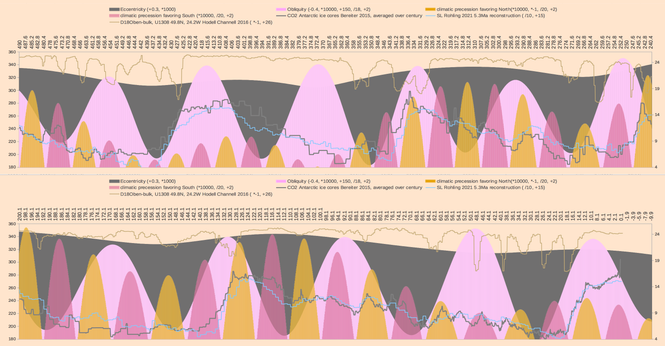
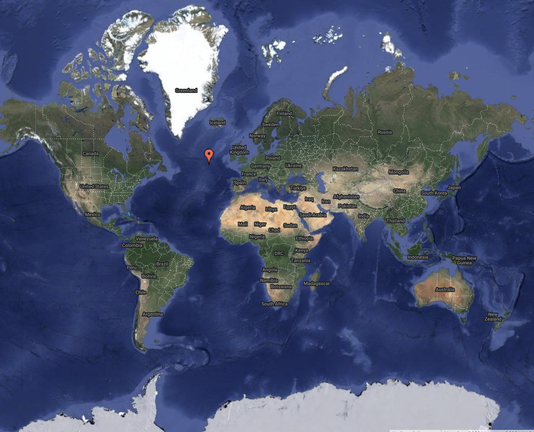
My girlie chart with 490ky years of #Milankovic cycles, CO2, sea level, and the top line is d18O of a sediment core from within the #ColdBlob, see map. I think, it records AMOC shutdowns in the past.

Would be intriguing to know why it shut down. Eg, 427ka, "just" before the interglacial MIS11.
And why it not shut down during that very long interglacial which was ~as warm as the Holocene,
and had an ice-free West #Greenland (with a leaf found just 2 years ago at rock-bottom of an ice core from there),

and why AMOC instead collapsed in the middle of the following #iceage.

The very long interglacial MIS11 with its ice-free West Greenland and stable AMOC throughout tells me that the amount of freshwater input from melting ice on its own isn't the trigger for a collapse. But instead, the speed at which freshwater is added: very slowly like during #MIS11 won't do it.

Also intriguing: why the stuttering motor during the last glacial before the #Holocene?

#d18O from sediment cores at other locations strictly follow the ups and downs of #sealevel and #CO2. This one site #IODP #U1308 is exceptional.
#paleoclimate #AMOC

Weird. Maybe, I've got a logical mistake in my thinking

Will #Steffen et al 2018 https://www.pnas.org/doi/10.1073/pnas.1810141115 warned in "Trajectories of the Earth System in the Anthropocene" of a "Hot House Earth" .
A term that got negative press all over and the paper is still discredited in public opinion among the non-scientific community, at least.
A Hot House Age is merely the term for an ice-less age in which the poles are not covered by kilometres of ice. That is called an Ice House Age.

#Talento et al 2021 https://esd.copernicus.org/articles/12/1275/2021/ modelled what happens to ice ages #glacial |s in several emission scenarios.
Today's CO2 concentration is already moving the next #iceage to later than what the #Milankovic cycles would dictate.
Scenarios for (in my opinion fictitious, unachievable) emissions of 1000 or 3000 Pg C move the next fullblown ice age to 600ky and 900ky from now.
Almost a million years. No ice age.

But the #AMOC is going to collapse: the convection in the Subpolar Gyre in the 2030s; the Northern branch of AMOC might tip before 2050 to later inevitably collapse, too.

Certainly that increases ice mass in Greenland, Europe, and Eurasia, and Arctic Sea Ice grows back, too. And all this AMOC-related ice grows and grows, each year puts more snow on the ever increasing ice layer.
I don't know how much ice is needed to meet criteria for a glacial definition.
But all that Eurasian ice also buries the boreal forests under it, ie removes their carbon from the cycle. And puts an ice plug on leaking methane from #permafrost in that area. (Tho not the permafrost in the far East. I gather, that area is not prone to ice sheets from Atlantic influences and needs other triggers to form? It wasn't covered by ice in #MIS11, 420ky ago. )

Weird isn't it, that ice mass models like Talento's don't factor in ever-increasing ice mass in low-to medium emission scenarios. Hm.

We need to save the coal. It's a good thing to reduce the carbon dioxide load in the atmosphere to limit global warming, but there is a far more important reason to reduce the use of fossil fuels. We need to save them. Check my post to see why.

#coal #ClimateChange #GreenhouseEffect #FossilFuels #Milankovic

https://greencomet.org/2023/06/28/save-the-coal/

Save The Coal

It is good that we are reducing coal-burning. It is important that we don’t waste it because we are going to need it. Of course, there’s the point of reducing the amount of carbon dioxi…

Green Comet

Finally the orbit stretches during 100 000 years

#Milankovic #earth #Nasa

It tilts in a 41000 year cycle

#Milankovic #earth #Nasa

It wobbles over 26000 years

#Milankovic #earth #Nasa

I use this chart as template for when I want to see a particular proxy for #paleoclimate in the bigger context of Earth's #climate factors. Because I add many and varying #proxy records to this template, they need to fit either y-axes. So all records get re-scaled. The individual formula is given in brackets () in the legend, eg., (*10000, /20, +2).
The x-axis is kiloyear ky before present BP (BP is 1950), data resolution is in centuries.

The background of the chart is always the #Milankovic cycles: #Eccentricity as black area, #obliquity / tilt in pink and climatic #precession favoring North in gold and favoring South in darker rosé.
Standard curves are CO2 (gray), CH4 (dark magenta), and sealevel (light blue). CO2 and CH4 are at home on the left y-axis, by the way. Virtually all other proxies end up to be at home on the right hand y-axis.

When I add a proxy from the Southern hemisphere, I usually choose a red-ish colour, and gold-ish for proxies from the NH. Exception to the rule is the tropical South American glacier index "TEG" in white.

Sources for the standard items in this chart are:
- #Milankovic cycles from Laskar 2004 / 2010 http://vo.imcce.fr/insola/earth/online/earth/online/index.php
- #SeaLevel (light blue) from Miller 2020 https://www.science.org/doi/full/10.1126/sciadv.aaz1346
- #CH4 #methane (dark magenta) from Loulergue 2008 https://www.ncei.noaa.gov/access/paleo-search/study/6093
- #CO2 (gray) from M. Yamamoto 2020 https://www.ncei.noaa.gov/access/paleo-search/study/34052

Non-standard proxies in this version for the #tegtmeier thread on modern humans :
- #d18O (magenta) for sea surface temperature in the South Atlantic from Starr 2020 (published January 2021) https://www.nature.com/articles/s41586-020-03094-7
- #Glacier index TEG (white) from Rodbell 2020 https://www.nature.com/articles/s41586-022-04873-0
- ºC in subtropical Africa from Chevalier 2021 https://pubs.geoscienceworld.org/gsa/geology/article/49/1/71/590736/Temperature-change-in-subtropical-southeastern

I use #LibreOffice #Calc.

#TegtmeierBasics

Computation of various insolation quantities for Earth

The absence of solidarity in Western, US-dominated cultures / societies will be the cause for their quick and violent collapse before 2040.
Once our Order NOW button no longer works, our "traditional knowledge of the environment and food options", ie knowing timetables of commuter trains and location of supermarkets and car parks has 0 chance to be updated as quickly as then necessary for adaptation.

OTOH, cultures which still know how to make do with less, including MAPA, then have a good chance to continue and maybe, to even build on knowledge of our civilisation – because all fossil fuel use ceases then and the warming in the pipeline after true-zero by 2040 is negligible.

Emissions from dried wetlands and thawing permafrost will cause +0.2ºC per century, I reckon. That's slow enough for adaption by human organisation and the biosphere.
Also continued cooling from Earth's orbital factors #Milankovic also helps.