Oh wow, another philosopher valiantly defending the sacred "intuitions" 🙄, because who doesn't love a good game of mental gymnastics? 🤹‍♂️ But fear not, this article promises to delve into the riveting world of #metaphilosophy, for when you're just *dying* to ponder the unknowable with the help of vague gut feelings! 😂
https://hilariusbookbinder.substack.com/p/a-defense-of-philosophical-intuitions #philosophy #mentalgymnastics #intuition #humor #HackerNews #ngated
A defense of philosophical intuitions

Be ye not afraid

Scriptorium Philosophia

We’ve never lived on granite foundations. What we call “objectivity” in social and moral life is scaffolding: provisional, rhetorical, maintained through care, reciprocity, and revolt.

In my new essay, I map an operating model for reasoning without granite illusions — and argue for an ethic of repair.

Read the full post:
👉 https://philosophics.blog/2025/09/24/stop-pretending-we-live-in-marble-halls/

#Philosophy #Ethics #MetaEthics #PhilosophyOfScience #Epistemology #MetaPhilosophy #SocialEpistemology #CriticalTheory #Subjectivism #Relativism

Pills often feature in thought experiments to eliminate the difficulty of one of the response options. Example: It's hard to [X] in reality, but suppose you could [X] by taking a pill. Would you take the pill?

I got curious about whether people find it so easy to take pills. Apparently not.

In this meta-analysis, #medication non-adeherence was more than 40%: https://doi.org/10.1136/bmjopen-2020-044987

#philosophy #metaphilosophy #experimentalPhilosophy #health

Prevalence and predictors of medication non-adherence among people living with multimorbidity: a systematic review and meta-analysis

Objectives This systematic review aimed to describe medication non-adherence among people living with multimorbidity according to the current literature, and synthesise predictors of non-adherence in this population. Methods A systematic review was conducted according to the Preferred Reporting Items for Systematic reviews and Meta-Analyses. PubMed, EMBASE, CINAHL and PsycINFO were searched for relevant articles published in English language between January 2009 and April 2019. Quantitative studies reporting medication non-adherence and/or predictors of non-adherence among people with two or more chronic conditions were included in the review. A meta-analysis was conducted with a subgroup of studies that used an inclusive definition of multimorbidity to recruit participants, rather than seeking people with specific conditions. Remaining studies reporting prevalence and predictors of non-adherence were narratively synthesised. Results The database search produced 10 998 records and a further 75 were identified through other sources. Following full-text screening, 178 studies were included in the review. The range of reported non-adherence differed by measurement method, at 76.5% for self-report, 69.4% for pharmacy data, and 44.1% for electronic monitoring. A meta-analysis was conducted with eight studies ( n =8949) that used an inclusive definition of multimorbidity to recruit participants. The pooled prevalence of non-adherence was 42.6% (95% CI: 34.0 - 51.3%, k =8, I 2=97%, p <0.01). The overall range of non-adherence was 7.0%–83.5%. Frequently reported correlates of non-adherence included previous non-adherence and treatment-related beliefs. Conclusions The review identified a heterogeneous literature in terms of conditions studied, and definitions and measures of non-adherence used. Results suggest that future attempts to improve adherence among people with multimorbidity should determine for which conditions individuals require most support. The variable levels of medication non-adherence highlight the need for more attention to be paid by healthcare providers to the impact of multimorbidity on chronic disease self-management. PROSPERO registration number CRD42019133849. Data are available in a public, open access repository. All data relevant to the study are included in the article or uploaded as supplementary information. All data relevant to the study are included in the article, uploaded as supplementary information or deposited on Open Science Framework: <https://osf.io/nym7v/>. Data are available under the terms of the Creative Commons Zero “No rights reserved” data waiver (CC0 1.0 Public domain dedication). Our systematic review produced a large amount of information and the arising database is available for future collaboration on additional analyses. Please contact the corresponding author with any inquiries.

BMJ Open

More successful predictions of my #BoundedReflectivism & #EpistemicIdentity article from 2022?

From about 2017 or 2018, I reviewed evidence suggesting that reflective thinking often helps, but may even hinder our judgment depending on factors like whether we are reasoning based on shared identities and epistemic standards (https://doi.org/10.1111/meta.12534).

Years later Robb Willer et al. solicited ideas for debiasing political judgments. After years of testing 25 different interventions, their results are published in #Science: https://doi.org/10.1126/science.adh4764

They found that biased evaluations of politicized facts were impacted by both
- REFLECTION (on potential misperceptions of undemocratic actions) and
- shared IDENTITY cues (which could help *or* hinder!)

#decisionScience #politics #psychology #philosophy #epistemology #metaphilosophy #JDM #debiasing #chatBot

🚨 Free book alert! (ePub and PDF!)

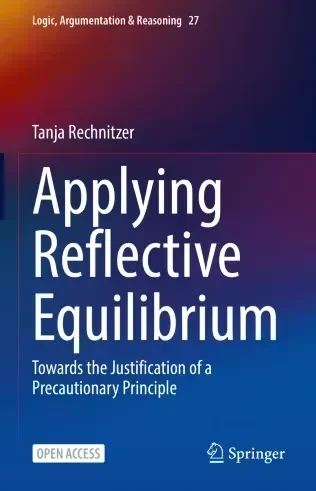
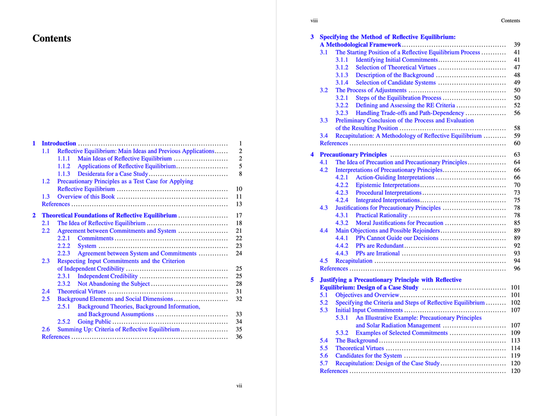
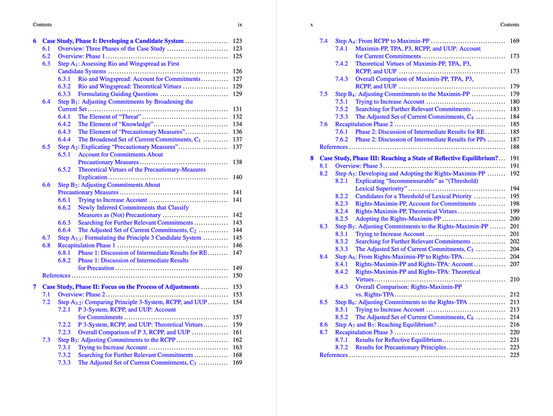
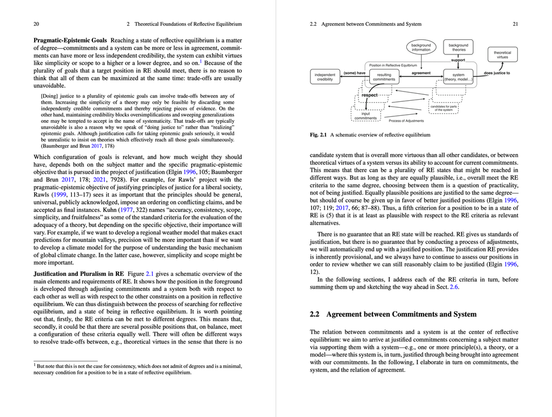
*Applying Reflective Equilibrium* shows each step of #reflectiveEquilibrium (RE), so anyone can use it.

This reveals the limits of reflective equilibrium, but also its real benefits.

Where to find it: https://doi.org/10.1007/978-3-031-04333-8

#CriticalThinking #Logic #Ethics #Bioethics #Politics #Science #Medicine #Epistemology #Metaphilosophy #PhilosophyOfScience #PrecautionaryPrinciple #Philosophy #OpenAccess

Applying Reflective Equilibrium

This open access book provides the first explicit case study for an application of the method of reflective equilibrium (RE), using it to develop.

SpringerLink

New book: Experimental Philosophy for Beginners

The book includes chapters on various experimental designs and analyses of various kinds of data (from numeric scores to text analysis): https://doi.org/10.1007/978-3-031-58049-9

Seems like a great foundation for a course on the topic or for self-learners to get their feet wet.

#xPhi #philosophy #psychology #quantiativeMethods #decisionScience #philosophyOfScience #Metaphilosophy #higherEd

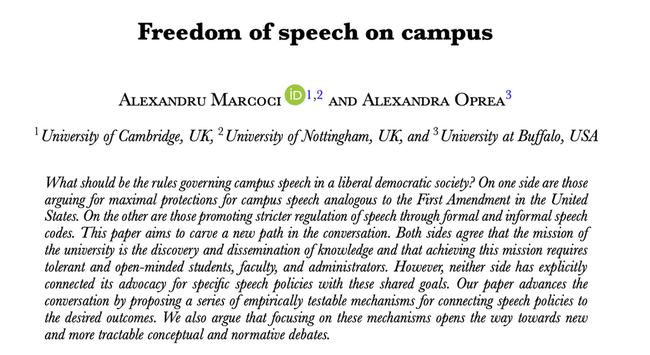
How should #higherEd govern #freeSpeech?

A new (and free) paper in Philosophical Quarterly argues that the parties to this debate haven't sufficiently based their proposals on (a) the goals of #education or (b) scientific tests of their assumed mechanisms: https://doi.org/10.1093/pq/pqae095

#edu #policy #ethics #politics #logic #science #philosophyOfScience #metaphilosophy

Freedom of speech on campus

Abstract. What should be the rules governing campus speech in a liberal democratic society? On one side are those arguing for maximal protections for campu

OUP Academic

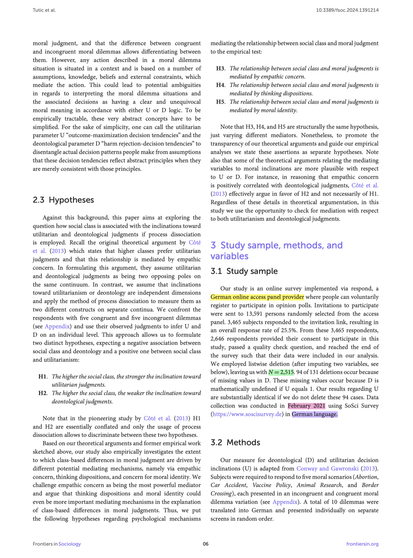
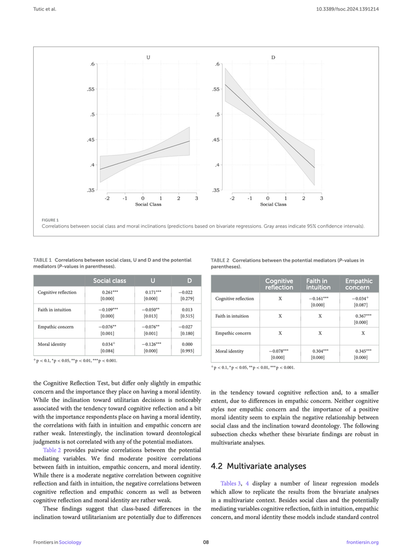
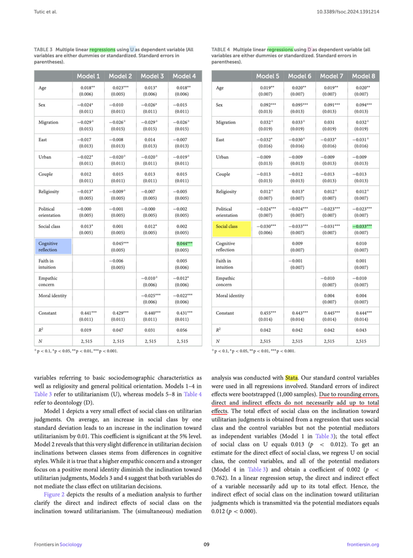
Are there social class differences in moral decision-making?

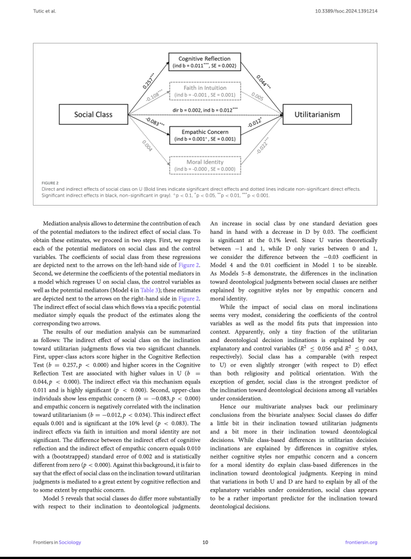
When dissociating anti-social from deontological and utilitarian responses to moral dilemmas, social class predicted differences in the latter two response patterns among thousands of German speakers — the class differences in utilitarian thinking were partially mediated by reflection and empathic concern.

https://doi.org/10.3389/fsoc.2024.1391214

#ethics #psychology #MoralPsychology #xPhi #philosophy #Demography #Metaphilosophy

Social class and moral judgment: a process dissociation perspective

Do social classes differ in moral judgment? Previous research showed that upper-class actors have a greater inclination toward utilitarian judgments than lower-class actors and that this relationship is mediated by empathic concern. In this paper, we take a closer look at class-based differences in moral judgment and use the psychometric technique of process dissociation to measure utilitarian and deontological decision inclinations as independent and orthogonal concepts. We find that upper-class actors do indeed have a greater inclination toward decisions consistent with utilitarian principles, albeit only to a quite small extent. Class-related differences are more pronounced with respect to deontological judgments, in so far as upper-class actors are less inclined to judgments consistent with deontological principles than lower-class actors. In addition, it is shown that class-based differences in utilitarian judgments are mediated by cognitive styles and not so much by empathic concern or moral identity. None of these potential mediators explains class-based differences in the inclination toward deontological judgments.

Frontiers

I find that this assumption of the intelligibility of nature, especially to a specific species of ape, is also very common, or even more common, in philosophy, where intuitions are often seen as a sort of evidence. Same for the tendency to simplify issues so as to fit specific standards of how a philosophy talk/paper must look like.

Link to the book (OA): https://mitpress.mit.edu/9780262548045/the-brain-abstracted/

#philsci #metaphilosophy

The Brain Abstracted

An exciting, new framework for interpreting the philosophical significance of neuroscience.All science needs to simplify, but when the object of research is ...

MIT Press

By Mary Midgley

https://ravenmagazine.org/magazine/rings-books/

> ... an account of human knowledge which women’s whole experience falsifies is inadequate and partial and capricious. Philosophers have generally talked for instance as though it were obvious that one consciousness went to one body, as though each person were a closed system which could only signal to another by external behaviour, and that behaviour had to be interpreted from previous experience.

[1/2]

#metaphilosophy #feministPhilosophy

Rings & Books

Practically all the great European philosophers have been bachelors. In case you doubt that, here are some figures. Unmarried: Plato, Plotinus, Bacon, Descartes, Spinoza, Leibniz, Hobbes, Locke…

The Raven Magazine