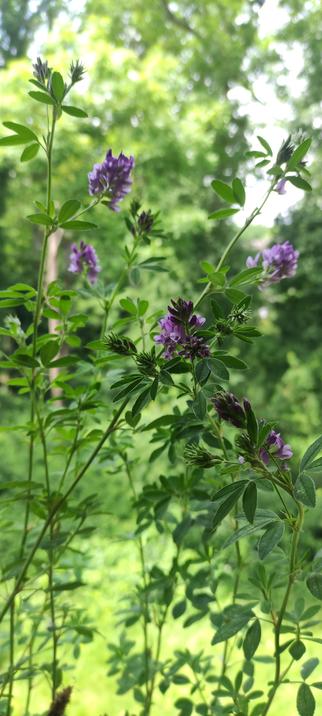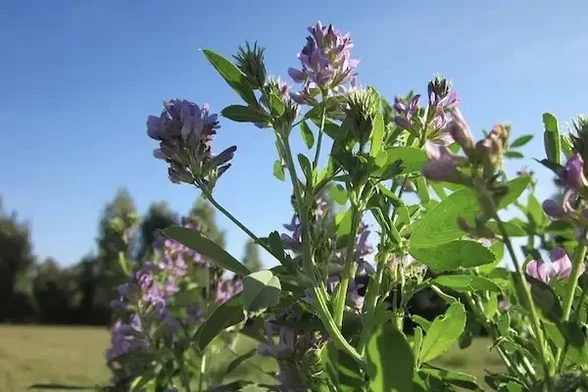
#Sicklealfalfa #Medicago sativa L.subsp. #falcata is considered a #subspecies of lucerne, but is sometimes also seen as own #species of the M. sativa-#complex. It is native to #Eurasia and prefers deep, lime-rich #soils, here on Mount #Teufelsberg #Berlin with #Chorthippus cf.#mollis. K. Kaljund & V. Jaaska (2010) found a high genetic #diversity even in smaller #isolatedpopulations due to plant's biology, i.a.#autotetraploidy.

©#StefanFWirth 2025

Ref
https://doi.org/10.1016/j.bse.2010.05.007

Photos
©S.F.Wirth

Update 21.08. I guess and hope that it is Alfalfa (Medicago sativa) and not a Bastard Alfalfa. Medicago sativa is a perennial legume with purple flower clusters and trifoliate leaves, widely grown as a high-protein forage and soil-improving cover crop; it fixes nitrogen, supports pollinators, has deep roots that enhance soil health, and is also used as sprouts or herbal remedies, though with some caution.

#violetflower #flowers #flower #meadow #green #medicago #medicagosativa #alfalfa #luzerne

🌱 luzerne cultivée, élégante légumineuse aux grappes florales d’un mauve délicat. Ses tiges fines se dressent vers la lumière, ses feuilles trifoliées vibrent sous le vent, et ses fleurs en spirales attirent discrètement les butineurs 🐝 🦋
💜 Plante rustique et nourricière, elle soigne les sols… et parfois les esprits

#botanique #fleuristonfil #plantesauvages #luzerne #nature #herbiervivant #medicago #poésieverte #green #violet #purple #flowers #photo #photography #naturelovers

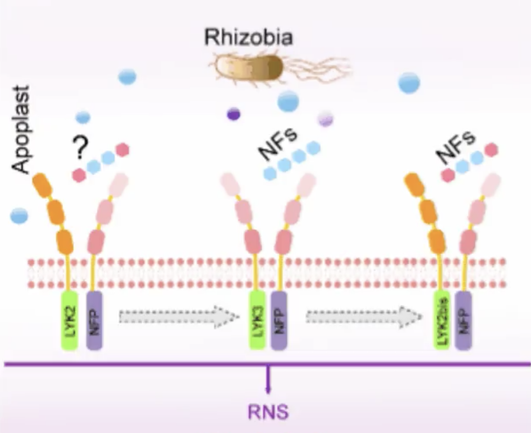
The formation of #root nodules is a fascinating example of organism #symbiosis. Li et al. explore built-in redundancies in the mechanism of #nodulation in #Medicago. Read all about it in a new #JIPB Brief Comms feature. Access is free!
https://doi.org/10.1111/jipb.13718
@wileyplantsci
#PlantSci #botany
An inside look at how plants and mycorrhizal fungi cooperate

For millions of years, underground fungi have lived in symbiosis with plant roots. Plants provide photosynthesized carbon, while fungi deliver water and nutrients. In order to do so, these organisms share space at the cellular scale: fungi stretch a network of tendrils called arbuscules into a plant's root cells, and both organisms rearrange their cells around this structure to facilitate sharing.

Phys.org
Word Search Puzzle 901

Word List : #esterlin #slaps #lazy #farmhand #daunted #medicago #anasazi #pinoleum #tsarinas #copart #redispel #upgrader #connies #stetch #racecard #furazane #lochagus #erecter

Kara Finance
Researchers find promising locus for molecular design breeding in legumes

In cereal and legume crops, the size of the plant organs, particularly seeds, is closely related to final yield. However, the molecular mechanisms underlying organ size control in legumes are still poorly understood.

Phys.org
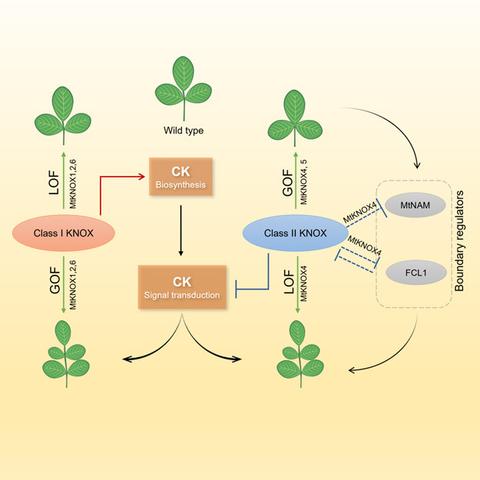
#Leaf shape is a complex #developmental process involving coordination of #genetic factors, #hormones, and other signals. Here, Wang et al. explore the functions of #KNOXII genes in #Medicago truncatula. https://doi.org/10.1111/jipb.13549
@wileyplantsci
#JIPB #PlantScience #plants #botany

Uncovering the Mysteries of Alfalfa Seed Dormancy Through Multispectral Imaging Analysis

Alfalfa (Medicago sativa) is a legume grown in many parts of the world as animal fodder. It is prized in the forage industry for its high protein content and biomass yield. Furthermore, it is seen as an environmentally beneficial crop, with positive impacts on biodiversity and soil nitrogen conservation.

https://globalplantcouncil.org/uncovering-the-mysteries-of-alfalfa-seed-dormancy-through-multispectral-imaging-analysis/ #agriculture #plantscience #science #alfalfa #medicago

Uncovering the Mysteries of Alfalfa Seed Dormancy Through Multispectral Imaging Analysis - The Global Plant Council

Alfalfa (Medicago sativa) is a legume grown in many parts of the world as a source of animal fodder. It is prized in the forage industry for its high protein content and biomass yield. Recently, alfalfa protein has found applications in aquaculture, pet food industry and human diet. Furthermore, it is seen as an environmentally beneficial crop, with positive impacts on biodiversity and soil nitrogen conservation.

The Global Plant Council