 damian entwistle
静夜思
床前明月光,
疑是地上霜。
举头望明月,
低头思故乡。
Thoughts in the Silent Night
- by Li Bai
Moonlight reflects off the front of my bed.
Could it actually be the frost on the ground?
I look up to view the bright moon,
And look down to reminisce about my hometown.
静夜思
床前明月光,
疑是地上霜。
举头望明月,
低头思故乡。
Thoughts in the Silent Night
- by Li Bai
Moonlight reflects off the front of my bed.
Could it actually be the frost on the ground?
I look up to view the bright moon,
And look down to reminisce about my hometown.
Wolf Moon
This afternoon the Wolf Moon rose over the tall trees behind the garden, butter-yellow and gleaming in the late daylight, seeming far brighter than the setting sun. Somehow it tugged at our hearts to see it there in the clear air, appearing to hang above the feathery treetops like a memory from another time.
There seems to be something atavistic in our being human that responds to “signs in the sky” – the moon especially – from some pre-scientific place we’ve long since forgotten to be consciously aware of. Wolves have been absent from England since around 1390, and yet the very phrase “Wolf Moon” resonates with some ancient yearning in us. The cold air itself seems to long for something lost.
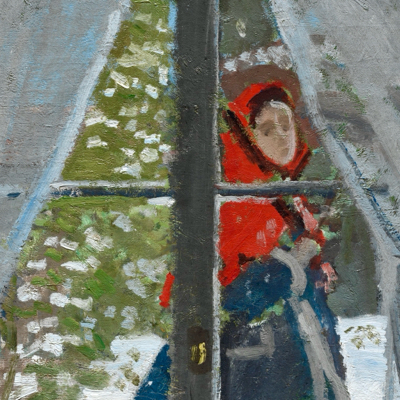
To sit still by the window in the moonlight is one of the loveliest things at this time of year. In the 8th century CE the Chinese poet Li Bai wrote:
At the foot of my bed, moonlight
Yes, I suppose there is frost on the ground.
Lifting my head I gaze at the bright moon
Bowing my head, thinking of home.
We were already home, watching the moon rise; and yet something of Li Bai’s nostalgia touches me in moonlight. What is it I am longing for? Ah, but it is a sweet longing, though. I don’t expect something to fulfil it. I am at peace in the moonlight. I don’t want anything, and yet. And yet in the New Year’s rising away from the solstice there is a yearning, even when there is no moon. Perhaps as I said there is something in our merely being human that carries with it wordless memories from times we cannot remember, far back before people built cities or wrote history.
Somehow our practice, and whatever philosophy we derive from it, has to leave room for these times of strange resonance. Dear old Li Bai, the poet and traveller of the Tang dynasty, evidently knew all about this.
#acceptance #contemplative #LiBai #longing #poems #reading #simplicity
The River-Merchant’s Wife: A Letter By Li Bai (Li Po), translated by Ezra Pound (1915)
Some poems arrive like a sudden tide — they rise in your heart before you even understand why. The River-Merchant’s Wife: A Letter, written by Li Bai in the 8th century and translated by Ezra Pound in 1915, came to me that way.
When I read it for the first time, something inside me stilled. I felt an ache that was both personal and universal — the kind of longing that crosses centuries and continents, binding us to someone who lived long ago and yet seems to be speaking directly to us. By the time I reached the final lines, I wanted to cry.
The River-Merchant’s Wife: A Letter
By Li Bai (Li Po), translated by Ezra Pound (1915)
While my hair was still cut straight across my forehead
I played about the front gate, pulling flowers.
You came by on bamboo stilts, playing horse,
You walked about my seat, playing with blue plums.
And we went on living in the village of Chōkan:
Two small people, without dislike or suspicion.
At fourteen I married My Lord you.
I never laughed, being bashful.
Lowering my head, I looked at the wall.
Called to, a thousand times, I never looked back.
At fifteen I stopped scowling,
I desired my dust to be mingled with yours
Forever and forever and forever.
Why should I climb the look out?
At sixteen you departed,
You went into far Ku-tō-yen, by the river of swirling eddies,
And you have been gone five months.
The monkeys make sorrowful noise overhead.
You dragged your feet when you went out.
By the gate now, the moss is grown, the different mosses,
Too deep to clear them away!
The leaves fall early this autumn, in wind.
The paired butterflies are already yellow with August
Over the grass in the West garden;
They hurt me. I grow older.
If you are coming down through the narrows of the river Kiang,
Please let me know beforehand,
And I will come out to meet you
As far as Chō-fū-Sa.
In just a few stanzas, we witness an entire life unfold. The young wife begins in childhood, pulling flowers by the gate while her future husband plays nearby. She remembers the shy awkwardness of marriage, eyes lowered, uncertain. Then love deepens until it becomes a vow of permanence — “I desired my dust to be mingled with yours… forever.” And then comes absence: the months apart, the quiet changes in her surroundings, the way even yellow butterflies wound her because they remind her of what she is missing.
Ezra Pound’s translation preserves not only Li Bai’s imagery but also the emotional heartbeat of the original. His free verse is plain, unadorned, yet every detail feels weighted with meaning: the moss grown too deep to clear away, the sound of monkeys overhead, the paired butterflies drifting through August air.
What moves me most is the steadfastness of the wife’s love. She doesn’t simply miss her husband — she carries him with her, shaping her days and her memories around his absence. In the end, she reaches outward: “If you are coming down through the narrows of the river Kiang, please let me know beforehand, and I will come out to meet you as far as Chō-fū-Sa.” It is not only a plea; it is an offering, a willingness to bridge the distance between them.
This is why the poem still feels alive today. It is not about an 8th-century river merchant and his wife alone. It is about how love endures across absence, how memory keeps someone present even when they are far away, and how longing itself becomes a form of devotion.
My Takeaway
Reading this poem reminded me that connection is not always about proximity. Sometimes the truest form of love is the willingness to hold another person in your heart, trusting that the bond will endure until you meet again. And in that waiting, there is beauty as well as ache.
Until the next page turns,
Rebecca
Genre Note
This poem belongs to the tradition of “classical Chinese lyric poetry”, written by Li Bai (701–762), one of the great voices of the Tang Dynasty. It is also an ”epistolary poem”, written in the form of a letter from a wife to her absent husband. When Ezra Pound translated it in 1915, he shaped it into “modernist free verse”, blending the intimacy of Li Bai’s original with the clarity and immediacy of early modernist style. Thus, the poem lives at the crossroads of traditions: classical, lyrical, epistolary, and modernist.
#EzraPound #LiBai #LiPo #ModernestPoetry #Poetry #PoetryInTheAfternoon #PoetryInTheEvening #PoetrySalon #TheRiverMerchantSWifeALetter

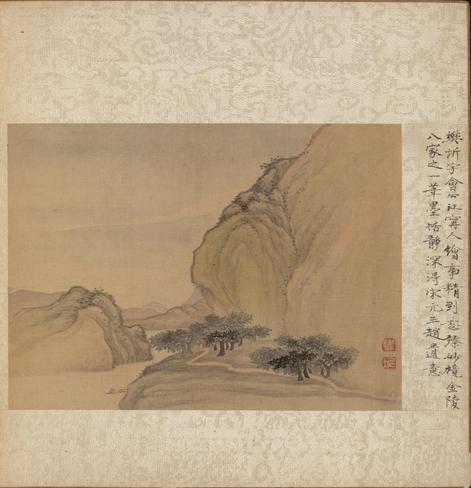
Fan Qi's exquisite painting captures the essence of a serene journey through nature, echoing Li Bai’s poetic imagery. The delicate brushwork and muted tones invite reflection. What does this harmonious landscape inspire within you?
#ClevelandArt #ChineseArt #LiBai
https://clevelandart.org/art/1975.22.1
Today's poem:
Thoughts in the Silent Night
- by Li Bai
李白《静夜思》
床前明月光,
疑是地上霜。
举头望明月,
低头思故乡。
Thoughts in the silent night
Beside my bed a pool of light -
Is it hoarfrost on the ground?
I lift my eyes and see the moon,
I bend my head and think of home.
You ask why I stay in the mountains
I smile without speaking, my heart content
Peach blossoms in the stream float into the distance
There’s another realm beyond the world of people.
-Li Pai (701–762)
From #DailyZen : https://www.dailyzen.com/quotes/peach-blossoms-in-the-stream/
Li Bai: "Schodząc we śnie z Tianmu"
Marynarze rozprawiają o Yingzhou,
których mgły i fale widok skrywają.
Ludzie Yue mówią o górze Tianmu,
która pojawia się i znika wśród chmur.
https://wp.me/p3fv0T-gnb #poezja #Tang #wiersze #Chiny #唐詩三百首 #300wierszyTang #kultura #klasyka #李白 #LiBai #Tianmu #sen #夢遊天姥吟留別
Today's poem:
Songs to the Peonies Sung to the Air: “Peaceful Brightness”
- by Li Bai
 An Open Ground
 Rebecca's Reading Room
 Hidden Gems
 AmiW Streetart ❄️
 Annelous Stiggelbout
 Carson Hill
 Michal Bogusz