@MonniauxD @deevybee maybe there's 4 levels: (1) fully using/demanding #impactfactors IFs, (2) token @DORAssessment signing, (3) not using IFs officially (4), fully changed the assessment culture/thinking in the institutional community. Some UK institutions are at level 3 at least. E.g. Imperial College: https://sfdora.org/institutions/imperial-college-london/
Imperial College London | DORA

DORA

Really great to see the continued growth at Rogue Scholar ( @rogue_scholar )

@StephenCurry 's blog "Reciprocal Space" is now part of the Rogue Scholar community too.

Which means among other things, the super famous "Sick of Impact Factors" blog post now has its own DOI: 10.59350/xqrv5-7bv94

#ResearchBlogging #ImpactFactors

https://blog.front-matter.io/posts/joining-rogue-scholar-december-2024/

Blogs joining Rogue Scholar in December 2024

December has seen good growth in the number of blogs participating in the Rogue Scholar science blog archive, with 10 blogs joining in the last three weeks. Here you can find all Rogue Scholar blogs, sorted by join date, and the December 2024 additions are listed below. The newly participating

Front Matter

20 years of bibliometric data illustrates a lack of concordance between journal impact factor and fungal species discovery in systematic mycology

"...journals with low, and even no, impact factor to account for substantial parts of the species hypothesis landscape, often discovering new fungal taxa that are only later picked up by journals with high impact factors"

https://doi.org/10.3897/mycokeys.110.136048

#mycology #taxonomy #ImpactFactors #fungi #systematics

20 years of bibliometric data illustrates a lack of concordance between journal impact factor and fungal species discovery in systematic mycology

Journal impact factors were devised to qualify and compare university library holdings but are frequently repurposed for use in ranking applications, research papers, and even individual applicants in mycology and beyond. The widely held assumption that mycological studies published in journals with high impact factors add more to systematic mycology than studies published in journals without high impact factors nevertheless lacks evidential underpinning. The present study uses the species hypothesis system of the UNITE database for molecular identification of fungi and other eukaryotes to trace the publication history and impact factor of sequences uncovering new fungal species hypotheses. The data show that journal impact factors are poor predictors of discovery potential in systematic mycology. There is no clear relationship between journal impact factor and the discovery of new species hypotheses for the years 2000–2021. On the contrary, we found journals with low, and even no, impact factor to account for substantial parts of the species hypothesis landscape, often discovering new fungal taxa that are only later picked up by journals with high impact factors. Funding agencies and hiring committees that insist on upholding journal impact factors as a central funding and recruitment criterion in systematic mycology should consider using indicators such as research quality, productivity, outreach activities, review services for scientific journals, and teaching ability directly rather than using publication in high impact factor journals as a proxy for these indicators.

MycoKeys

#Journal | #EDPSciences

📈 2024 Impact Factors & CiteScores showcase growth!
Key highlights:
EPJ Photovoltaics (IF: 1.9)
OCL (CiteScore: 4.7)
Radioprotection (IF up 27% to 1.4)
Astronomy & Astrophysics (IF: 5.4)
Acta Acustica ranks 12th in Music on Scopus
Read More🔗 https://www.edpsciences.org/en/news-highlights/2985-edp-sciences-journal-impact-factors-and-citescores-reflect-growth-in-key-and-emerging-disciplines

#ImpactFactors
#Photovoltaics
#RenewableEnergy
#Radioprotection
#Astronomy
#Astrophysics
#MusicResearch
#Acoustics
#ScienceMastodon
@ScienceScholar @academicsunite
@academicchatter

EDP Sciences - EDP Sciences journal Impact Factors and CiteScores reflect growth in key and emerging disciplines

EDP Sciences Publishing partner of the scientific communities

2024 | EDP Sciences #journal #ImpactFactors and #CiteScores reflect growth in key and emerging disciplines 🎉

Key highlights:

EPJ Photovoltaics (IF: 1.9)
OCL (CiteScore: 4.7)
Radioprotection (IF up 27% to 1.4)
Astronomy & Astrophysics (IF: 5.4)
Acta Acustica ranks 12th in Music on Scopus

Read the full announcement
🔗https://www.edpsciences.org/en/news-highlights/2985-edp-sciences-journal-impact-factors-and-citescores-reflect-growth-in-key-and-emerging-disciplines

EDP Sciences - EDP Sciences journal Impact Factors and CiteScores reflect growth in key and emerging disciplines

EDP Sciences Publishing partner of the scientific communities

Letter in Science highlighting that „Although #fieldwork has been pivotal in scientific breakthroughs across disciplines, the constraints imposed by fieldwork are often incompatible with high publication rates, journal #ImpactFactors and citation counts, which are valued by hiring and tenure committees“. Call for attention to find ways to give this important research more due credit

https://www.science.org/doi/10.1126/science.ado6937

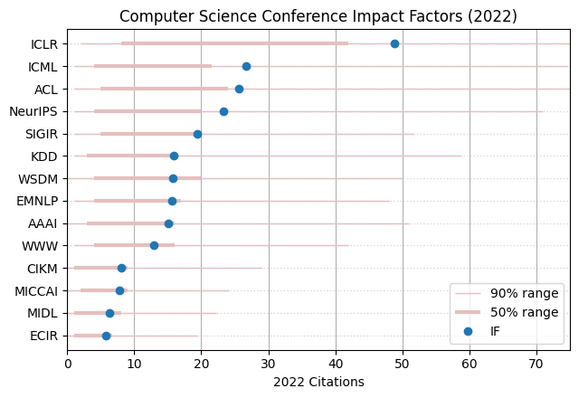
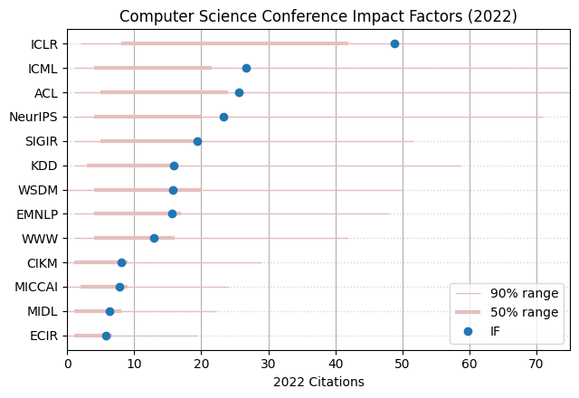
2022 Computer Science Conference Impact Factors

2022 Computer Science Conference Impact Factors

New journal #ImpactFactors are out. I know that it is highly disputed performance measure. It reflects rather whether authors produce papers that readers like and cite, than editorial foresight. That of NeoBiota increased to 5.1.

Still I am happy that our scientific community on #AlienSpecies (exotics, non-natives) value and trust our journal so much. Thank you to authors, reviewers, associate and special editors and the great production team at Pensoft Publishers.

https://neobiota.pensoft.net/

NeoBiota

NeoBiota is a peer-reviewed, open access, online journal launched to accelerate research on alien species and biological invasions: aquatic and terrestrial, animals, plants, fungi and micro-organisms. The journal is a continuation of the former NEOBIOTA publication series. NeoBiota publishes papers across all disciplines interested in biological invasions, specifically on the ecology, evolution and biogeography of non-indigenous aquatic and terrestrial animals, plants, fungi and micro-organisms, on mechanisms that drive the introduction, establishment and spread of these species, on ecological, evolutionary, economic and other consequences of biological invasions, and on the management of invasions in any part of the world. The journal also strongly encourages papers on ethical, social, legal and policy issues related to biological invasions.

NeoBiota
About - CoARA

CoARA