Let's settle the debate with actual data: Women's voices register as louder and sharper than men's voices.

If you look closely at the science, it is a perfect cross section of physics, anatomy, and neurology.

1. The Anatomy and Vocal Cord Physics: On average, a woman’s vocal cords are shorter and thinner, measuring around 12 to 17 mm, while a man’s measure 17 to 25 mm. Because they have less mass, they vibrate much faster, roughly 200 times per second compared to a man's 120 times. This creates a significantly higher fundamental frequency and pitch.
2. The Acoustic Physics and Intensity: Higher frequencies possess shorter wavelengths. In a closed room or crowd, these shorter wavelengths do not bend or dissipate around objects easily. Instead, they pierce straight through background noise with crisp intensity.
3. The Neurological Proof and Ear Sensitivity: This is the ultimate kicker. The human ear canal is shaped like a natural acoustic amplifier tuned specifically to boost sounds between 2000 and 5000 Hz. Evolutionary biology designed our brains to be hypersensitive to this exact range so humans could hear a baby's cry or an alert from afar. A woman's vocal upper harmonics land right in this biological sweet spot.

So, it is not just a guess. Human biology and physics are literally hardwired to amplify a woman's voice over a man's.

#Science #Acoustics #HumanBiology #PhysicsOfSound #BrainScience #Fediverse #DeepDive #Facts

The Geometry of Noise: Sound Waves Distort Under Intensity

New research from May 20, 2026, explains how sound waves distort at high volumes. Learn why high-intensity noise changes the way we hear and process sound.

#scienceupdate, #acoustics, #soundwaves, #physicsnews, #hearinghealth

https://newsletter.tf/sound-waves-distort-above-160-decibels/

Scientists found that sound waves change shape when they are louder than 160 dB. This is different from the old theory that sound always stays the same.

#scienceupdate, #acoustics, #soundwaves, #physicsnews, #hearinghealth
https://newsletter.tf/sound-waves-distort-above-160-decibels/

New 2026 Study Shows Sound Waves Change Shape Above 160 Decibels

New research from May 20, 2026, explains how sound waves distort at high volumes. Learn why high-intensity noise changes the way we hear and process sound.

NewsletterTF

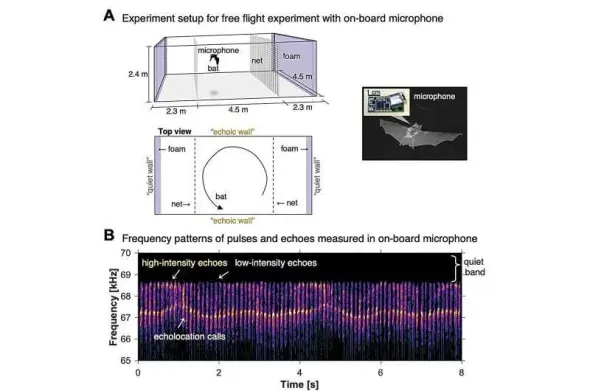
Bats Manipulate Acoustic Reality to Nullify Background Noise

Japanese horseshoe bats create silent frequency zones to hear prey better. Study shows how they filter noise for hunting.

#BatScience, #AnimalBehavior, #Acoustics, #DoshishaUniversity, #NatureStudy

https://newsletter.tf/bats-create-silent-zones-to-hear-bugs-better/

Japanese horseshoe bats can now create 'silent zones' to hear their prey better. This is a new way bats hunt in noisy places.

#BatScience, #AnimalBehavior, #Acoustics, #DoshishaUniversity, #NatureStudy
https://newsletter.tf/bats-create-silent-zones-to-hear-bugs-better/

Bats Create Silent Zones to Hear Bugs Better in Noise

Japanese horseshoe bats create silent frequency zones to hear prey better. Study shows how they filter noise for hunting.

NewsletterTF

The physics of how Olympic weightlifters exploit barbell’s “whip“

The type of bar matters when it comes to how it bends and recoils, but why is still a mystery.

Archive: ia: https://s.faithcollapsing.com/2axqr

#acoustics #physics #science #sports #sports-science
https://arstechnica.com/science/2026/05/the-physics-of-how-olympic-weightlifters-exploit-barbells-whip/

🏴‍☠️🎶 Psychologists explain that the steady beat of #sea shanties functioned as a biological metronome for sailors. The rhythmic coordination allowed groups to time their physical efforts while creating a shared experience that reduced #stress during difficult labor.

👉 https://www.popsci.com/science/sea-shanties-work-psychology/

#psychology #biology #music #history #science #neuroscience #sociology #anthropology #acoustics #research

Sea shanties actually help people work together better

Centuries-old work songs still possess real psychological benefits today.

Popular Science

Am 25.05.2026 plane ich eine Mischung aus Soundwalk und Vogelsitmmenführung gemeinsam mit der GERÄSCHKULISSE in Dresden.

Wer gerne dabei sein mag schreibt eine Mail an [email protected]

Ich freu mich.

https://www.geraeuschkulisse.org/de/events/geraeuschkulisse-soiree-6/

#soundwalk #birding #Dresden #sound #nature #listening #acoustics

Inside an Ear

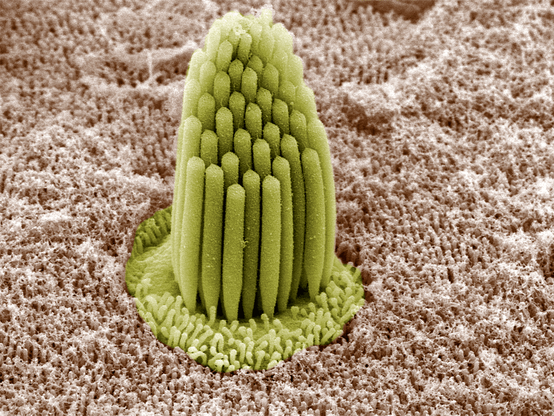
Our ears, like those of many other animals, convert mechanical signals to electrical ones, through a Rube-Goldberg-esque series of transformations. External sound waves make their way down the soft tube of the ear canal, which funnels them to a thin-walled cone, the eardrum, that’s about half as large as a dime. Here, the vibrating air pushes against the cone’s membrane, and those vibrations travel onward through a linked trio of small bones that amplify the vibration’s amplitude.

The last of these bones presses against an even smaller, oval-shaped membrane. As the bone moves, it shakes the membrane, sending waves through the liquid on its other side. Those waves travel down the spirals of the tiny, pea-sized cochlea, named for a snail shell’s shape. As the waves move through the liquid, they bend bundles of hair-like strands back and forth, like tall grass waving in a breeze. The bending triggers a chemical that binds to nerves at the base of the bundles, sending an electrical signal through the nerve and into the brain.

But the hair-like bundles, known as stereocilia, are also able to amplify incoming vibrations. In this case, the bundles in the outer portion of the cochlea expend energy to bend more than the incoming vibrations naturally make them move. This bending amplifies the fluid motion that gets transmitted to stereocilia further down the line; it’s those bundles that will make the final conversion to an electrical signal the brain receives. (Image credit: B. Kachar; research credit: Y. Thipmaungprom et al.; via APS)

Scanning electron microscope view of the stereocilia “hair bundles” inside a frog’s inner ear. #acoustics #biology #cilia #fluidDynamics #physics #science #vibration