Arctic Sea Ice Near Historic Low; Antarctic Ice Continues Decline - NASA

Arctic sea ice retreated to near-historic lows in the Northern Hemisphere this summer, likely melting to its minimum extent for the year on Sept.11, 2024,

NASA

Blog post on my thoughts attending the NASA Earth Sciences UW Hackweek in Seattle from 19-23 Aug 2024.

I wanted to capture some of the small moments during the Hackweek that really got me thinking about the current state of open science. There are also incredible stories behind technical achievements that I wish I could tell better. This is a little biased towards the ICESat-2 side, but hopefully the passion makes up for it.

https://weiji14.xyz/blog/engaging-in-the-2024-uw-hackweek

#BlogPost #OpenScience #ICESat-2 #HackWeek

Engaging in the 2024 UW Hackweek

I'll be presenting a tutorial on Machine Learning with ICESat-2 today, for classifying ATL07 sea ice data (point cloud) into different surface types (water/thin ice/thick ice). We'll learn to develop a data pipeline by using earthaccess/STAC to get coincident ICESat-2/Sentinel-2 data, process it into a GeoParquet format, and then train a Pytorch model on it!

Tutorial page is at https://icesat-2-2024.hackweek.io/tutorials/machine-learning/point_cloud_classifier.html

#PointCloud #SeaIce #MachineLearning #NASA #ICESat-2 #UW #HackWeek

Machine Learning with ICESat-2 data — ICESat-2 Hackweek 2024

JP Swinski presenting a tutorial on accessing ICESat-2 data using libraries like icepyx and sliderule. Also demo-ing how to use h5coro to directly read ICESat-2 granules from an s3 bucket.

Tutorial page at https://icesat-2-2024.hackweek.io/tutorials/data_access/ICESat2_Data_Access_Tutorial.html

#Python #icepyx #SlideRule #h5coro #NASA #ICESat-2 #UW #HackWeek

Accessing ICESat-2 Data — ICESat-2 Hackweek 2024

Mikala and Gail presenting their tutorial on Data Access, specifically SnowEx and ICESat-2 data, using earthaccess (A Python library for NASA Earthdata APIs).

Docs for the library is at https://earthaccess.readthedocs.io, and tutorial content is at https://snowex-2024.hackweek.io/tutorials/Data_access/index.html

#Python #earthaccess #NASA #SnowEx #ICESat-2 #UW #Hackweek

earthaccess

Client library for NASA Earthdata APIs

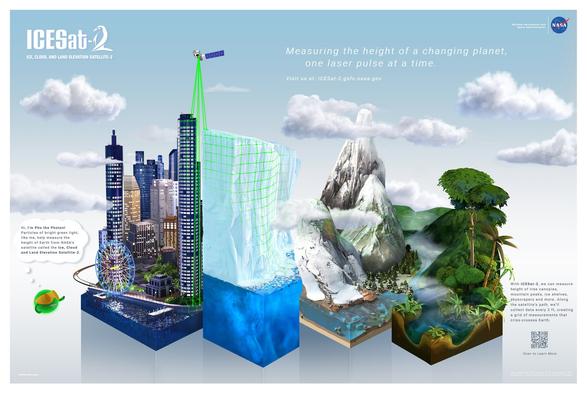
@tylersutterley up on the podium again to give the Ice, Cloud and land Elevation Satellite-2 (ICESat-2) Mission Overview talk!

Content page at https://icesat-2-2024.hackweek.io/tutorials/mission-overview/icesat-2-mission-overview.html (pdf slides are linked there).

#RemoteSensing #ICESat-2 #Altimeter #NASA #UW #HackWeek

ICESat-2 Mission Overview — ICESat-2 Hackweek 2024

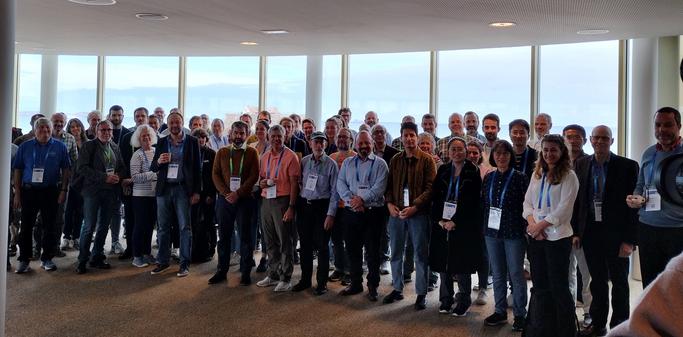
After 5 years of trying to attend the ICESat-2 Hackweek in-person, including 2 years of rejection, and 2 years of remote participation (because Covid + life), I've finally made it to Seattle this time for the 3-in-1 NASA Earth Sciences UW #Hackweek!!

Looking forward to seeing all the folks I've been interacting with on GitHub for years, and will try to live-toot as much as possible. I'll also be running an #ICESat-2 point cloud classification tutorial on Wednesday 🤗

https://2024.hackweek.io

NASA Earth Sciences & UW Hackweek

Tutorials + peer-to-peer learning + project based teamwork

🔚 Fin du #CALIPSO Symposium sur les lidars spatiaux ! Cet événement a mis en lumière la valeur des lidars spatiaux et leur synergie avec d'autres observations pour comprendre climat, météo et qualité de l'air. #ICESAT #AEOLUS #EarthCare 🚀
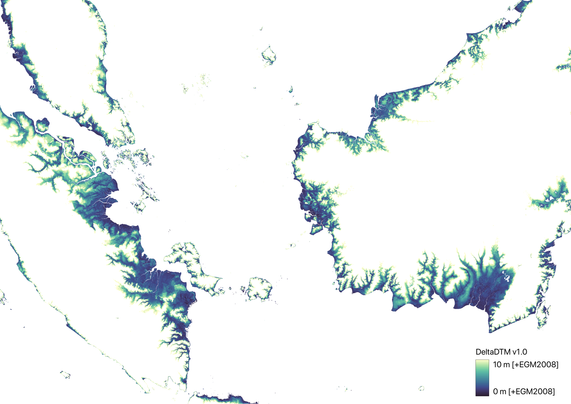
I am very happy to announce DeltaDTM, a cutting-edge global coastal Digital Terrain Model (DTM) made by @deltares which was just published in Nature Scientific Data https://www.nature.com/articles/s41597-024-03091-9. Other coastal elevation models are often based on older data, or commercial in nature. DeltaDTM is the most accurate thus far, and free for everyone (CC-BY licensed). This publication is the first paper of my PhD research on creating better global elevation models using #NASA #ICESat-2 and #GEDI data.
DeltaDTM: A global coastal digital terrain model - Scientific Data

Coastal elevation data are essential for a wide variety of applications, such as coastal management, flood modelling, and adaptation planning. Low-lying coastal areas (found below 10 m +Mean Sea Level (MSL)) are at risk of future extreme water levels, subsidence and changing extreme weather patterns. However, current freely available elevation datasets are not sufficiently accurate to model these risks. We present DeltaDTM, a global coastal Digital Terrain Model (DTM) available in the public domain, with a horizontal spatial resolution of 1 arcsecond (∼30 m) and a vertical mean absolute error (MAE) of 0.45 m overall. DeltaDTM corrects CopernicusDEM with spaceborne lidar from the ICESat-2 and GEDI missions. Specifically, we correct the elevation bias in CopernicusDEM, apply filters to remove non-terrain cells, and fill the gaps using interpolation. Notably, our classification approach produces more accurate results than regression methods recently used by others to correct DEMs, that achieve an overall MAE of 0.72 m at best. We conclude that DeltaDTM will be a valuable resource for coastal flood impact modelling and other applications.

Nature