A more pessimistic outlook, based on 2023 recalibrations... (From #Resiliency.org)

#LimitsToGrowth was right about collapse

By Andrew Curry, May 20, 2025

Excerpt: "Downhill from here

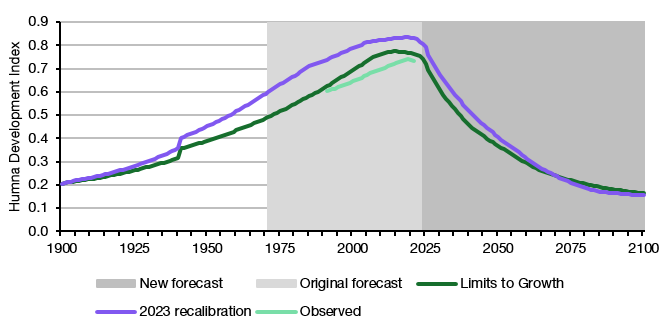
"The last chart assembles something from the data that wasn’t done in the original Limits to Growth work because the concept hadn’t been developed. But it is possible to assemble a #HumanDevelopmentIndex from the data, and reference it against the original model and the revised version. It doesn’t come out well.

(Source: Nebel et al, 2023, adapted Klement)

"On this last chart, Klement is most depressed, and I think with good reason:

" 'If [this chart] is true, it says that today is peak human civilisation, from now on we are going backward on a global level in terms of human development and quality of life, While some countries will continue to improve, other countries and the planet as a whole will start to go backward, ultimately dropping back to similar levels of human development and quality of life as in 1900 by the end of this century.'

"Tipping point

"The overall conclusion by the article’s authors is:

" '[T]he model results clearly indicate the imminent end of the exponential growth curve. The excessive consumption of resources by industry and #IndustrialAgriculture to feed a growing world population is depleting reserves to the point where the system is no longer #sustainable. #Pollution lags behind industrial growth and does not peak until the end of the century. Peaks are followed by sharp declines in several characteristics.

"They also note that the cause of this turning point is resources, not ‘pollution’:

" 'This interconnected collapse… occurring between 2024 and 2030 is caused by resource depletion, not pollution.

"They also have an interesting caveat. This is that the way the #World3 model works is a through a set of connections that exist within an environment of growth. In an environment of decline, they are likely to reconfigure themselves in different ways. That doesn’t mean that there won’t be a decline—just that the current lines in the model that describe it may not follow quite the same patterns.

"But one final note from me. Economists get over-excited when anyone mentions ‘#degrowth’, and fellow-travellers such as the Tony Blair Institute treat climate policy as if it is some kind of typical 1990s political discussion. The point is that we’re going to get degrowth whether we think it’s a good idea or not. The data here is, in effect, about the tipping point at the end of a 200-to-250-year exponential curve, at least in the richer parts of the world. The only question is whether we manage degrowth or just let it happen to us. This isn’t a neutral question. I know which one of these is worse."

Read more:
https://www.resilience.org/stories/2025-05-20/limits-to-growth-was-right-about-collapse/

#Capitalism #CorporateColonialism
#Warning #Extinction #ClimateCrisis #EnvironmentalCollapse
#Resources #Ecocide #Technology #SocietalChange #Collapse

@GeofCox @ChrisMayLA6 @gcvsa

And #france scores a lot higher on the #humandevelopmentindex because of a higher life expectancy and lower infant mortality. Just don't ever expect the #french to admit that they are happy!

Men have grown twice as much as women over past century, study shows | Biology | The Guardian www.theguardian.com/science/2025... #Men #Women #Growth #Height #Weight #Earnings #Cancer #HumanDevelopmentIndex

Men have grown twice as much a...
Men have grown twice as much as women over past century, study shows

Data from dozens of countries reveals height and weight differences between sexes have increased since 1900

The Guardian

Men have grown twice as much as women over past century, study shows | Biology | The Guardian
theguardian.com/science/2025/j…

#Men
#Women
#Growth
#Height
#Weight
#Earnings
#Cancer
#HumanDevelopmentIndex

Men have grown twice as much as women over past century, study shows

Data from dozens of countries reveals height and weight differences between sexes have increased since 1900

The Guardian
Men have grown twice as much as women over past century, study shows

Data from dozens of countries reveals height and weight differences between sexes have increased since 1900

The Guardian

[1 of 2]
How many of us are affected due to climate change?

As per the journal publication "Global Hotspots of Climate-related Disasters" (June 2024) [1] climate-related disaster events directly impacted over 44 % of the global population in 2020. The climate related disasters are drought, riverine flood, tropical cyclone, flash flood, land slide and mudslide, wildfire and heatwave. Droughts have affected the most people, with over 1.4 billion, followed by riverine floods, which have affected more than 1.2 billion. The percentage of the population impacted understandably decreases with an increase in Human Development Index.

Climate-related disasters affected substantially less people in European countries than in Australia, Africa, North America, Asia, and South America. The low percentage of individuals harmed by climate-related disasters in countries with high levels of Human Development Index, as well as in European countries, could be attributed to people's ability to execute adaption techniques.

Climate-related disasters have touched more than 100% (cumulative percentage) of people in 19 nations, indicating that vast numbers of people in certain countries, particularly in the Caribbean, Africa, and Asia, have been affected year after year. This recurring impact most likely indicates that adaptation efforts in those countries have fallen short in assisting people and ecosystems to adjust to climate change.

Due to 205 climate disaster related events (mostly riverine flood, heatwave, flash flood and land slide) in India between 2000 and 2020, more than one billion Indians were impacted. India ranked 131 out of 189 countries in the Human Development Index in 2020 and 134 in 2022.

1. https://www.sciencedirect.com/science/article/pii/S2212420924002504

#Climate #ClimateChange #ClimateCrisis #HumanDevelopmentIndex #MastodonIndians #MastIndia #India

[1 of 2]
How many of us are affected due to climate change?

As per the journal publication "Global Hotspots of Climate-related Disasters" (June 2024) [1] climate-related disaster events directly impacted over 44 % of the global population in 2020. The climate related disasters are drought, riverine flood, tropical cyclone, flash flood, land slide and mudslide, wildfire and heatwave. Droughts have affected the most people, with over 1.4 billion, followed by riverine floods, which have affected more than 1.2 billion. The percentage of the population impacted understandably decreases with an increase in Human Development Index.

Climate-related disasters affected substantially less people in European countries than in Australia, Africa, North America, Asia, and South America. The low percentage of individuals harmed by climate-related disasters in countries with high levels of Human Development Index, as well as in European countries, could be attributed to people's ability to execute adaption techniques.

Climate-related disasters have touched more than 100% (cumulative percentage) of people in 19 nations, indicating that vast numbers of people in certain countries, particularly in the Caribbean, Africa, and Asia, have been affected year after year. This recurring impact most likely indicates that adaptation efforts in those countries have fallen short in assisting people and ecosystems to adjust to climate change.

Due to 205 climate disaster related events (mostly riverine flood, heatwave, flash flood and land slide) in India between 2000 and 2020, more than one billion Indians were impacted. India ranked 131 out of 189 countries in the Human Development Index in 2020 and 134 in 2022.

1. https://www.sciencedirect.com/science/article/pii/S2212420924002504

#Climate #ClimateChange #ClimateCrisis #HumanDevelopmentIndex #MastodonIndians #MastIndia #India

das klingt etwas wenig konkret, aber vermutlich müsste man dafür mal sich über die grundlagen dieser untersuchungen informieren. interessant ist es auf jeden fall.

#wissenschaft #archäologie #neolithikum #Cucuteni-Trypillia #Human-Development-Index

Nachrichten aus der Archäologie @ Archäologie Online wrote the following post Fri, 29 Nov 2024 22:47:00 +0100

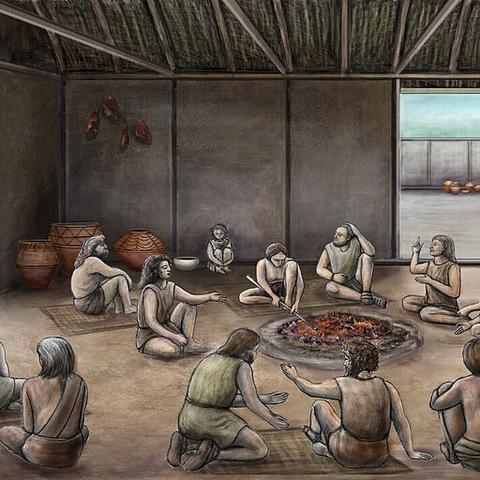
Chancen auf Verwirklichung beflügeln Innovationen vor 6.000 Jahren

#^Chancen auf Verwirklichung beflügeln Innovationen vor 6.000 Jahren

Der Index Menschlicher Entwicklung der UN liefert neue Erklärungsansätze für den Erfolg von Europas ersten Großsiedlungen.
| Scherben von Keramikgefäßen, Spuren von Hausgrundrissen, ein paar Knochen – archäologische Grabungen bringen vor allem die Reste materieller Kultur zutage. Um daraus Rückschlüsse auf soziale Verhältnisse oder das Denken und Fühlen von Menschen in der Vergangenheit zu ziehen, bedarf es zahlreicher Hilfsmittel. Dazu gehören auch philosophische Konzepte. Diese kamen bislang aber eher in archäologischen Grundsatzdebatten zur Anwendung, kaum in der Analyse von konkreten Funden und Befunden.

Netzgemeinde/Hubzilla

A new philosophical-archaeological study by #ClusterROOTS members Vesa Arponen, @archaeohlrau and Tim Kerig provides an analytical tool based on the #UnitedNations' #HumanDevelopmentIndex that can be applied directly to archaeological data. Read the whole story: https://www.uni-kiel.de/en/cluster-roots/details/news/200-archaeo-capability-approach
#Archaeology #Philosophy
Peoples’ opportunities spur innovation 6,000 years ago

The UN’s Human Development Index provides new explanations for the success of Europe’s first mega settlements.

Uni Kiel
Why we believe in our Digital Monthly | D+C - Development + Cooperation

We are sometimes asked why our Digital Monthly is valuable long term, and how it differs from our print issue. Here are the reasons.