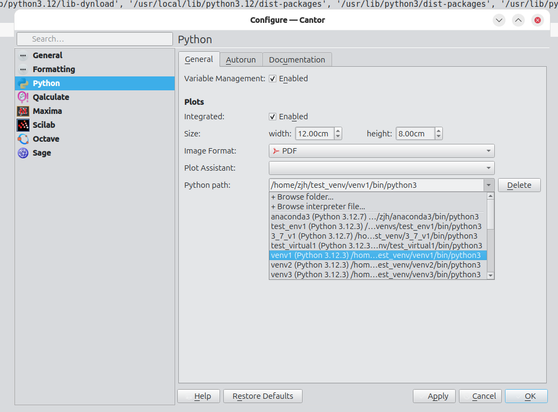
This year, as part of Google Summer of Code, one of the students improved #Python support by adding a feature that lets users easily switch between different virtual environments. Once this merge request is finalized, this will create a more unified and stable user experience in #LabPlot. 
@[email protected]
@opensource
➡️ https://mentorship.kde.org/blog/2025-11-04-gsoc-end/
#GSOC #Programming #OpenSource #FOSS #FLOSS #KDE #AlternativeTo #DataAnalysis #DataViz #Notebook #freeoriginProAlternative

Electropolymerised PEDOT:Polydopamine enables high-performance bioelectrode coatings - Scientific Reports
Conductive polymers are promising interface materials due to the ability to tailor conductivity, mechanics, and biocompatibility. A prevalent example is poly(3,4-ethylenedioxythiophene) doped with polystyrene sulfonate (PEDOT:PSS), a mixed-conduction composite widely employed as electrode coating. Despite widespread use, data indicate that PEDOT-based coatings could benefit from improved substrate adhesion. Here, we investigate polydopamine (PDA) as co-ion dopant for PEDOT, aiming at leveraging its adhesive properties. We develop a repeatable electropolymerization process for PEDOT:PDA on gold, and find performance metrics comparable to PEDOT:PSS, with large charge storage capacity of ~ 42 mC cm−2, effective interface capacitance of ~ 17.8 mF cm−2, and small variability. Sonication tests verify the adhesion advantage of PEDOT:PDA compared to PEDOT:PSS controls. We show manufacturability by integrating PEDOT:PDA in microfabricated devices, as well as scalability to electrode radii in the mm to 50 µm range. We anticipate the protocols and results herein to pave the way towards wider use of PDA in bioelectrode coatings.
 LabPlot (labplot.org)