Understand Your Printer Better With The Interactive Inkjet Simulator

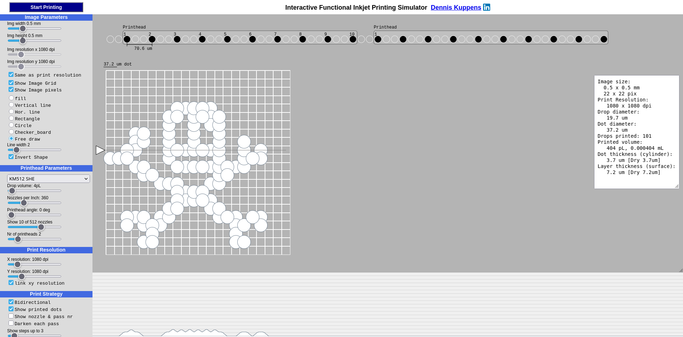
Love them or hate them, inkjets are still a very popular technology for putting text and images on paper, and with good reason. They work and are inexpensive, or would be, if not for the cartridge …

Hackaday
Understand Your Printer Better With The Interactive Inkjet Simulator

Love them or hate them, inkjets are still a very popular technology for putting text and images on paper, and with good reason. They work and are inexpensive, or would be, if not for the cartridge …

Hackaday
Fluid fun with py5 and NumPy

Hello! I felt like sketching this afternoon, so I dusted off my old implementation of Stam’s Real-Time Fluid Dynamics for Games. The original version used pygame and NumPy – turns out porting it to py5 was straightforward. Here’s a screenshot: And here’s the code: import py5 import numpy as np def remap(a, low0, high0, low1, high1): return a * (high1 - low1) / (high0 - low0) def normalize(a): a_min = np.min(a) a_max = np.max(a) return remap(a, a_min, a_max, 0, 1) def ...

Processing Community Forum

Ivan Fioravanti ᯅ (@ivanfioravanti)

Eulerian 유체 시뮬레이션을 제로샷으로 테스트하며 Opus 4.6, GPT-5.3, Gemini 3 Deep Think를 비교한 벤치마크 게시물입니다. 작성자는 Gemini 3 Deep Think을 개인적으로 최고로 꼽았고, Opus 4.6와 GPT-5.3도 언급되었습니다 — 응용(유체 시뮬레이션)에서의 모델 성능 비교 사례입니다.

https://x.com/ivanfioravanti/status/2022744459654430787

#fluidsimulation #zeroshot #modelcomparison #gpt5.3 #gemini3

Ivan Fioravanti ᯅ (@ivanfioravanti) on X

Eulerian Fluid simulation test! Zero-shot! Opus 4.6 vs GPT-5.3 vs Gemini 3 Deep Think! My personal preference: 🥇 Gemini 3 Deep Think (really strong!) 🥈 Opus 4.6 🥉 GPT 5.3 High

X (formerly Twitter)

A bit of stress testing the system, and already found #EmergentGameplay out of a single non-resizable dumb rectangular part 😉

Here is how you can build a bridge, even though you don't have the right parts, and also that you can't (yet) lift or otherwise move your contraption, and deleting parts is not implemented either.

Which means you have to find creative ways to tilt the orientation of the thing during construction and be careful about the weight balance.

#Godot #GameDev #FluidSimulation

Here is a video showing what can be done with the #Transvoxel terrain and the #FluidSimulation.

Nothing related to actual gameplay, I'm just using a debug tool to dig spherical holes (it's actually possible to dig/add matter in other shapes, making planar walls, etc.)

In the game I'm imagining, digging with manual tools would be very slow (only useful to recover small quantities of materials), and the player would need to design and use machines for larger earthworks.

#Godot #gamedev

Here is how it looks in the game, and also with the #FluidSimulation to have actual rivers infinitely flowing from the sources I've placed, until it gets to the sea.

It's still very empty, but there should be some potential for interesting perspectives.

It's not finished yet, notably I need to configure the erosion simulations to make mountains look more realistic, place big rivers strategically for gameplay reasons (this is of course where the #FluidSimulation https://mastodon.gamedev.place/@youen/115860872576805368 will come in action). And there are tons of things that could be improved. It can look cool in the preview, but not that much in-game with the different perspective.

And then, that's only elevation data, I also need to work on texturing, vegetation, etc 😅

I have finished implementation of the liquid mesher in a separate thread for the #FluidSimulation, which fixes the remaining performance issues.

And I'm spending way too much time looking at the results, especially when I'm tired 😅 I guess it's a bit mesmerizing.

Each horizontal slice of water runs a micro-fluid-simulation to compute the local flow map, using the "virtual pipes" method, which is nicely explained here: https://lisyarus.github.io/blog/posts/simulating-water-over-terrain.html (thanks to @lisyarus)