Exclusive Theater Review: MAB.
Playwrite/Director: Hayley Spivey
Stage Manager: Rachel Oshrin
Actors: Hayley Spivey, Siobhan Carroll, Alex Casillas, Oreine Robinson
By Taylor Hunsberger
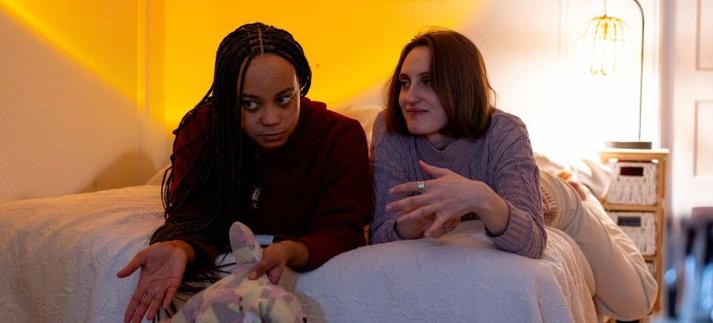
The site-specific Eugene O’Neill finalist play MAB. by Hayley Spivey will run again this weekend inside Hayley’s actual Brooklyn apartment. The show which was created, designed, and stage managed by a team of all women artists follows a group of roommates who have a chance encounter with someone who may or may not be invading their space. I got to chat with some of the team including Hayley Spivey (playwright, director, producer, performer), Siobhan Carroll (producer, devisor, performer), and Rachel Oshrin (stage manager) all about their process! The team also includes Alex Casillas and Oreine Robinson. Make sure to bookmark MAB. to follow whose apartment the show decides to haunt next!
The following interview has been edited for length and clarity.
ITOL: What inspired MAB. and what was the writing process like for you Hayley?
Hayley Spivey: I took a screenwriting class in horror and the instructor told us that you should write what you fear. I am petrified of ghosts and have been since childhood so I really wanted to write a ghost story. I also had just gone through college which included a lot of experiences that fall under the #MeToo category. I felt very motivated to write a play about what I feared the most hidden within a ghost narrative. We entered the rehearsal process with zero pages. We would share stories about our own experiences and then I’d write pages the next day. We’d put them up and then continue on scene by scene. I took the lead on directing, but it was a devised, collaborative effort.
Siobhan Carroll: Hayley started talking about MAB. the year after we graduated college when we were roommates for real. We lived with our friend Bev and Hayley thought the idea of us doing an apartment play would be cool. That year Alex (another performer in the show) had to couch surf with us, so that meant that it was the four of us hearing Hayley start to come up with this spooky as hell idea and some of the intricacies of the plot. She told me a ghost story so scary during one of those nights that I was like, “please never, ever say that to me again.” Sadly it’s in the play so I hear it quite frequently.
ITOL: For readers who have not seen the show yet, could you give a quick summary of the show?
Hayley Spivey: Three roommates struggle to get along with their creepy new subletter who only leaves her room late at night and enters their rooms while they’re sleeping. Once they realize this roommate wields a mysterious, dark power, they’re forced to evict. However, getting this roommate out of their rent stabilized apartment may be harder than they expect…
ITOL: How has the piece grown and changed over time?
Hayley Spivey: It started with a draft in 2017 that contains the same exact story, but written in a different way. It’s really incredible how radically different the script is while still telling the same story with the same characters and tone.
ITOL: How did you come to the decision of the site-specific nature of MAB.? How did you go about finding a space and then tailoring it to the project?
Hayley Spivey: The play was always meant to be performed in an apartment. No one can afford theater spaces right out of college, so you use what you have. That said we actually followed through with putting it up once I moved into my current apartment. It’s just a unique, beautiful space with tons of doors and site lines. I had actually forgotten about this play, so Siobhán was the one who noticed how perfect it would fit the play. I was shocked she remembered it!
Siobhan Carroll: There are a lot of secrets we know about the space that we don’t want to give away. We kind of had to teach ourselves how to do some magic to make this show. We figured those things out by spending a ton of time in the space, having one person be the eyes, and the rest of us playing around until we found the most powerful images. We also do a lot of tricks with lights (thanks Rosh)!
ITOL: How has the reception been to MAB. from audiences? Has it been different throughout the various showings?
Hayley Spivey: People go crazy for it. I think its site specific nature is really refreshing. I’ve been told multiple times that people have gone on to create projects that were inspired by our DIY structure. I think it really reminded people how much we’re capable of making with very little. It’s wildly meaningful any time someone tells me that. Some shows are more vocal than others, but people are always gripped!
Siobhan Carroll: The reception of MAB. has been overwhelming! From the first show, we could not believe how our friends responded to the invite and turned up to support us. During the first run, we grabbed audience members after each show and asked them what they thought, and thanks to that we have a fantastic audience reaction video. My favorite audiences are the ones that actually scream at some of our jump scares.
ITOL: Hayley, can you discuss the process of applying to the O’Neill Award? How does it feel to have gotten so far in the process?
Hayley Spivey: O’Neill was wild because I had to really create a firmer script. There are some scenes that we acted out without ever having a real script–movement pieces that had story elements woven in. Those moments are extremely difficult to capture with words. It’s an insane honor to be recognized as a finalist by the NPC. I was very afraid that one of the main appeals of the show was that it was an apartment play, so having people read the play without seeing it and still feel connected to it really sealed the deal for me.
ITOL: What do you hope audiences get out of MAB.?
Hayley Spivey: I hope audiences can chew on some difficult subject material in a really safe, fun way. I wanted audience members to walk away feeling loved and seen rather than triggered and upset. I think all the magic in the play helps us push the harder topics while keeping the energy in the room positive and warm.
Siobhan Carroll: For me, at its core, the play is about what it means to take care of each other. The characters, especially Tally–the one I play–do not know how to take care of their friends at the top of this play. And hopefully by the end of it that has changed or started to change.Hayley also always says this thing about the haunting effects of trauma, which again for me, she’s really captured through her metaphor or allegory here in this work. For me, the theatre is always most effective when it’s entertaining. So basically I hope this experience is a total romp that makes it effortless to think about these larger issues and perhaps feel seen if you identify with any of the characters’ experiences.
ITOL: Rachel, can you talk about your process as a stage manager?
Rachel Oshrin: Because no two plays are alike, my process as a stage manager always involves a fair amount of adaptation and flexibility. For most plays, that means learning how a director likes to run a rehearsal room, or how a designer prefers to communicate light cues, or how to best preset the space each night. When it comes to MAB., that means transforming an apartment kitchen into a fully-functioning tech booth, syncing countless devices across a nontraditional space, and calling cues to be carried out on a stage that I cannot see.
ITOL: What’s it like working on a show when you cannot physically see the space?
Siobhan Carroll: Wow, cannot wait for Rosh (editor’s note: this nickname is short for Rachel Oshrin) to answer you! My favorite way she says it is, “I call the show based mainly on vibes.” And boy, does she! I literally don’t know how she does what she does back there. And it’s always fun to visit her in the kitchen in the scenes where the play takes me back there as Tally.
Rachel Oshrin: I often joke that I call MAB. purely based on vibes, and while that isn’t entirely untrue, there’s more to it than that. The genius of Hayley’s script is that it’s both precise and expansive – the core moments are so specific and consistent, but there’s also so much room for the cast to collaborate and devise. Because of this, the play sometimes feels like a living thing– growing and changing throughout the rehearsal process of each run. The challenge (and the fun!) of stage managing MAB. is making space for an ever-evolving project to continue to develop, while still making sure that certain necessary benchmarks are hit in every iteration of the piece. We’ve been very intentional in building in specific moments to ensure that I’m always able to track what’s going on onstage. Calling the show blind can be a challenge – after all, if someone is out of their light, I can’t see them and adjust it in the moment, and if I don’t hear a door slam onstage when it usually does, I don’t know when to start counting down to the next sound cue – but as we approach our fourth run, the rhythm of the show is so ingrained in all of us that it’s practically second nature. So all that to say…I call MAB. purely based on vibes.
ITOL: Tell me all about having such elaborate tech in an apartment space! How do you manage it?
Rachel Oshrin: When you first enter the space, MAB. seems as low-tech as you’d expect any small apartment play to be. Even once the audience realizes that we might have a few bluetooth speakers and lights supplementing the onstage practicals, they think that that’s it. It’s deceivingly simple…until it isn’t. As the story progresses, and the world of the play diverges further and further from the realism of what might reasonably happen in an apartment, the tech follows suit, transforming the space into something else entirely. I’m always so delighted when audience members come up to me after the show and ask how all of the tech is possible in the space, or tell me that they want to come back to shadow me and see everything that I’m doing backstage (full disclosure: I’m mostly dancing while manually operating strobe lights). Figuring out the technical elements needed to create the world of MAB. has been a true collaboration for the entire team, and making it all happen each night is such a joy.
ITOL: What do you hope is next for the project?
Hayley Spivey: We want to go to the Edinburgh festival. That’s the immediate goal. We also want to find a real venue. It’s been invite only so far because of the type of venue, so we want a space where we can invite all the strangers of the world to come join us.
Siobhan Carroll: I want us to move to other apartments! I aspire for MAB. to move to other super cool apartments in NYC. So if anyone feels like they have a super creepy apartment and would be down to let a bunch of actors transform it for about two weeks, I want to talk to you. As you acknowledged in your questions we really tailored this production around this space, so we’d love to adapt the play, especially its staging and visual imagery, around each space in a super specific way. Who knows what other spooky moments totally different architecture would offer us?
ITOL: Is there anything else you would like readers to know?
Hayley Spivey: I want readers to know that the DIY scene is very alive. In this age of AI, live events are more exciting than ever. A computer could never do what we do!
#AlexCasillas #Brooklyn #FemaleCharacters #FemaleDirectors #HayleySpivey #Horror #Interactive #livePerformance #MAB #Movies #OreineRobinson #RachelOshrin #Reviews #SiobhanCarroll #Theater #womenPlaywright #WritingCPFF 2026 Short Film Roundup
By Guest Reviewer Alexei Holloway
Review: Don’t Be Long, Little Bird
Year: 2025
Runtime: 23 min
Director: Reem Jubran
Actors: Banna Bazzarie, Muna Basha, and Clara Khoury
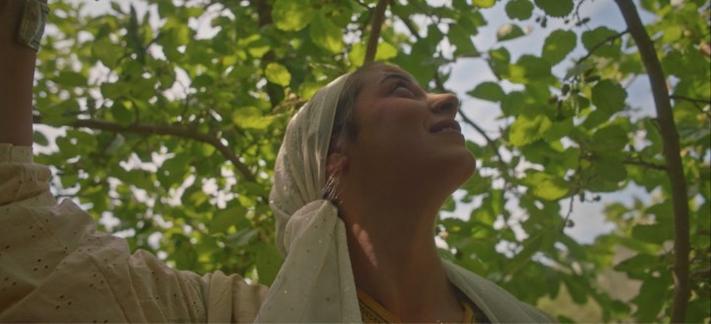
“Don’t be Long, Little Bird” is a short film that centers on the life of Palestinian women before the Nakba.
After arguing with her mother, Rima (Banna Bazzarie), an American born Palestinian teenager reunites with her Palestinian great-grandmother, also named Rima (Muna Basha) in 1930’s Palestine through the use of time travel. As Rima spends time with her great-grandmother, she realizes that while she once thought of nothing but escaping the familiar for the “exotic”, what she truly wanted was to return home all along.
The heart of the film is the life of Palestinian women before the Nakba. When we first meet Great-Grandma Rima she and her friend are playing around with a broken gun, laughing and pulling pranks on each other. The Zionist settlers are mentioned just once, but they have no presence in the film. They do not yet matter because Palestine has not yet been colonized. Great-Grandma Rima is part of a beautiful and loving community that eagerly welcomes teenage Rima even if she can’t provide straight answers on where she is from and how she arrived in Palestine.
However, there is tension within both Rimas. Great-Grandma Rima dreams of leaving her village and traveling to the city, but, instead, she is married off to teenage Rima’s future grandfather. Teenage Rima asks her mother if she married her father because she loved him or because she had to and her mother tells her when she was married she felt a suffocation in her chest until she had Rima and that Rima was the best thing that ever happened to her. This tension is not fully explored or satisfactorily resolved. Maybe it is something director Reem Jubran can explore in her future films.
Review: What a Pattern Tells
Year: 2025
Runtime: 15 min
Director: Bayan Abuta’ema
“What a Pattern Tells” is a brief look at the importance of embroidery in Palestinian life. It follows a day in the life of Aseel, a young Palestinian who hosts embroidery classes and has an embroidery circle, and Um Qusai, an elderly Palestinian who has her own embroidery circle and makes a living selling her embroidery.
The short film can be broken into two sections. The first section focuses on Um Qusai and her friends who have been embroidering all their lives. Um Qusai shows off books that detail the patterns used by their ancestors and explains how she uses those same patterns in her own embroideries to prevent the settlers from stealing their culture from them. Embroidering is more than a hobby. It is an active weapon against the erasure of Palestine and Palestinian culture and life.
The second part focuses on Aseel and her classes. She got into embroidery to reclaim a part of herself and realized that she could share that gift with hers by hosting classes. In one year, she taught 30 classes to people of all ages. She also has an embroidery circle (and one adorable fluffy cat) that meets weekly and each member of the circle expresses similar sentiments to Aseel. They embroider because it connects them to the past, to themselves, and to each other.
While the film is an important look into the importance of embroidery, it lacks a firm structure. Additionally, given its short run time, it doesn’t have time to delve into embroidery and its importance, providing us only a big picture view of something that is vital to Palestinian identity. Hopefully, Director Bayan Abuta’ema can return to this subject in a longer feature.
#ChicagoPalestineFilmFestival #FemaleCharacters #FemaleDirectors #FemaleFilmmaker #FilmReview #Palestine #Review #ShortFilm #WomenInFilmCPFF2026 Review: Sink
Year: 2025
Runtime: 88 min
Director/Writer: Zain Duraie
Actors: Clara Khoury, Mohammad Nizar, and Wissam Tobaileh
By Guest Reviewer Alexei Holloway
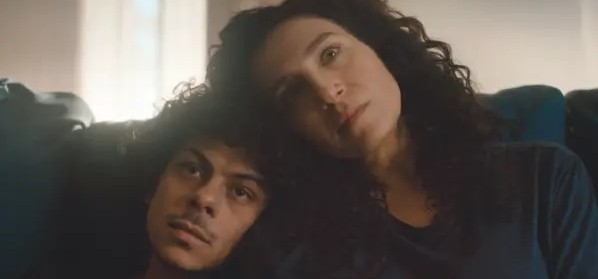
“Sink” (2025) is a heartrending look at a family coming to terms with their son’s mental illness.
Basil (Mohammad Nizar) is the middle child of a middle-class, Jordanian family. While he is brilliant, he struggles socially and prefers spending time alone studying and watching videos on open heart surgery. He wants to be a heart surgeon. His oldest brother is the charming all-star basketball player and his sister is the cute and sweet little sister. His father travels for his work and while he adores his oldest and youngest children, he has a hard time connecting with his middle child. Basil’s mother, Nadia (Clara Khoury) adores him and is his biggest supporter and champion.
Nadia’s love for her son and his father’s distance prevent both parents from recognizing and acknowledging that Basil needs help. However, their ignorance is shattered when Basil is suspended for hitting a teacher. We see the events that lead up to the supposed assault, but we don’t see the assault itself, leaving it up to the audience to decide who is telling the truth: the school or Basil, who claims it was an accident. The father sides with the school while Nadia sides with her son.
Their eldest son has a championship game out of the city. The rest of the family goes to the game while Basil and Nadia remain home. Nadia believes if they have a few days alone, she can reach her son and “fix” whatever the problem is. Their loving moments of reconnecting are with many alarming moments such as when Basil wakes her up while wearing a horse mask and forces her to wear a bunny mask and then grunts at her and when he goes to a park with a chicken coop and tries to murder the chickens.
Basil’s parents schedule a therapist but he refuses to go and lashes out, hurting his mother in the process. Horrified by what he’s done, Basil reports himself to the police. When the police arrive, Nadia rushes to her son’s side and sits with him in the ambulance, holding his hands, making it clear that she will remain by his side no matter what.
“Sink” can be a difficult watch as Nadia struggles with accepting that her son needs help and Basil grows increasingly unpredictable. Clara Khoury gives an outstanding performance as her love for her son is always present, even when she is terrified of him. She never gives up on him, even when he attacks her, and yet she can’t stop her heart from breaking when she realizes she isn’t sure she can help him. Mohammad Nizar gives a truly moving performance as a teen who knows he is different but doesn’t understand why. Nizar never allows Basil to be a monster. He makes Basil adorably at ease when he is playing with his little sister, letting her put makeup on him and playing charades, and helping his mother around the house and, even when Basil is at his most threatening, he is not a cruel psychopath. He is a lost and struggling child who doesn’t have the tools to help him survive in a neurotypical world.
#ChicagoPalestineFilmFestival #ClaraKhoury #FemaleCharacters #FemaleDirectors #FemaleFilmmaker #FilmFestival #FilmReview #MentalHealth #Palestine #Review #Underpresented #WomenInFilm #WorldCinema #ZainDuraieCPFF 2026 Review: Thank You for Banking with Us
Year: 2024
Runtime: 92 minutes
Writer/Director: Laila Abbas
Actors: Yasime Al Massri, Clara Khoury, Kamel El Basha, Adam Khattar, Salwa Nakkara
By Guest Reviewer Alexei Holloway
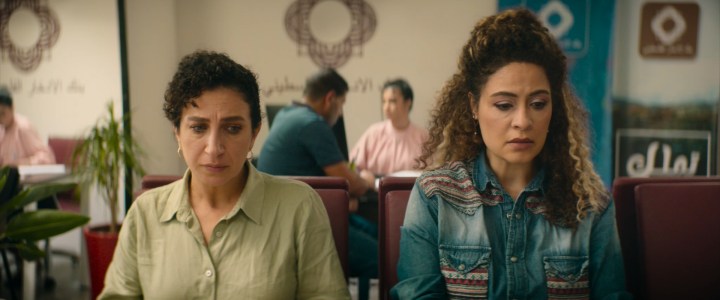
“Thank You For Banking With Us” (2024) is a funny and moving look at sisterhood and challenging the patriarchy.
Noura (Yasime Al Massri) and Maryam (Clara Khoury) are estranged sisters with less than perfect lives. Noura is a beauty clinician who cares for their ailing father while Maryam is stuck in a loveless marriage with children she no longer feels connected to. When their father dies, the two work together to take their father’s money out of the bank before their absent and judgmental brother who lives in America comes along and takes the money and half the house (per Sharia law).
What follows is a funny pseudo-heist as the sisters bounce off of obstacle after obstacle trying to navigate a deeply patriarchal society and arguing with each other. While looking for help from every man they know, they are constantly shut down, told they are sinners and ungrateful daughters, and have no right to ask for that money. Yet, their brother never bothered to care for their father or check in on his sisters. It was Noura and Maryam who cared for their father, feeding him, cleaning up after him, checking in on him. Why should their brother get both the money and half the house when he did nothing? Why do male relatives, husbands, and lovers have the right to tell these women no when they’ve done nothing to help Noura and Maryam survive?
Clara Khoury and Yasmine Al Massri are a powerful and hilarious duo. When they are not cursing and arguing with the unhelpful men in their lives, they are arguing with each other, pulling up old wounds and half-remembered fights from their past like real siblings. Yet, when they see how the other lives and are betrayed by the men they are supposed to be able to rely on, they realize all they have ever had is each other. That will never stop them from fighting, but it helps bring them closer together and, with a little help from Maryam’s youngest son Ali (Adam Khattar) enables them to finally work together to get the money they deserve and to properly lay their father to rest. By the end, one hopes that their newly rekindled friendship can also prevent Maryam’s sons from turning into the very men who did nothing to help the women retrieve their rightful inheritance.
#ChicagoPalestineFilmFestival #Comedy #ElderCare #FemaleCharacter #FemaleCharacters #FemaleDirectors #FemaleFilmmaker #FilmFestival #FilmReview #Heist #Palestine #ShariaLaw #UnderrepresentedInFilm #WomenInFilmReview: Palestine ’36
Year: 2026
Runtime: 1hr 59 min
Director: Annemarie Jacir
Writer: Annemarie Jacir
Actors: Hiam Abbass, Yasmine Al Massri, Karim Daoud Anaya, Robert Aramayo, Jeremy Irons, and Liam Cunningham
By Guest Reviewer Alexei Holloway
It would be hard to find a film more timely than “Palestine ‘36” (2026.) Written and directed by Annemarie Jacir, “Palestine ‘36” is a historical drama that immerses its viewers into the Palestinian perspective of the Palestinian Revolt of 1936.
The film follows the stories of three Palestinian families: Yusuf, Hanan, and Afra; Khouloud and her husband Amir, and Father Boulos, a Christian priest, and his son Kareem.
Yusuf, played by Karim Daoud Anaya, is from the fictional village of al Basma and finds himself torn between village life and city life. When Yusuf’s father is killed and his brother is arrested, Yusuf joins the rebels who live in the countryside. However, the rebel’s actions bring increased British scrutiny and raids to his village and threaten the lives of his family and neighbors.
Khouloud, played by the amazing Yasmine Al Massri, is a journalist writing under the pseudonym of Ahmad Canaanli because people will only read her articles if they believe she is a man. Khouloud is a firm believer in Palestinian autonomy and reports on the British army’s violent repressive measures and the Zionist settlers’ seemingly neverending stealing of Palestinian land. Her husband, Amir, is a landlord who believes he can retain his wealth and power if he works with the British and the Zionist settlers.
Father Boulos, played by Jalal Altawil, and Kareem are members of Yusuf’s village and the fact that they are Christian Palestinians who side with their Muslim neighbors flabbergasts the British.
The film’s greatest strength is its cast. Predictably, Jeremy Irons is the perfect face of British indifference to indigenous people’s rights and humanity and Robert Aramayo’s Orde Wingate is appropriately cruel and fanatic. Dhafer L’Abidine provides Amir, a man we should hate, with just enough charm to turn his character into a walking tragedy. The moment he realizes that he’s betrayed his people for nothing is one of the most haunting moments in a film full of haunting moments.
However, the true stars of the film are the female leads: Hiam Abbass and Yasmine Al Massri. Hiam Abbass’ Hanan is a loving mother with a spine of steel who does whatever she can to protect her family and land, even if that means helping a wounded rebel and hiding arms from the British. She is often left alone, weaponless and at the mercy of British patrols but never cowers or hesitates. She is the ultimate representation of the inner strength of every Palestinian mother, wife, and sister who has survived the worst anyone can imagine and still gets up in the morning to do it all over again.
Yasmine Al Massri’s Khouloud is, perhaps, the star of the film. She is absolutely charming, courageous, and powerful as the voice of the Palestinian people. As a member of the elite, she is often gathering secrets from British diplomat Thomas and insulting Wingate before leaving him to deal with matters of real importance. Although she knows Amir does not agree with her pro-Palestinian stance, she still loves him and never imagines he’d actually work with the Zionist settlers to sellout their own land. She is crushed by his betrayal but not broken and continues to fight for a free Palestine.
“Palestine ‘36″’s vast and complicated story combined with its two hour runtime creates choppy pacing, underdeveloped relationships, obscures the depth and brutality of the Zionist and British alliance, and prevents the full exploration of the many ideas it introduces. At the same time, what it manages to cover is both impressive and heartbreaking. While far from a perfect movie, it is an important film that tells the story of the carving up of Palestine from the Palestinian perspective; a perspective that has been overshadowed and suppressed for the last seventy years. The power of Palestinian voices is what makes this movie a must see.
#FemaleCharacters #FemaleDirectors #FemaleFilmmaker #FilmReview #History #JeremyIrons #LiamCunningham #Palestine #Review #RobertAramayo #WomenInFilm #WorldCinemaRaymonde or the Vertical Escape
https://fed.brid.gy/r/https://stopmotionmagazine.com/raymonde-or-the-vertical-escape/
Every Studio Film Directed by Female Filmmakers Coming Out in 2025 and 2026
#IndieWire #Features #General #FemaleDirectors #FemaleFilmmakers #Film