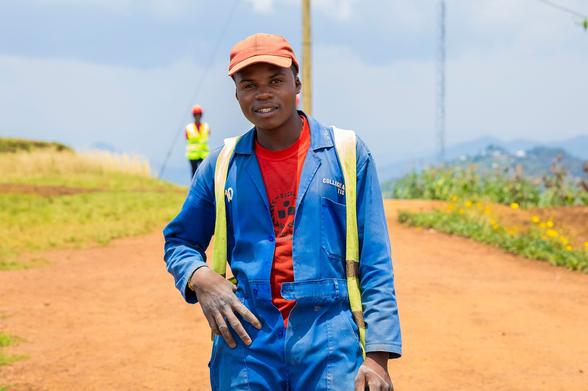
#Agroecology as the path to #ClimateResilient and just food systems

By Dr Susan Chomba, Director Food, Land and Water at World Resources Institute Africa

Monday, July 28, 2025 — updated on August 02, 2025

"The 2nd National Agroecology Symposium, held in Nairobi from July 10–11, 2025, marked a pivotal moment in #Kenya’s food systems transformation.

"The event brought together farmers, researchers, civil society, private sector actors, media, and policymakers with one clear message: Agroecology must move from the margins to the centre of national agricultural strategy. It is not just an alternative; it is the most viable path forward to achieve our intertwined goals for #people, #nature, and #climate—without compromising one for the other.
Agroecology offers a coherent framework for #RegeneratingSoils, producing safe and nutritious food, and building #ClimateResilient and #equitable #FoodSystems.

"As #ClimateChange intensifies, this approach provides Kenya and other #AfricanNations a powerful opportunity to lead a just transition—rooted in #LocalKnowledge, backed by #science, and responsive to the realities of #smallholder #farmers.

A crossroads for Kenya’s food systems

"Kenya’s food systems are at a crossroads. The dominant model—based on chemical-intensive agriculture and ultra-processed foods—is driving soil degradation, poor nutrition, increased prevalence of non-communicable diseases, and the pollution of our rivers and lakes. This model also contributes significantly to #biodiversity loss and #GreenhouseGasEmissions.

"Alternatively, a more resilient and #sustainable path is within reach—one that aligns human health with ecological integrity. But this transition cannot be left to smallholder farmers alone. It requires coordinated leadership from governments—particularly ministries of agriculture, health, environment, and finance—as well as development partners, scientists, and the private sector.

"Farmers should not be expected to feed a growing population and withstand escalating #ClimateShocks while being under-supported or misdirected by ineffective policies and subsidies. Without the right investments and incentives, we risk deepening the crisis.

What agroecology is—and isn’t

"Agroecology is too often misunderstood as a nostalgic return to low-productivity farming. In reality, it is a sophisticated, evidence-informed, and farmer-driven approach to transforming food systems in ways that are locally appropriate and ecologically sound. It is not a one-size-fits-all solution, but a dynamic practice that integrates scientific research with #TraditionalKnowledge.

"The Food and Agriculture Organization (FAO) outlines 10 elements of agroecology, while the High-Level Panel of Experts (HLPE) has identified 13 principles. These include #RecyclingNutrients, enhancing biodiversity, strengthening synergies, and co-creating knowledge."

Source [paywall]:
https://nation.africa/kenya/blogs-opinion/blogs/agroecology-as-the-path-to-climate-resilient-and-just-food-systems-5140556

Archived version:
https://archive.ph/QxY8u

#SolarPunkSunday #AgroEcology #FoodSecurity #Africa #ClimageChangeResiliency #SharingKnowledge

Climate change indicators reached record levels in 2023: WMO

The state of the climate in 2023 gave ominous new significance to the phrase “off the charts.”
“Climate change is about much more than temperatures. What we witnessed in 2023, especially with the unprecedented ocean warmth, glacier retreat and Antarctic sea ice loss, is cause for particular concern."

“Sirens are blaring across all major indicators... Some records aren’t just chart-topping, they’re chart-busting. And changes are speeding-up.” United Nations Secretary-General António Guterres.
https://wmo.int/media/news/climate-change-indicators-reached-record-levels-2023-wmo

‘Red alert’: last year was hottest on record by clear margin, says UN report
"Records being broken for greenhouse gas pollution, surface temperatures and ocean heat ."

“If we do not stop burning fossil fuels, the climate will continue to warm, making life more dangerous, more unpredictable, and more expensive for billions of people on earth.” Friederike Otto, climate scientist
https://www.theguardian.com/environment/2024/mar/19/red-alert-last-year-was-hottest-year-ever-by-wide-margin-says-un-report
#FossilFuels #climate #displacement #ClimateShocks #heatwaves #floods #droughts #bushfires #cyclones #GHG #pollution #ExtremeHeat

Climate change indicators reached record levels in 2023: WMO

A new report from the World Meteorological Organization (WMO) shows that records were once again broken, and in some cases smashed, for greenhouse gas levels, surface temperatures, ocean heat and acidification, sea level rise, Antarctic sea ice cover and glacier retreat.Heatwaves, floods, droughts, wildfires and rapidly intensifying tropical cyclones caused misery and mayhem, upending every-day life for millions and inflicting many billions of dollars in economic losses, according to the WMO State of the Global Climate 2023 report.

World Meteorological Organization
Enjoy this from folk over at World Economic Forum who are encouraging the use of #DirectCashTransfers to make vulnerable communities more resilient to #ClimateShocks
Think we're moving into an era of more widespread appreciation for #DirectCashTransfer like #BasicIncome and I am delighted to see it
https://www.weforum.org/agenda/2023/03/just-in-time-cash-transfers-makes-vulnerable-communities-resilient-to-climate-shocks/
Cash transfers make people more resilient to climate shocks

Cash transfers to those impacted by climate-induced disasters can financially empower people and minimise the effects of a climate shock on them.

World Economic Forum