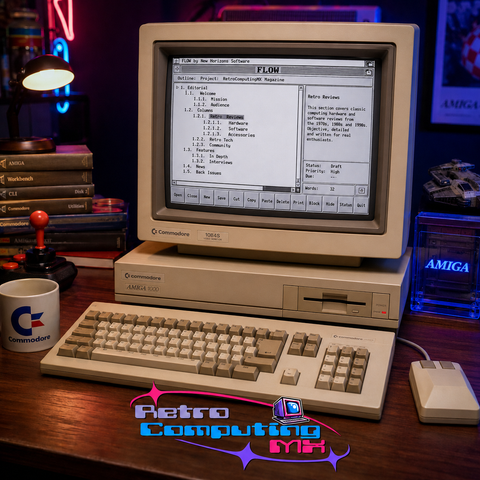
𝗙𝗹𝗼𝘄 no conquistó el mercado, pero dejó una idea poderosa: antes de escribir bien, había que pensar bien.

#retrocomputingmx #amiga #flow #NewHorizonsSoftware #ideaprocessor #retrocomputing #vintagecomputing #SoftwareHistory

Con el tiempo, 𝗙𝗹𝗼𝘄 llegó a versiones posteriores como 𝗙𝗹𝗼𝘄 3.x, pero quedó opacado por suites más amplias, procesadores de texto más conocidos y por el cambio del mercado hacia PC y Macintosh.

New Horizons sería más recordada por herramientas como ProWrite, mientras 𝗙𝗹𝗼𝘄 quedó como una pieza de nicho: valiosa, rara y profundamente representativa de una época experimental del software.

#amiga #flow #NewHorizonsSoftware #ideaprocessor #retrocomputing #vintagecomputing #SoftwareHistory

Anunciado como un 𝙞𝙙𝙚𝙖 𝙥𝙧𝙤𝙘𝙚𝙨𝙨𝙤𝙧, 𝗙𝗹𝗼𝘄 no era simplemente un procesador de texto. Su propuesta era trabajar con ideas en forma estructurada: esquemas, jerarquías, bloques de texto y organización lógica de información.

En una época en la que muchos usuarios todavía escribían de manera lineal, 𝗙𝗹𝗼𝘄 proponía algo más cercano al pensamiento visual y modular.

#retrocomputingmx #amiga #flow #NewHorizonsSoftware #ideaprocessor #retrocomputing #vintagecomputing #SoftwareHistory

En los primeros años del 𝐀𝐦𝐢𝐠𝐚, no todo era 𝙳𝚎𝚕𝚞𝚡𝚎 𝙿𝚊𝚒𝚗𝚝, animación, música y videojuegos. También hubo software de productividad que intentó convertir a la computadora de 𝘾𝙤𝙢𝙢𝙤𝙙𝙤𝙧𝙚 en una herramienta seria para pensar, escribir y organizar ideas.

Uno de esos programas fue 𝗙𝗹𝗼𝘄, de New Horizons Software.

#retrocomputingmx #amiga #flow #NewHorizonsSoftware #ideaprocessor #retrocomputing #vintagecomputing #SoftwareHistory

Survey of Theme One Program
https://inquiryintoinquiry.com/2023/03/30/survey-of-theme-one-program-5/

This is a Survey of resources for the Theme One Program I worked on all through the 1980s. The aim was to develop fundamental algorithms and data structures for integrating empirical learning with logical reasoning. I had earlier developed separate programs for basic components of those tasks, namely, 2-level formal language learning and propositional constraint satisfaction, the latter using an extension of C.S. Peirce's logical graphs as a syntax for propositional logic. Thus arose the question of how well it might be possible to get “empiricist” and “rationalist” modes of operation to cooperate. The long-term vision is the design and implementation of an Automated Research Tool able to double as a platform for Inquiry Driven Education.

Please follow the above link for the full set of resources. An initial sample is linked below.

Wiki Hub —

Theme One Program • Overview
https://oeis.org/wiki/Theme_One_Program_%E2%80%A2_Overview

Documentation —

Theme One Program • Pascal Source Code
https://www.academia.edu/5210987/Theme_One_Program_Pascal_Source_Code

Theme One Program • User Guide
https://www.academia.edu/5211369/Theme_One_Program_User_Guide

Theme One Program • Exposition
https://oeis.org/wiki/Theme_One_Program_%E2%80%A2_Exposition

Applications —

Applications of a Propositional Calculator • Constraint Satisfaction Problems
https://www.academia.edu/4727842/Applications_of_a_Propositional_Calculator_Constraint_Satisfaction_Problems

Exploratory Qualitative Analysis of Sequential Observation Data
https://oeis.org/wiki/User:Jon_Awbrey/Exploratory_Qualitative_Analysis_of_Sequential_Observation_Data

References —

An Architecture for Inquiry • Building Computer Platforms for Discovery
https://www.academia.edu/1270327/An_Architecture_for_Inquiry_Building_Computer_Platforms_for_Discovery

Exploring Research Data Interactively • Theme One : A Program of Inquiry
https://www.academia.edu/1272839/Exploring_Research_Data_Interactively._Theme_One_A_Program_of_Inquiry

#Peirce #Logic #LogicalGraphs #ThemeOneProgram #IdeaProcessor
#BooleanSatisfiability #CactusLanguage #DeclarativeProgramming

Survey of Theme One Program • 5

Inquiry Into Inquiry

Theme One Program • Discussion 10
https://inquiryintoinquiry.com/2023/04/17/theme-one-program-discussion-10/

Re: Seamus Bradley
https://web.archive.org/web/20230422200222/https://mathstodon.xyz/@Scmbradley/110198310724722597

❝I thought of a programming language where every function can only return one type: the return type. The return type is just a wrapper around a struct that contains the actual return value, but also a reference to the called function and arguments, and possibly an error code.❞

My flashback —

Way back in the last millennium I started work on a programming style I called an “idea processor”, where an “idea” is a pointer to a “form” and a form is a minimal type of record containing 1 character, 1 number, and 4 more ideas.

I implemented a functional style where all the main functions are transformations of one or more ideas to a return idea. The principal data type is an “idea-form flag” which serves a role analogous to a “cons cell” in #Lisp.

Here's one entry point —

Theme One Program • Exposition 1
https://inquiryintoinquiry.com/2022/06/15/theme-one-program-exposition-1-2/

#Peirce #Logic #LogicalGraphs #ThemeOneProgram #IdeaProcessor
#CactusLanguage #DeclarativeProgram #FunctionalProgramming

Theme One Program • Discussion 10

Re: Mathstodon • Seamus Bradley SB: I thought of a programming language where every function can only return one type:  the return type.  The return type is just a wrapper around a s…

Inquiry Into Inquiry

@Scmbradley

Way back in the last millennium I started work on a programming style I called an #IdeaProcessor, where an “idea” is a pointer to a “form” and a form is a minimal type of record containing 1 character, 1 number, and 4 more ideas.

I implemented a functional style where all the main functions are transformations of one or more ideas into a return idea.

The principal data type is an “idea-form flag” that serves a role analogous to a #ConsCell in #Lisp.

Here's one entry point —

Theme One Program • Exposition 1
https://inquiryintoinquiry.com/2022/06/15/theme-one-program-exposition-1-2/

Theme One Program • Exposition 1

Inquiry Into Inquiry