https://bsky.app/profile/mbrasovives.bsky.social/post/3mctuhgks7k2q
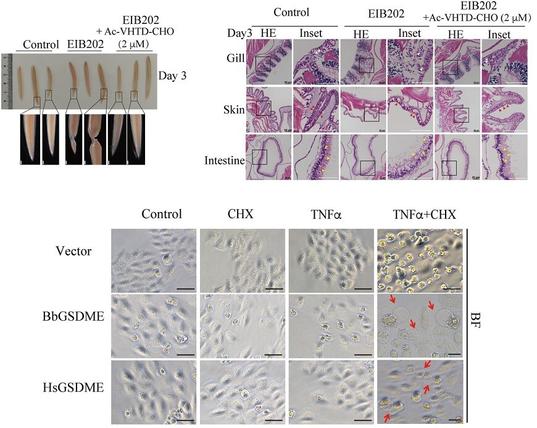
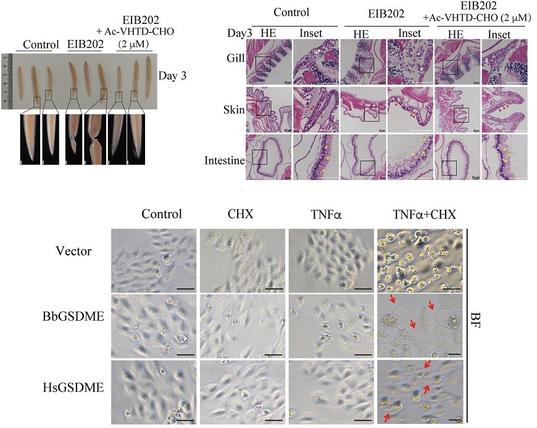
Characterization of Gasdermin E-mediated pyroptosis in the basal chordate amphioxus reveals that it is transcriptionally regulated by IRF1/8, involved in bacteria induced tissue damage, and inhibited by caspase inhibitor.
Attached: 1 image We are really excited to share the news that for the first time, EuroEvoDevo will have five satellite meetings @EED2024 Helsinki! Endless #EvoDevo most beautiful! Save the dates: 📅June 24 & 25, 2024: Satellites 📅June 25 – 28, 2024: Main EED Meeting Thanks to the organizers! More info soon on http://www.euroevodevo2024.fi
Background Amphioxus are non-vertebrate chordates characterized by a slow morphological and molecular evolution. They share the basic chordate body-plan and genome organization with vertebrates but lack their 2R whole-genome duplications and their developmental complexity. For these reasons, amphioxus are frequently used as an outgroup to study vertebrate genome evolution and Evo-Devo. Aside from whole-genome duplications, genes continuously duplicate on a smaller scale. Small-scale duplicated genes can be found in both amphioxus and vertebrate genomes, while only the vertebrate genomes have duplicated genes product of their 2R whole-genome duplications. Here, we explore the history of small-scale gene duplications in the amphioxus lineage and compare it to small- and large-scale gene duplication history in vertebrates. Results We present a study of the European amphioxus (Branchiostoma lanceolatum) gene duplications thanks to a new, high-quality genome reference. We find that, despite its overall slow molecular evolution, the amphioxus lineage has had a history of small-scale duplications similar to the one observed in vertebrates. We find parallel gene duplication profiles between amphioxus and vertebrates and conserved functional constraints in gene duplication. Moreover, amphioxus gene duplicates show levels of expression and patterns of functional specialization similar to the ones observed in vertebrate duplicated genes. We also find strong conservation of gene synteny between two distant amphioxus species, B. lanceolatum and B. floridae, with two major chromosomal rearrangements. Conclusions In contrast to their slower molecular and morphological evolution, amphioxus’ small-scale gene duplication history resembles that of the vertebrate lineage both in quantitative and in functional terms.