Postdoctoral Fellow - RNA Biology, Functional Genomics

Post a job in 3min, or find thousands of job offers like this one at jobRxiv!

jobRxiv
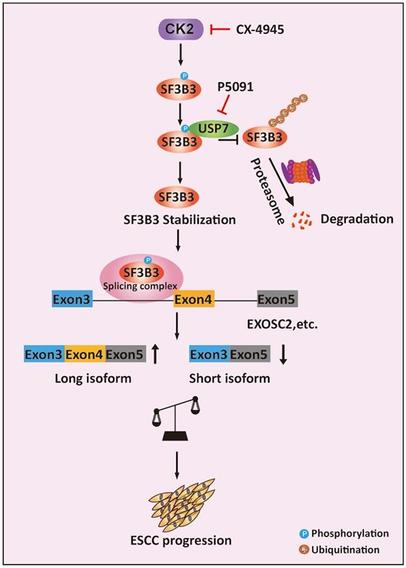
Protein #kinase dysregulation is often implicated in #cancer. This study shows that casein kinase 2-mediated phosphorylation of splicing factor SF3B2 enhances its #deubiquitination & stability, driving aberrant #AlternativeSplicing & promoting ESCC progression @PLOSBiology plos.io/4tjuKgI

🧬 Can combining LLMs with full-length RNA isoforms unlock hidden cellular diversity?

🔗 Advancing automated cell type annotation with large language models and single-cell isoform sequencing. Computational and Structural Biotechnology Journal, DOI: https://doi.org/10.1016/j.csbj.2025.11.008

📚 CSBJ: https://www.csbj.org/

#LargeLanguageModels #Genomics #CellBiology #SingleCellRNASequencing #AlternativeSplicing #LLMs #SystemsBiology

Postdoctoral Scholar in Molecular Neuroscience and RNA Biology

Post a job in 3min, or find thousands of job offers like this one at jobRxiv!

jobRxiv
Postdoctoral Scholar in Molecular Neuroscience and RNA Biology

Post a job in 3min, or find thousands of job offers like this one at jobRxiv!

jobRxiv
Postdoctoral Scholar in Molecular Neuroscience and RNA Biology

Post a job in 3min, or find thousands of job offers like this one at jobRxiv!

jobRxiv

This exciting issue includes articles on #AI and #Huanglongbing resistance, vertical farming, #reviews on genetic variation in adaptive #evolution, and on #AlternativeSplicing, along with many more research articles!

Read more great #PlantScience from this issue here: https://onlinelibrary.wiley.com/toc/17447909/current

Postdoctoral Scholar in Molecular Neuroscience and RNA Biology

Post a job in 3min, or find thousands of job offers like this one at jobRxiv!

jobRxiv
Postdoctoral Scholar in Molecular Neuroscience and RNA Biology

Post a job in 3min, or find thousands of job offers like this one at jobRxiv!

jobRxiv

@verdantsquare

Interesting.

From the original research article*:

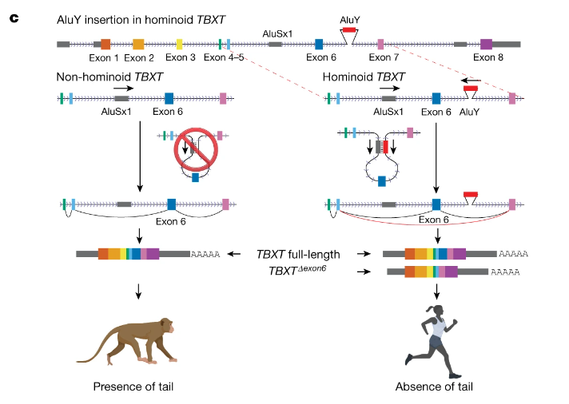
"...we inferred that the AluY insertion may mediate an alternative splicing (AS) event of the hominoid TBXT in an unusual way. This AluY element is not inserted in the vicinity of a splice site; instead, it is >500 bp from exon 6 of TBXT, the nearest coding exon (Fig. 1b). As such, it would not be expected, by itself, to lead to an AS event, as found for other individual intronic Alu elements near exon boundaries that directly affect splicing32,33,34. However, we noted the presence of another Alu element (AluSx1) in the reverse orientation in intron 5 of TBXT that is shared among all monkeys and apes (simians). Together, the AluY and AluSx1 elements form an exon-flanking inverted repeat pair (Fig. 1b). We therefore posited that during transcription, the hominoid-specific AluY element pairs with the simian-shared AluSx1 element to form a stem–loop structure in TBXT pre-mRNA and traps exon 6 in the loop (Fig. 1c). An inferred model of the RNA secondary structure supported the interaction between these two Alu elements35 (Extended Data Fig. 2). The secondary structure of the transcript may conjoin the splice donor and receptor site of exons 5 and 7, respectively, and promote the skipping of exon 6, thereby leading to a hominoid-specific and in-frame AS isoform: TBXTΔexon6 (Fig. 1c). "

* https://www.nature.com/articles/s41586-024-07095-8

#Genetics #AlternativeSplicing #SpinalCord #NeuralTubeDefects
#SpinaBifida #TetheredCord

On the genetic basis of tail-loss evolution in humans and apes - Nature

An insertion of an Alu element into an intron of the TBXT gene is identified as a genetic mechanism of tail-loss evolution in humans and apes, with implications for human health today.

Nature