 Dr Priya Sammani ( MBBS ,DFM )
The ultrasound room. It’s supposed to be full of joy, isn't it? Seeing those first fuzzy images of your little one. But sometimes, the quiet in the room gets a bit too heavy. #brainmalformations #cephalicdisorders #congenitaldisorders #fetaldevelopment #microcephaly #neuraltubedefects #spinabifida
 Rhyothemis
Interesting.
From the original research article*:
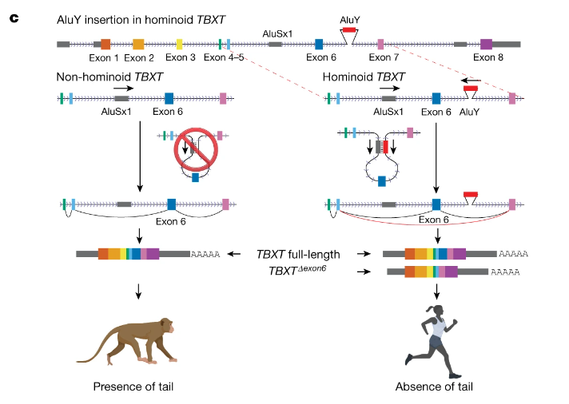
"...we inferred that the AluY insertion may mediate an alternative splicing (AS) event of the hominoid TBXT in an unusual way. This AluY element is not inserted in the vicinity of a splice site; instead, it is >500 bp from exon 6 of TBXT, the nearest coding exon (Fig. 1b). As such, it would not be expected, by itself, to lead to an AS event, as found for other individual intronic Alu elements near exon boundaries that directly affect splicing32,33,34. However, we noted the presence of another Alu element (AluSx1) in the reverse orientation in intron 5 of TBXT that is shared among all monkeys and apes (simians). Together, the AluY and AluSx1 elements form an exon-flanking inverted repeat pair (Fig. 1b). We therefore posited that during transcription, the hominoid-specific AluY element pairs with the simian-shared AluSx1 element to form a stem–loop structure in TBXT pre-mRNA and traps exon 6 in the loop (Fig. 1c). An inferred model of the RNA secondary structure supported the interaction between these two Alu elements35 (Extended Data Fig. 2). The secondary structure of the transcript may conjoin the splice donor and receptor site of exons 5 and 7, respectively, and promote the skipping of exon 6, thereby leading to a hominoid-specific and in-frame AS isoform: TBXTΔexon6 (Fig. 1c). "
* https://www.nature.com/articles/s41586-024-07095-8
#Genetics #AlternativeSplicing #SpinalCord #NeuralTubeDefects
#SpinaBifida #TetheredCord