#Evolution #Biologie #Ornithologie
👉Evolution in nur 10 Jahren👈

#SnailKites (#Schneckenbussarde)

(2/2)

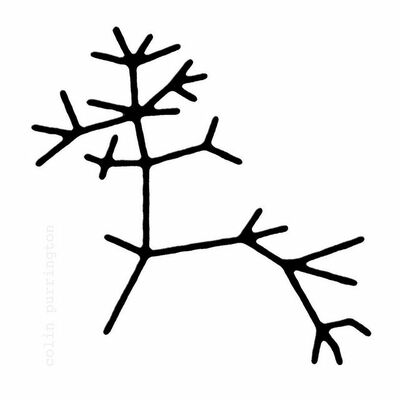
...#Vogelart schon früher auf den #Galápagos beobachtet, den #DarwinFinken bzw. #GalápagosFinken, welche sich von nur einem gemeinsamen Vorfahren aus #Ekuador zu ca. 18* differenzierten Arten von #Tangaren weiterentwickeltenten (mehrfache #AdaptiveRadiation):

https://de.wikipedia.org/wiki/Darwinfinken

*
https://en.wikipedia.org/wiki/Darwin's_finches

//

Darwinfinken – Wikipedia

@GhostOnTheHalfShell

#Evolution #Biology #Ornithology

👉Evolution in just 10 years👈

#SnailKites

(2/2)

...The #DarwinsFinches or #GalápagosFinches, which 👉evolved from but one common ancestor👈 from #Ecuador to about 18 differentiated species of #Tanager family (multiple Casey of #AdaptiveRadiation):

https://en.wikipedia.org/wiki/Darwin's_finches

//

Darwin's finches - Wikipedia

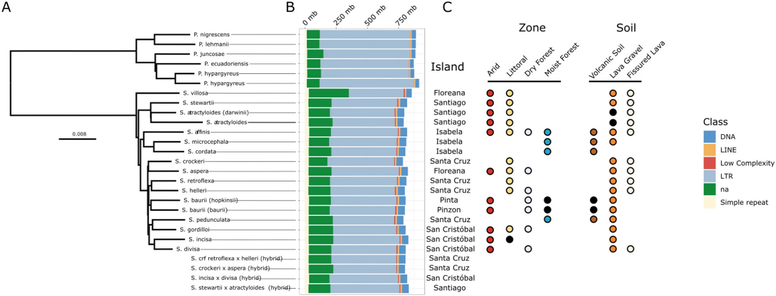
No evidence of transposable element bursts in the Galápagos Scalesia adaptive radiation despite hybridization, diversification and ecological niche shifts.

#Transposons #TEburst #AdaptiveRadiation #Diversification #Hybridization #Scalesia #PlantScience

https://mobilednajournal.biomedcentral.com/articles/10.1186/s13100-025-00362-z

No evidence of transposable element bursts in the Galápagos Scalesia adaptive radiation despite hybridization, diversification and ecological niche shifts - Mobile DNA

Transposable elements (TEs) have been hypothesized to play a pivotal role in driving diversification by facilitating the emergence of novel phenotypes and the accumulation of divergence between species. Hybridization and adaptation to novel niches have been proposed to destabilize mechanisms constraining TE proliferation, potentially inducing a ‘TE burst’ that promotes TE accumulation on the genome. The rapid speciation and ecological diversification characteristic of adaptive radiations offer a unique opportunity to examine the link between TE accumulation and speciation, diversification, hybridization and adaptation. Here, focusing on all 15 species of the genus Scalesia (Asteraceae), a radiation endemic to the Galápagos Islands, we test whether diversification, hybridization, or shifts in ecological niche are associated with changes in TE accumulation in genomes. Our analyses reveal little to no variation in TE accumulation among Scalesia species nor its hybrid populations. Shifts in ecological niches, linked to climatic variation, did not result in discernible changes in TE accumulation, a surprising finding given the anticipated selective pressure imposed by aridity, a factor often linked to genome size reduction. We found no distinct patterns in the temporal accumulation of TEs, and no effects at the class or superfamily level. Our findings suggest that while TEs may play a key role in evolution at the locus level, their macroevolutionary association with diversification or speciation appears weak. Rather than actively driving evolutionary diversification, TEs may simply be'along for the ride.
BioMed Central

New publication out 🆕 📤

"No evidence of transposable element bursts in the Galápagos Scalesia adaptive radiation despite hybridization, diversification and ecological niche shifts"

https://mobilednajournal.biomedcentral.com/articles/10.1186/s13100-025-00362-z

🔍 Despite rapid speciation, niche shifts, & hybridization, we found no significant TE accumulation differences across species or hybrids.
🌵 Even in arid-adapted lineages—where genome downsizing may be expected—TEs didn’t decline.
#TransposableElements #Speciation #AdaptiveRadiation #Genomics

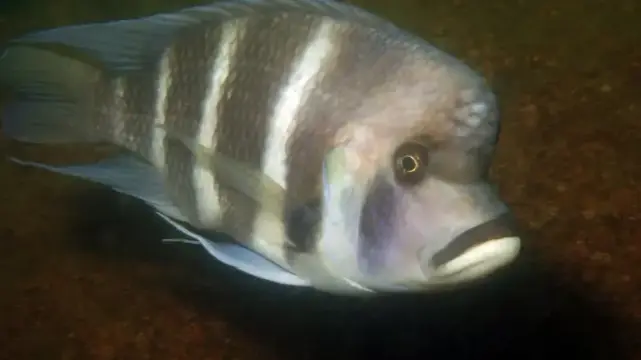
#Fish curiosity promotes #biodiversity: How exploratory behavior aids in ecological adaptation
https://phys.org/news/2024-04-cichlid-fishes-curiosity-biodiversity-exploratory.html

The #genetics of niche-specific behavioral tendencies in an #AdaptiveRadiation of #cichlid fishes https://www.science.org/doi/10.1126/science.adj9228

"#Cichlids exhibit differing degrees of curiosity. The cause for this lies in their genes. This trait influences their ability to adapt to new habitats... curious individuals can inhabit different areas compared to more cautious conspecifics."

Cichlid fishes' curiosity promotes biodiversity: How exploratory behavior aids in ecological adaptation

Cichlid fishes exhibit differing degrees of curiosity. The cause for this lies in their genes, as reported by researchers from the University of Basel in the journal Science. This trait influences the cichlids' ability to adapt to new habitats.

Phys.org

The fitness landscape of a community of Darwin’s finches

Basically confirms and expands on Darwin's understanding of adaptive radiation in Galapagos finches in real-time. Adaptive radiation is the idea that a population, in an environment with varied unoccupied habitats and resources, can relatively quickly diverge into many new species.

https://academic.oup.com/evolut/article/77/12/2533/7261081

#evolution #birds #darwin #Galapagos #adaptiveradiation #speciation #ecology

The fitness landscape of a community of Darwin’s finches

Abstract. Divergent natural selection should lead to adaptive radiation—that is, the rapid evolution of phenotypic and ecological diversity originating from a s

OUP Academic
My lovely friend whatsapped me this morning to say they’d come across me in a book they were reading and now I feel like a real scientist, thank you Jeffrey McKinnon #cichlids #adaptiveradiation #botswana #paleolake
Hey There! #introduction. My lab group uses genetics/genomics approaches to understand eco-evolutionary processes acting on natural populations within their environmental context. #speciation, #adaptation, #Evolution, #GlobalChangeBio, #InvasiveSpecies, #PopulationGenetics, #FollowForPopGenBack, #demography, #AdaptiveRadiation, #FunctionalGenomics, #epigenetics, #phenomics, #Anolis, #herpetology, #biodiversity, #museumomics, #microbiomes, #biogeography