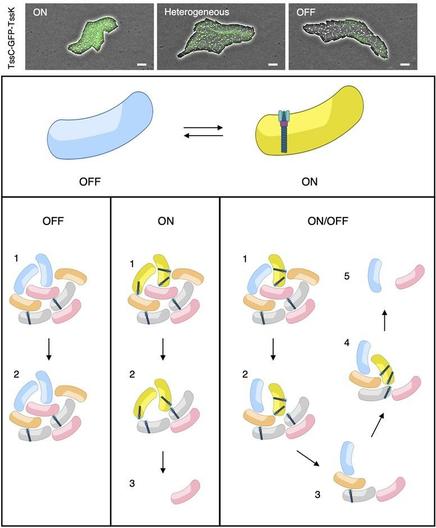
The T6SS is a widespread nanoweapon deployed by #bacteria, but why is it deployed heterogeneously? This study shows that #Ecoli adopt distinct #T6SS attacker "ON" & defender "OFF" roles to optimize survival, a key strategy in microbial warfare @PLOSBiology https://plos.io/3S5dL45
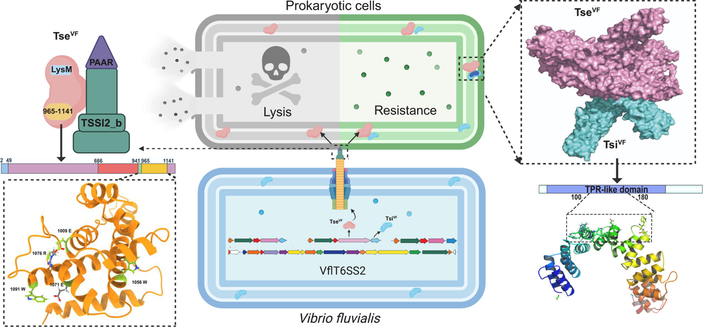
TseVF-TsiVF, a novel bacteriolytic effector-immunity pair of #Vibrio fluvialis VflT6SS2, provides a fitness advantage in microbial competition

https://www.sciencedirect.com/science/article/pii/S2666517426000076 #OpenAccess #T6SS #Microbiology

Secretion mechanisms of many T6SS effectors in Gram-neg #bacteria remain unclear. @DrDorSalomon &co identify a new class of #T6SS effectors, which can harbor either 1 or 2 toxic domains and use the WHIX domain as a secretion motif #plosbiology https://plos.io/4iCxVL3
A new class of type VI secretion system effectors can carry two toxic domains and are recognized through the WHIX motif for export

The secretion mechanisms of many type VI secretion system (T6SS) effectors in Gram-negative bacteria remain unclear. This study identifies a new class of T6SS effectors, which can harbor either one or two toxic domains, and use WHIX as a secretion motif.

#Vibrio coralliilyticus is a pathogen of #coral & #shellfish. @DrDorSalomon &co show it has two #T6SS systems that are activated at high temperatures. One targets bacterial rivals; the other launches 9 novel toxins against eukaryotic hosts #PLOSBiology https://plos.io/3Tvxw2B
The coral pathogen Vibrio coralliilyticus uses a T6SS to secrete a group of novel anti-eukaryotic effectors that contribute to virulence

Vibrio coralliilyticus is a pathogen of coral and shellfish that is becoming more virulent as ocean temperatures rise, causing significant damage. This study shows that V. coralliilyticus has two type VI secretion systems (T6SSs) that are activated at high temperatures; one targets bacterial competitors, while the other launches up to 9 novel toxins against eukaryotic hosts like shrimps.

Proud to share our new paper on RIX, a delivery domain defining a new class of polymorphic #T6SS effector in #Vibrio.

https://www.nature.com/articles/s41467-023-40659-2

The RIX domain defines a class of polymorphic T6SS effectors and secreted adaptors - Nature Communications

Bacteria use the type VI secretion system (T6SS) to deliver toxic effectors into bacterial or eukaryotic cells. Here, Kanarek et al. identify a protein domain, RIX, that defines a class of polymorphic T6SS effectors with antibacterial and anti-eukaryotic toxic domains, and that enables T6SS-mediated delivery of other effectors.

Nature
Preprint alert: A couple of weeks ago, my mentor, collaborator, and friend, Prof. Guido Sessa, passed away unexpectedly. I am proud to share the fruit of our most recent collaboration on #T6SS.
https://www.biorxiv.org/content/10.1101/2023.07.16.549128v1
New preprint from our lab. We report that genomic islands containing Gamma-Mobile-Trio proteins are bacterial armories stockpiled with antibacterial, anti-phage, and anti-eukaryotic weapons.
This one has something for everybody: #antiphage #T6SS #Vibrio #MGE
https://www.biorxiv.org/content/10.1101/2023.03.28.534373v2

Another collaboration with the Gerlic lab on #T6SS of #Vibrio proteolyticus. We show that T6SS3 delivers 3 anti-eukaryotic effectors to kill brine shrimp. This horizontally shared T6SS also induces pyroptosis in mammalian cells, so can it lead to the emergence of new pathogens?

https://www.biorxiv.org/content/10.1101/2023.03.06.530577v1

bioRxiv by @Marta_Rudzite et al from @FillouxLab
#T6SS
---
RT @biorxiv_micrbio
Effectiveness of Pseudomonas aeruginosa type VI secretion system relies on toxin potency and type IV pili-dependent interaction https://biorxiv.org/cgi/content/short/2022.11.30.518499v1 #biorxiv_micrbio
https://twitter.com/biorxiv_micrbio/status/1598139335932534784