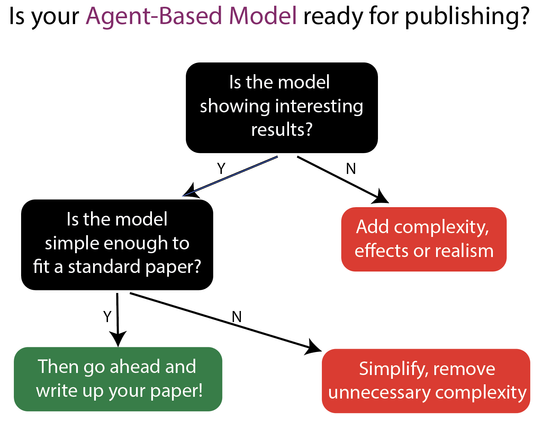
In my experience, a simple but reliable way to build #ABMs is to alternate between phases of complexity and phases of simplicity.

If the model is too simple, it will show results that are not interesting enough to be in a scientific article. We can solve this problem by adding new effects, non-linearities, interactions and some realism.

and he is at the forefront of research examining #LLMs in agent-based settings and agent-based modelling

e.g., https://s.bingheai.cn:8443/abs/2409.02822

and

https://arxiv.org/abs/2409.02822

so this will be a totally different aspect to LLMs than what we’ve seen in the seminar series so far! @cogsci @philosophy #cogsci #ABMs

Large Language Model agents can coordinate beyond human scale

Large Language Models (LLMs) are increasingly deployed as interacting agents, forming ``LLM societies''. Understanding whether these societies can self-organize and coordinate on norms without external influence is crucial to understand their risks and opportunities. Here we explore their opinion dynamics finding that it is governed by a majority force coefficient such that LLM societies can spontaneously reach consensus only up to a critical group size. This critical size grows exponentially with the language understanding capabilities of the models, exceeding the typical size of informal human groups for advanced LLMs. These results reveal emerging self-organization properties in LLM societies and provide insights for designing collaborative AI systems where coordination is either a goal or a risk.

arXiv.org

Traditional Activity-based models (#ABMs) treat individuals as isolated entities.

Rezvany et al. propose a choice set generation framework for household activity scheduling.
Their methodology adopts a Metropolis-Hastings sampling approach.

Utilising this approach, they estimate the parameters of a household-level scheduling model. This approach aims to capture household dynamics.
#STRC24
https://strc.ch/2024/program.pdf

I used to do this more often when I was more active in twitter but our group has (infrequent) journal clubs and we like to post about them. This week was about Stacy Finley's group. For those of you working on #ABMs this has great ideas.

Parameterizing complex ABMs with experimental data, especially imaging, is not easy but it is key for models that can provide quantitative predictions and using a #GeneticAlgorithm is a great way to go about it

https://journals.plos.org/ploscompbiol/article?id=10.1371/journal.pcbi.1011070

Calibrating agent-based models to tumor images using representation learning

Author summary Parameter estimation is a key step in computational model development, and accurate parameters are required to produce robust model predictions. Agent-based models (ABMs) are commonly used to simulate tumor growth; however, these models are exceedingly difficult to fit to experimental or clinical imaging data due to the complex spatial relationships of various cell types. Currently, simple comparison metrics extracted from tumor images and ABM simulations are used to qualitatively assess the model fit. In this work, we present a novel method for comparing spatial ABM simulations to tumor images as a single quantitative value that measures how different the two are and can then be used as the objective function for a parameter estimation algorithm. Our approach uses representation learning, where a neural network is used to project an input into low-dimensional space. This method can be used to aid researchers in developing and fitting tumor ABMs based on actual patient data.

Did you know you can get a printout of your favorite articles from https://nyt.com ? Paper quality is low but the wide format is fun.

This one is about the origins of agent-based modeling and life in Japanese-American internment camps. Digital edition: https://t.co/X4RS0wVdl4

#ABMs #selfpromotion

The New York Times - Breaking News, US News, World News and Videos

Live news, investigations, opinion, photos and video by the journalists of The New York Times from more than 150 countries around the world. Subscribe for coverage of U.S. and international news, politics, business, technology, science, health, arts, sports and more.

That's why simulation and #ABMs seem to be helpful. From @CairneyPaul Understanding Public Policy.
#introduction (sorry, a bit late…): Hi everyone, I investigate how #personal_networks are formed, what they look like, how they change, how they function, what flows through them, & particularly how they can both mitigate & reproduce #social_exclusion, #polarization and #segregation. I love #mixing methods (#qual, #quan, #CSS, #ABMS…). I am Dutch but work in #Barcelona since 16 years. I am also a mother of a teenage son who loves #basketball (so I watch it a lot!)
Tutorial on agent-based modeling and simulation part 2: How to model with agents
(2006) : Macal, Charles M and North, Michael J
DOI: https://doi.org/10.1109/WSC.2006.323040
#ABMS #agent_based_modeling #agents #complex_systems #sugarscape #tutorial
#my_bibtex
Tutorial on Agent-Based Modeling and Simulation PART 2: How to Model with Agents

Agent-based modeling and simulation (ABMS) is a new approach to modeling systems comprised of interacting autonomous agents. ABMS promises to have far-reaching effects on the way that businesses use computers to support decision-making and researchers use electronic laboratories to do research. Some have gone so far as to contend that ABMS is a new way of doing science. Computational advances make possible a growing number of agent-based applications across many fields. Applications range from modeling agent behavior in the stock market and supply chains, to predicting the spread of epidemics and the threat of bio-warfare, from modeling the growth and decline of ancient civilizations to modeling the complexities of the human immune system, and many more. This tutorial describes the foundations of ABMS, identifies ABMS toolkits and development methods illustrated through a supply chain example, and provides thoughts on the appropriate contexts for ABMS versus conventional modeling techniques