Rob Lancefield

@roblancefield
153 Followers
217 Following
120 Posts

A few of my keywords are:

#MuseTech #Strategy #Sustainability #OpenContent #Infrastructure #Ethnomusicology #Repatriation

One of my interests is how #museums use digital technologies to serve communities.

I remain active in the cultural heritage sector as a retired museum professional (I worked at #WesleyanUniversity and then #Yale). In pre-museum life, I was a musician, recording engineer, and photographer.

For more, please see my pinned intro and links.

( Testing: searchable )
LinkedInhttps://www.linkedin.com/in/roblancefield/
Humanities Commonshttps://hcommons.org/members/roblancefield/
Google Scholarhttps://scholar.google.com/citations?user=re0V6ZQAAAAJ&hl=en
ORCIDhttps://orcid.org/0000-0001-8758-2469
Quick blog post noting some thoughts on 'Documenting AI-created/enhanced records in catalogues/metadata/displays' - I'd love to know who's already doing it, and how? https://www.openobjects.org.uk/2026/02/documenting-automatic-text-transcription-tools-in-catalogues-metadata-displays/ #AI4LAM #MuseTech
Documenting AI-created/enhanced records in catalogues/metadata/displays? – Open Objects

Hi Everyone. Two great new positions are open at @crossref --Director of Technology and Director of Programs & Services: https://www.crossref.org/jobs/ I'm on the Board and would be happy to speak with anyone about the organization and these opportunities! #jobs #scholarlycommunications #openscience
Jobs - Crossref

Help us achieve our mission to make research outputs easier to find, cite, link, assess, and reuse. We are ~51 fully remote people spanning 14+ countries from East to West (e.g. Hong Kong to Oakland) and from South to North (e.g. Quito to Amsterdam) and we all like to interact with and co-create with our engaged community. We take our work seriously but usually not ourselves… so come and work with us - where else can you do something a bit geeky and important that is also sometimes fun?!

www.crossref.org

Wow. This is huge news for anyone who uses Finale music notation software. 😮
And it’s on a very short timeline as such things go.

https://www.finalemusic.com/blog/end-of-finale-new-journey-dorico-letter-from-president/

The End of Finale - Finale

Updates 04/30/2025 @ 8:00 AM ET: Dorico 6, the latest major update to the Dorico notation software, is available now. […]

Finale

“Moving Institutions toward Open—Building on 6 Years of the Open GLAM Survey”

“How common is it for cultural organisations to permit the free reuse of their digitised public domain collections? Where are these materials published online, and under what conditions?
Since 2018, [ @CultureDoug ] and Andrea Wallace’s Open GLAM Survey has been…providing valuable insights into open access activity within…galleries, libraries, archives and museums….”

#OpenAccess #OpenCulture

https://creativecommons.org/2024/06/26/moving-institutions-toward-open-building-on-6-years-of-the-open-glam-survey/

Moving Institutions Toward Open—Building on 6 Years of the Open GLAM Survey - Creative Commons

“Violette Heymann, 1910” by Odilon Redon (French, 1840–1916), The Cleveland Museum of Art, Hinman B. Hurlbut Collection ,CC0. Creative Commons’ Open Culture Platform is supporting 25 institutions in opening up access to their collections by the end of 2025. Members of the Platform community will be working together to create a policy template, conduct outreach,…

Creative Commons

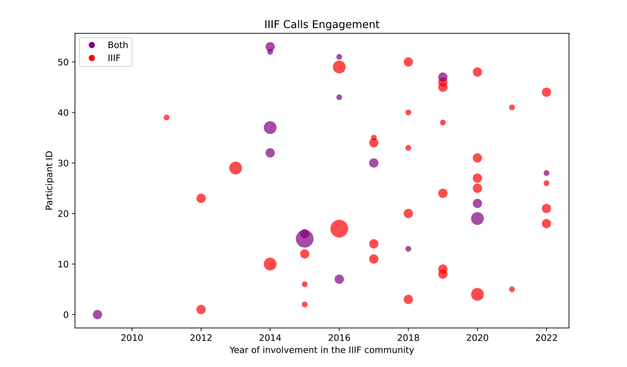
You may remember that last March, I launched a survey that aimed to explore the socio-technical characteristics of the @IIIF and #LinkedArt communities.

For instance, It sought to situate these initiatives within a broader discourse of scholarly movements and principles (#OpenScience, #CitizenScience, #FAIR, #CARE). Additionally, it serves as a preliminary means of exploring the prospective impact of Linked Open Usable Data (LOUD) and its underlying design principles in the cultural heritage field.

I am happy to say that I have just published a 29-page report: https://hal.science/hal-04162572

I have provided some insights to the people involved in those communities in Chapter 5 (pp. 25-27).

It's indeed a snapshot but I hope it's relevant for anyone interested in community practices in the cultural heritage field. I would also like to thank all of the 79 individuals who participated! :)

#LOUD #LODLAM #IIIF #culturalheritage @[email protected]

Characterising the IIIF and Linked Art communities

This report presents the findings and analysis of a survey conducted between 24 March and 7 May 2023, exploring the socio-technical characteristics of two prevalent community-driven initiatives in Digital Humanities, namely the International Image Interoperability Framework (IIIF) and Linked Art. With 79 participants, the survey investigates the practices and activities of individuals involved in these initiatives, which focus on developing and maintaining shared application programming interfaces (APIs) for enhanced interoperability and access to cultural heritage resources. It also seeks to situate these initiatives within a broader discourse of scholarly movements and principles. Additionally, it serves as a preliminary means of exploring the prospective impact of Linked Open Usable Data (LOUD) and its underlying design principles in the cultural heritage field.

“Throughout the document, we outline specific technical guidelines for various modes of modern digital lending, including how to lend digital books when an e-book license was not available at the time of digitization, how to work with publishers to allow for CDL of their undigitized backfile, and how to address digitization concerns about special and irreplaceable physical objects.”

https://libraryfutures.net/post/niso-cdl-statement

Library Futures | Stepping Down as Co-Chair of the National Information Standards Controlled Digital Lending Working Group

Championing the right to equitable access to knowledge.

I quit Twitter and moved to Mastodon in October 2022 when Elon Musk took over. Many other academics also came to Mastodon, and I was very happy - see my pinned posts. But most of them later became inactive.

I stick around because I've decided that corporate-owned social media are dangerous - especially now, when authoritarians are spreading their reach. Turns out it's unrealistic to expect that most academics feel this way - yet. They may get the idea when it's too late.

(1/2)

https://arxiv.org/abs/2406.04005

The Failed Migration of Academic Twitter

Following changes in Twitter's ownership and subsequent changes to content moderation policies, many in academia looked to move their discourse elsewhere and migration to Mastodon was pursued by some. Our study looks at the dynamics of this migration. Utilizing publicly available user account data, we track the posting activity of academics on Mastodon over a one year period. We also gathered follower-followee relationships to map internal networks, finding that the subset of academics who engaged in migration were well-connected. However, this strong internal connectivity was insufficient to prevent users from returning to Twitter/X. Our analyses reveal significant challenges sustaining user engagement on Mastodon due to its decentralized structure as well as competition from other platforms such as Bluesky and Threads. The movement lost momentum after an initial surge of enthusiasm where the main network was fully established as most users did not maintain their activity levels, and those who did faced lower levels of engagement. Our findings highlight the challenges involved in transitioning professional communities to decentralized platforms, emphasizing the need for focus on community building for long-term user engagement.

arXiv.org

The Register: In a newly released paper, 4 university computer scientists report that OpenAI's GPT-4 large language model (LLM) can autonomously exploit vulnerabilities in real-world systems if given a CVE advisory describing the flaw. 🔗 https://www.theregister.com/2024/04/17/gpt4_can_exploit_real_vulnerabilities/

GPT-4, said Daniel Kang, assistant professor at UIUC, in an email to The Register, "can actually autonomously carry out the steps to perform certain exploits that open-source vulnerability scanners cannot find (at the time of writing)."

#AI #LLM #GPT4 #OpenAI #vulnerability #CVE

OpenAI's GPT-4 can exploit real vulnerabilities by reading security advisories

While some other LLMs appear to flat-out suck

The Register

Lawmakers share a draft of the American Privacy Rights Act, which would create a registry of data brokers, let consumers opt out of some data collection, more (Orion Donovan Smith/Spokesman.com)

https://www.spokesman.com/stories/2024/apr/07/cantwell-mcmorris-rodgers-strike-bipartisan-deal-o/
http://www.techmeme.com/240407/p8#a240407p8

Cantwell, McMorris Rodgers strike bipartisan deal on landmark data privacy bill

WASHINGTON – Since the dawn of the internet age, tech companies have developed increasingly sophisticated ways to collect and use vast swaths of Americans' personal data, while Congress has repeatedly failed to regulate the practice. Now, two Washington state lawmakers have a bipartisan plan to break that impasse and set a national standard for data privacy.

The Spokesman-Review

“Today, Creative Commons is releasing new guidelines for open culture:
Nudging Users to Reference Institutions When Using Public Domain Materials.”

#OpenCulture #PublicDomain #MuseTech

https://creativecommons.org/2024/02/23/helping-users-refer-to-host-institutions/

Where in the world is… this public domain material? Helping users refer to host institutions. - Creative Commons

CC’s new guidelines aim to encourage users to refer to host cultural heritage institutions when using public domain materials. Rooted in the Behavioural Insights Team’s EAST Model, they offer institutions practical design ideas to nudge users into referring back to them.

Creative Commons