#musetech #semweb #lod #lodlam #libtech #linkedart #fairglam
Two months ago would have been the approximate tenth anniversary of the American Numismatic Society receiving a major Preservation and Access grant from the National Endowment for the Humanities to complete Online Coins of the Roman Empire (OCRE). OCRE remains the ANS’ most popular digital project, attracting hundreds of unique users per day. Although the […]
DH@Guelph was pretty great. Took the session on Linked Open Data and the Semantic Web by THINCLAB and had about two months' worth of information jammed into my brain over the course of two and a half days. The neural fatigue was ROUGH but man, it was a great time nonetheless.
Brb I'm going to go sleep all three days of this holiday weekend now...
#DH #DigitalHumanities #Guelph #LOD #LODLAM #semanticWeb @acadmicchatter
Aujourd'hui, je vais faire une présentation sur le Linked Open Usable Data (LOUD) dans le cadre de la conférence internationale sur les humanités numériques (CIHN24) qui se déroule à la Haute école de gestion de Genève.
Je parle un peu de ce que je fais dans ma thèse de doctorat, des standards provenant des communautés #IIIF et #LinkedArt et pourquoi la collaboration transversale des communautés #LOUD est importante pour les institutions du patrimoine culturel.
Présentation en français :
https://julsraemy.ch/prezi/cihn24-loud-catalyseur-convergence.html
Même présentation en anglais :
https://julsraemy.ch/prezi/cihn24-loud-catalyst-convergence.html
Version avec DOI (Zenodo) : https://zenodo.org/doi/10.5281/zenodo.10526541
L'émergence du Linked Open Usable Data (LOUD) – littéralement « données ouvertes liées et utilisables » – représente un tournant dans la convergence des sciences de l'information et des humanités numériques. Ce concept innovant cherche à équilibrer la complétude et la précision des données avec leur accessibilité et utilité pour un public étendu. Historiquement, la connexion des données du patrimoine culturel a été entravée par des obstacles techniques et conceptuels. Les initiatives préexistantes se concentraient sur la rigueur ontologique, souvent au détriment de l'accessibilité et de l'usabilité des données pour les non-experts. Les projets Linked Open Data (LOD) étaient essentiellement axés sur la publication et la consommation de données pour un public d'experts en RDF (Resource Description Framework). L'introduction de JSON-LD en 2014 a réduit les barrières à l'entrée pour les développeurs, permettant une interprétation des données RDF en format JSON standard plus accessible. LOUD se distingue par ses principes de conception bien définis et ses spécifications basées sur JSON-LD. Il inclut des standards communautaires tels que l'API Présentation 3.0 de l'International Image Interoperability Framework (IIIF) et Linked Art ainsi que le Web Annotation Data Model du World Wide Web Consortium (W3C), orientant vers une meilleure accessibilité et interopérabilité des données. Ces principes couvrent a) la bonne abstraction en fonction du public, b) peu d'obstacles à l'entrée, c) compréhensibilité par introspection, d) documentation avec des exemples concrets, e) minimisation des exceptions et promotion de modèles cohérents. Les standards adhérants aux principes LOUD, en synergie, accroissent l'interopérabilité sémantique, même si cela peut impacter la pureté ontologique. Cette approche pragmatique facilite une meilleure utilisation et intégration des données du patrimoine culturel. LOUD peut également servir de fondements communs pour les institutions patrimoniales et les projets de recherche, offrant un cadre harmonisé pour la gestion des données culturelles. Malgré les défis d'adoption à grande échelle, l'exemple de Yale avec sa plateforme LUX, qui a été publiée officiellement en mai 2023, montre comment l'intégration des spécifications LOUD, notamment IIIF et Linked Art, peut améliorer l'interopérabilité et enrichir les données culturelles. LUX représente une application exemplaire des standards LOUD car la plateforme intègre les collections variées de l'université, incluant le Yale Center for British Art, la Yale University Art Gallery, le Yale Peabody Museum et la Yale University Library, totalisant quelque 41 millions de ressources. Cette intégration englobe des domaines tels que l'art, l'histoire naturelle, les catalogues de la bibliothèque et les données archivistiques. LUX se distingue par son architecture systémique comprenant la récolte et la réconciliation de données par le biais d'une chaîne de traitement automatique. Sa force réside dans sa capacité à intégrer des sources de données externes, offrant ainsi une richesse de perspectives et un enrichissement des données accessibles aux utilisateurs.LOUD émerge comme un catalyseur clé pour les sciences de l'information et les humanités numériques, équilibrant complétude, précision et accessibilité des données. L'approche illustrée par Yale démontre l'impact de LOUD dans l'amélioration de l'accès et de la valorisation des données du patrimoine culturel, marquant une avancée significative dans le domaine.
Very pleased that our research paper has just been published on ACM Journal on Computing and Cultural Heritage (JOCCH).
This contribution is part of the Special Issue on “Applying Innovative Technologies to Digitised and Born-Digital Archives” which is made possible through the AEOLIAN (Artificial Intelligence for Cultural Organisations) Network.
In our paper, we reflect on some of the preliminary findings of the PIA research project around annotations of photographic archives from the Swiss Society for Folklore Studies as knowledge practices, the underlying technological decisions, and their impact.
This was a truly interdisciplinary effort as we were one PhD Candidate in Cultural Anthropology (Murielle Cornut), one PhD Candidate in Computer Science (Florian Spiess), and myself.
#iiif #loud #lodlam #machinelearning #culturalheritage #LinkedArt
We reflect on some of the preliminary findings of the Participatory Knowledge Practices in Analogue and Digital Image Archives (PIA) research project around annotations of photographic archives from the Swiss Society for Folklore Studies (SSFS) as ...
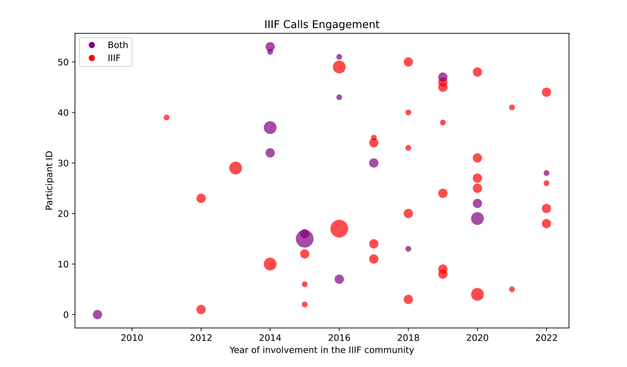
You may remember that last March, I launched a survey that aimed to explore the socio-technical characteristics of the @IIIF and #LinkedArt communities.
For instance, It sought to situate these initiatives within a broader discourse of scholarly movements and principles (#OpenScience, #CitizenScience, #FAIR, #CARE). Additionally, it serves as a preliminary means of exploring the prospective impact of Linked Open Usable Data (LOUD) and its underlying design principles in the cultural heritage field.
I am happy to say that I have just published a 29-page report: https://hal.science/hal-04162572
I have provided some insights to the people involved in those communities in Chapter 5 (pp. 25-27).
It's indeed a snapshot but I hope it's relevant for anyone interested in community practices in the cultural heritage field. I would also like to thank all of the 79 individuals who participated! :)
This report presents the findings and analysis of a survey conducted between 24 March and 7 May 2023, exploring the socio-technical characteristics of two prevalent community-driven initiatives in Digital Humanities, namely the International Image Interoperability Framework (IIIF) and Linked Art. With 79 participants, the survey investigates the practices and activities of individuals involved in these initiatives, which focus on developing and maintaining shared application programming interfaces (APIs) for enhanced interoperability and access to cultural heritage resources. It also seeks to situate these initiatives within a broader discourse of scholarly movements and principles. Additionally, it serves as a preliminary means of exploring the prospective impact of Linked Open Usable Data (LOUD) and its underlying design principles in the cultural heritage field.