

Maud Bénard

@mtmd
70 Followers
123 Following
125 Posts

PhD student in Translation Studies at #UniversiteParisCite (université Paris Cité, France).

My thesis explores the assessment of complex noun phrases in machine translation when dealing with English for specific purposes. Focus is given to EN-to-FR translations of research articles in the fields of medicine and NLP.

Research interest: academic discourse, translation, machine translation, applied linguistic, terminology, linguistic corpus, English for specific purposes

LanguagesFrench, English (newbie with Korean and Chinese)
ORCID ID0000-0001-7031-8637
Faculty profile (lectures and responsibilities)https://clillac-arp.u-paris.fr/annuaire/benard-maud/
LinkedInhttps://www.linkedin.com/in/maud-b%C3%A9nard-81286b14/?locale=en_US

The strain on scientific publishing 📄:

The publishing sector has a problem. Scientists are overwhelmed, editors are overworked, special issue invitations are constant, research paper mills, article retractions, journal delistings… JUST WHAT IS GOING ON!?

Myself, pablo, @paolocrosetto and Dan have spent the last few months investigating just that.
https://arxiv.org/abs/2309.15884

A thread🧵1/n

#AcademicChatter #PublishOrPerish #Elsevier #Springer #MDPI #Wiley #Frontiers #PhDAdvice #PhDChat #SciComm

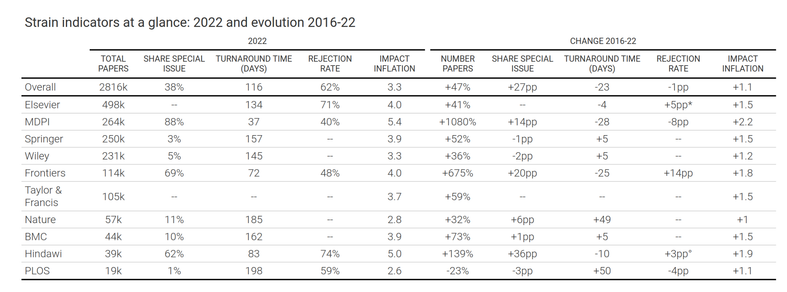
The strain on scientific publishing

Scientists are increasingly overwhelmed by the volume of articles being published. Total articles indexed in Scopus and Web of Science have grown exponentially in recent years; in 2022 the article total was approximately ~47% higher than in 2016, which has outpaced the limited growth - if any - in the number of practising scientists. Thus, publication workload per scientist (writing, reviewing, editing) has increased dramatically. We define this problem as the strain on scientific publishing. To analyse this strain, we present five data-driven metrics showing publisher growth, processing times, and citation behaviours. We draw these data from web scrapes, requests for data from publishers, and material that is freely available through publisher websites. Our findings are based on millions of papers produced by leading academic publishers. We find specific groups have disproportionately grown in their articles published per year, contributing to this strain. Some publishers enabled this growth by adopting a strategy of hosting special issues, which publish articles with reduced turnaround times. Given pressures on researchers to publish or perish to be competitive for funding applications, this strain was likely amplified by these offers to publish more articles. We also observed widespread year-over-year inflation of journal impact factors coinciding with this strain, which risks confusing quality signals. Such exponential growth cannot be sustained. The metrics we define here should enable this evolving conversation to reach actionable solutions to address the strain on scientific publishing.

arXiv.org

#LangTech specialists! #Translators! #Terminologlists! Heard of IATE? It's the EU's inter-institutional terminology database (http://iate.europa.eu) by @EU_CdT. Download IATE and use the IATE extraction tool! https://data.europa.eu/euodp/en/data/dataset/iate

#InternationalTranslationDay

🐦🔗: https://nitter.eu/EU_opendata/status/1575921296432504832

iate

The terminology database of the European Union

✍️ 🗣️ While #interpreters & #translators have different tasks, the purpose of #InternationalTranslationDay is to recognise the contribution of language specialists to promote peace & growth across linguistically varied countries

More on our #SCICkci 👇

#EDLangs

@translatores

🐦🔗: https://nitter.eu/EUInterpreters/status/1575884654892269568

EU Interpreters (@EUInterpreters)

✍️ 🗣️ While #interpreters & #translators have different tasks, the purpose of #InternationalTranslationDay is to recognise the contribution of language specialists to promote peace & growth across linguistically varied countries More on our #SCICkci 👇 #EDLangs @translatores

Nitter
It can happen to the best of us.
#academia #research #science #scifi

The strain on scientific publishing: “in 2022 the article total was 47% higher than in 2016. Thus, publication workload per scientist (writing, reviewing, editing) has increased dramatically. We define this problem as the strain on scientific publishing. Such exponential growth cannot be sustained”

https://arxiv.org/abs/2309.15884

The strain on scientific publishing

Scientists are increasingly overwhelmed by the volume of articles being published. Total articles indexed in Scopus and Web of Science have grown exponentially in recent years; in 2022 the article total was approximately ~47% higher than in 2016, which has outpaced the limited growth - if any - in the number of practising scientists. Thus, publication workload per scientist (writing, reviewing, editing) has increased dramatically. We define this problem as the strain on scientific publishing. To analyse this strain, we present five data-driven metrics showing publisher growth, processing times, and citation behaviours. We draw these data from web scrapes, requests for data from publishers, and material that is freely available through publisher websites. Our findings are based on millions of papers produced by leading academic publishers. We find specific groups have disproportionately grown in their articles published per year, contributing to this strain. Some publishers enabled this growth by adopting a strategy of hosting special issues, which publish articles with reduced turnaround times. Given pressures on researchers to publish or perish to be competitive for funding applications, this strain was likely amplified by these offers to publish more articles. We also observed widespread year-over-year inflation of journal impact factors coinciding with this strain, which risks confusing quality signals. Such exponential growth cannot be sustained. The metrics we define here should enable this evolving conversation to reach actionable solutions to address the strain on scientific publishing.

arXiv.org
An interesting initiative from the french public research institute CNRS: the development of a new scholarly literature search engine named Matilda
#ESR #Research #Science

Mind maps are not a recent invention. The insightful book Lines of Thought by Even-Ezra shows how medieval authors used mind maps in the marginalia of their books to help them understand what they read. #medieval #mindmap

Fun cat: The curly braces { } were derived from this habit. They are not parenthesis but branches of a mind map.

IA génératives : la fin des exercices rédactionnels à l’université ?

Stéphane Crozat est membre de Framasoft, auteur de « Traces » et de « Les libres », et surtout, enseignant à l'Université de Technologie de Compiègne (UTC). Il nous livre ci-dessous une réflexion personnelle - initialement publiée sur son blog - au sujet de l'usage des LLM (ChatGPT ou autre) dans les travaux des étudiant⋅es....

Framablog

Just being a newbie in writing for academic journals, how bad is it if reviewer 1 is like "great idea, well written, but x,y,z need some more attention", reviewer 3 is like "nice work, interesting points, though I miss a,b" and reviewer 2 is like "I thought this would be good but it's meh, you're too far from this journal's standard and why would this be novel cuz don't see it." ? @phdlife @academicchatter

Oh yeah. I have a 10k word count limit, already at 9993.

Applications are now open for the eighth summer school on statistical methods for linguistics and psychology:

https://vasishth.github.io/smlp2024/

Applications close April 1, 2024.

The Eighth Summer School on Statistical Methods for Linguistics and Psychology