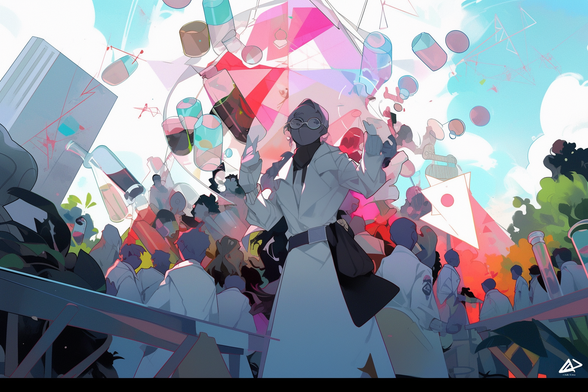
Outtake from recent work generating #illustrations for #SciComm.
#midjourney prompt "science–#policy relations. illustration."
| Website | https://criticalzone.org/dust2 |
| popsci+ profile | https://www.popsci.com/environment/dust-clouds-dangerous-air-pollution/ |
Outtake from recent work generating #illustrations for #SciComm.
#midjourney prompt "science–#policy relations. illustration."
The relationship between #scientists and #policymakers is changing.
Traditionally #science is made available to those who are interested, and the scientist goes on to do more work.
This 2022 paper examines how #Dutch scientists took a more active role in shaping #policy.
"An engagement with the politics of knowledge by experts as well as policymakers can encourage more effective and legitimate knowledge production and use."
Formulating adequate responses to pressing socio-ecological challenges requires effective and legitimate knowledge production and use. The academic debate has gradually shifted from a linear model of science–policy relations towards co-productive alternatives. Yet, in practice, the linear model remains lingering. This paper uses a case study of a collaboration between a Dutch research institute and a ministerial department to examine how and why this linear model is so persistent. Our analysis shows the dominance of the linear model in this collaboration, while openings for a more co-productive relationship remain largely unexplored. Our findings illustrate that an important reason for this persistence of the linear model is the lack of a convincing and attractive alternative imaginary of science–policy practices, which defines clear roles and competencies for researchers as well as policy actors involved. We argue this is symptomatic of a wider tendency among both researchers and policy actors to construct science as an obligatory passage point towards policy. However, this tendency not only enables policy actors to offload their responsibility but also fails to capitalise on the opportunities offered by these practices to explicate the politics embedded in and foregrounded by knowledge production. Such an engagement with the politics of knowledge by experts as well as policymakers can encourage more effective and legitimate knowledge production and use.
Read some of our work studying the transport and deposition of #microplastics: https://criticalzone.org/dust2/publications
This work has taken on unexpected importance as we study how particulates move through the #CriticalZone.
If you're a journalist and writing about #microplastics Cluster member Janice Brahney is a great source of information and insight for you.
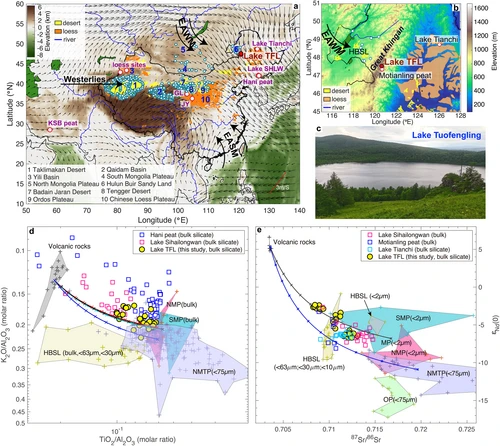
"Here, we present records of the...composition of sediments from...over the past ∼25 thousand years."
Fascinating paper from June 2023 by Wenfang Zhang, et. al.
This is #SourceToSink research in the #CriticalZone in #China and aligns with some of the the early findings from our Cluster projects.
#EnvironmentalScience #ScienceCommunications
https://agupubs.onlinelibrary.wiley.com/doi/10.1029/2023GL103633
"A lot of people refer to it as social justice. I call it social injustice in terms of the people that are being exposed to poor air quality," Cluster member and University of #Utah faculty member told students during a 2022 #FieldTrip to the #GreatSaltLake.
Full article here: https://www.ksl.com/article/50504223/students-get-expansive-great-salt-lake-experience
Image of a #dust storm captured by #MODIS in 2002.
The African countries of #Sudan (top left), #Ethiopia (bottom left), with #Eritrea nestled between them along the western coast of the Red Sea. On image right are Saudi Arabia (top) and #Yemen (bottom) on the Arabian Peninsula. Overlooking the Red Sea, a long escarpment runs along the western edge of the Arabian Peninsula, and in this image appears to be blocking the full eastward expansion of the dust storm.
https://visibleearth.nasa.gov/images/60664/dust-storm-over-the-red-sea
Our Cluster studies how mineral #dust moves through the #CriticalZone, the part of the Earth which supports surface life.
As part of a three day meeting finding ways to pool their knowledge and advance #EnvironmentalScience members of the nine clusters in the Critical Zone Collaborative Network visited a #FieldSite near #SaltLakeCity which provides some of our #dust on #snow data, managed by a #Dustˆ2 team based at the #University of #Utah.
More about their work: https://kslnewsradio.com/2013500/how-altas-dirtiest-snow-year-ended-its-2022-snowmelt-process-2-weeks-early.
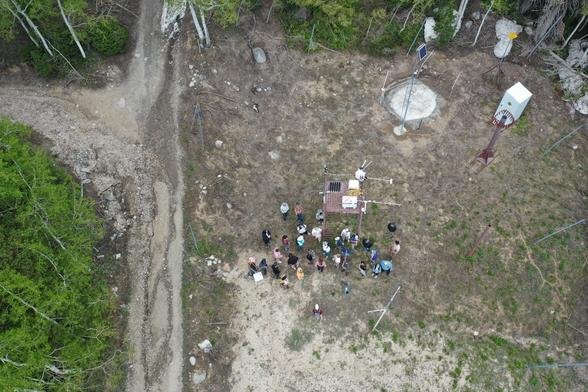
#WildlandFires in #Canada have been making headlines in the U.S. #CriticalZone researchers have been studying the effects of stronger and more frequent large #widlfires for decades. And, of interest to us here in the #Dust Cluster, how these disturbances contribute to the movement of small particles throughout the #ComplexSystems of the #CriticalZone.
#EnvironmentalScience #ecology
https://www.preventionweb.net/news/wildfires-often-lead-dust-storms-and-theyre-getting-bigger
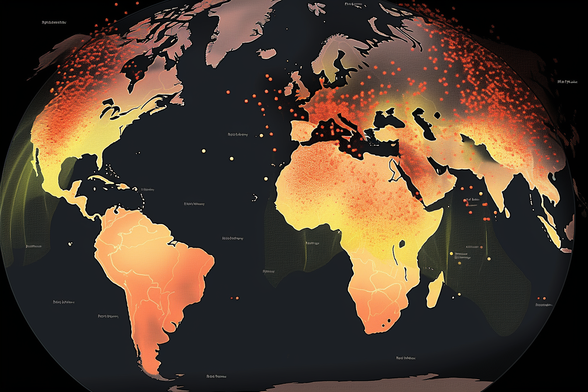
Members of the #Dustˆ2 Cluster often collaborate with policy makers as we learn more about how #LandUse and #ClimateChange influence the movement of dust in the #CriticalZone.
Look for Cluster member @jmunroe at @EuroGeosciences #EGU23 this week and find out more about how this team is part of finding solutions to large scale environmental emergencies like the collapse of the #GreatSaltLake in #Utah.

