#People4Bikes just released their 2026 city rankings

https://www.peopleforbikes.org/news/2026s-best-places-to-bike

This is a really cool project that tries to estimate the biking stress level of every street in a city, and calculate how likely you can get to where you want to go on low stress streets.

However, taking a look at how #CambridgeMA and #SomervilleMA are rated, I have some questions and thoughts.

Let's dive in! 🧵
#BikeTooter #BikeBoston

2026’s Best Places to Bike | PeopleForBikes

Our annual City Ratings is a data-driven approach to evaluate, compare, and celebrate the best cities for biking in the U.S. Based on data from PeopleForBikes’ Bicycle Network Analysis (BNA), each city receives a City Ratings score on a scale of 0-100.

PeopleForBikes

To start with, let's take a look at how #CambridgeMA and #Somerville scores have changed (graph from https://cityratings.peopleforbikes.org/cities/cambridge-ma)

👀

Somehow when P4B updated their methodology this year, Cambridge and Somerville specifically were massively negatively affected. I can confidently say that both cities have made biking improvements over the last year, so there is something else going on.

#People4Bikes #BikeTooter

Let's take a look at the #Massachusetts top 10

👀

#1: P-Town - sure, small town that you could bike everywhere in town easily enough

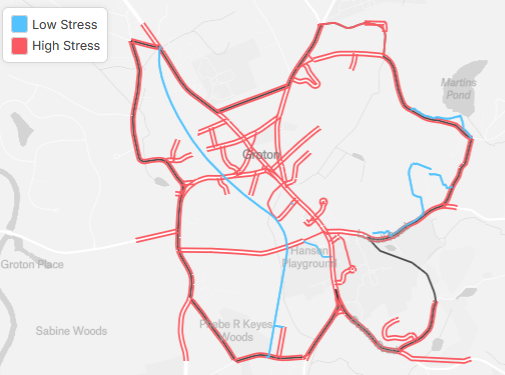
#2: Groton - ??? Take a look at that map and tell me you can reasonably travel throughout town on low-stress streets

#5: Sturbridge - LOL

#6: Cambridge - Yeah, I can confidently say the low-stress network here is much better than basically all those other towns

#BikeTooter #BikeBoston #People4Bikes

Somerville is down at #32, below such biking havens as Bedford, Hopkinton, Lynnfield, and Acton

#Massachusetts #BikeTooter #BikeBoston #People4Bikes

To be clear, I actually have a pretty good understanding of how hard a problem P4B are trying to solve. Using #OSM data to estimate biking stress is exactly how our @bikeboston.bsky.social Stress Map (https://labs.bostoncyclistsunion.org/stressmap/) is created.

I know more than most the limitations to this type of project. But I don't think their stress map is off, its how they rate cities after creating the stress map.

#BikeTooter #BikeBoston #People4Bikes

Bike Stress Map - BCU Labs

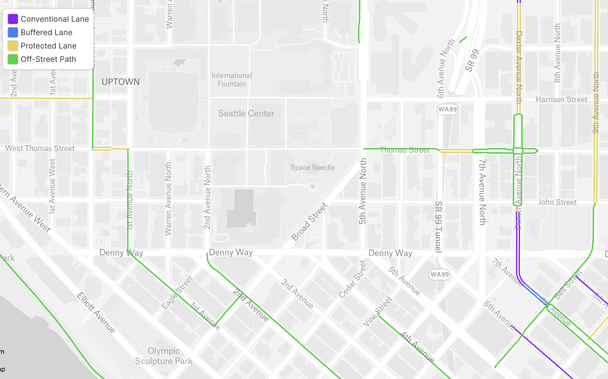
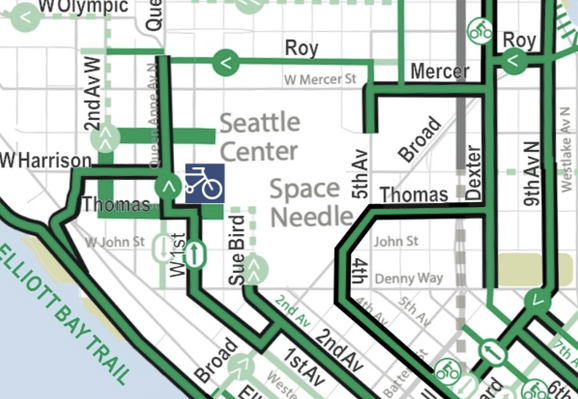
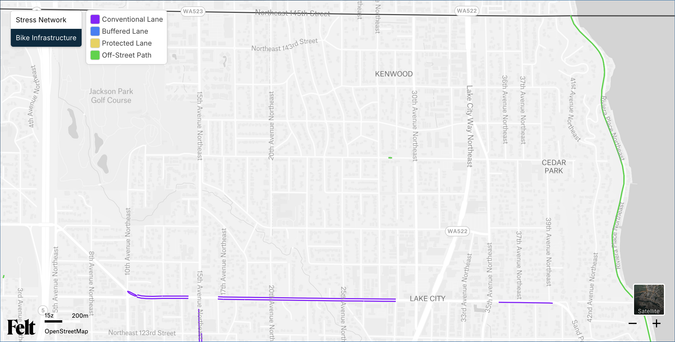
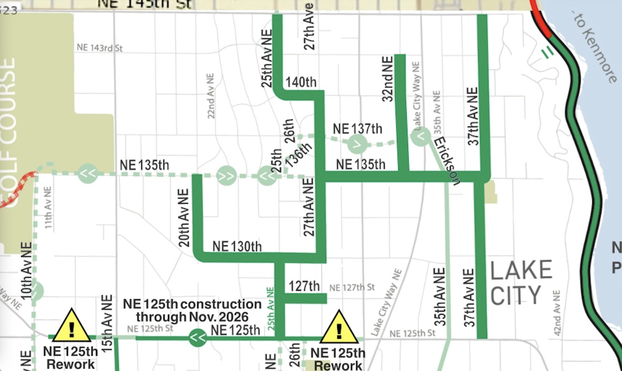
@BostonBikeData @bikeboston.bsky.social I do think their stress map is off for Seattle in some areas I know, and I _know_ their infrastructure map is off. Wildly so, even. Not just because we have entire categories of infrastructure that is valid but not "bike lanes," but also because they either don't know things they _do_ understand are there, or they've miscategorised it.

(I'm not even including issues like "all our transit is also bike infrastructure." Which it is.)

I sent in some rather specific criticisms the last time I noticed them missing big swaths of data. I never heard back.

Here are a couple of areas I'm particularly familiar with as examples. One's up in northeast Seattle, one's around the Space Needle.

@BostonBikeData @bikeboston.bsky.social We similarly have the jurisdiction issue you describe. It's not as bad as Boston, I don't think, but along the Northshore / North end area, it's five cities _if_ you stay entirely within King County, and more like... 10 or 11? counting unincorporated areas of Snohomish County like Esperance? And that's all areas which are very much Greater Seattle.

@BostonBikeData @bikeboston.bsky.social And I'm like... _as a bike infrastructure map maker_, I understand _directly_ that their task is severely difficult. But when I check areas I know particularly well and find them _so_ divergent from what I know on the ground, it's really hard to know how seriously I can take any of it.

And I have to think the cities they're trying to talk to will see similar issues and have similar reactions.

@moira I don't know Seattle well enough to dig in, but some of what you describe is likely the state of OSM being inaccurate.

A few years ago I fixed up Cambridge posted speed limits and the rating jumped considerably. They wrote an article that year about the success in Cambridge and talked about all the good stuff the city has been doing, but it was only recognized because OSM got fixed.

@moira Converting from OSM to stress is HARD. Specifically, the official LTS tables are based on car speed and volume, neither of which are or should be tagged in OSM.

So you end up guessing based on road classification and characteristics for volume, and signed speed limit or citywide default speed limit for speed. These can easily be off for the real experience of a street. But this is where I'm pretty generous on their execution. They do a pretty good job with what they have.

@moira but their choice to make it a simple binary really isn't how people experience streets and obscures some nuance that I think is valuable. The LTS scale does too, but at 4 levels, you can see the differences between "I only see young riders" and "no shit no one bikes here"