To recap:

-P4B has a cool and challenging project to rate biking in cities across the US
-Doing this well is HARD
-They made changes this year that don't track with what gets people biking
-Bike networks extend beyond city borders, and cities have influence outside their borders
-Useful destinations are important, ignoring the lack of them hurts accuracy
-People will bike small distances of high-stress, and accounting for that will give a more accurate network analysis

#People4Bikes

Related to P4B simplifying, they chose to compress Level of Traffic Stress from 4 levels to 2 levels. This is a pretty reasonable choice, especially for how they perform their analysis (all high-stress is the same). But, even if they don't show it, calculating the 4 levels and using that to weight each segment and how far people will choose to bike on them would likely give a more accurate version of the suggestion in the previous post.

#People4Bikes

Cambridge has been systematically improving its bike network over the past decade, and has seen steady increase in bike usage. But you don't really see that in the ratings. Small high-stress segments isolate in these ratings more than they do in real life.

P4B should learn from this and allow high-stress travel, but where those segments have an added cost. This is standard practice in any routing algorithm.

Year-over-year bike improvements will show up better in the ratings!

#People4Bikes

Problem #2: This is actually a harder decision, but P4B is rigid that if there is any high-stress, then it is inaccessible. But this decision is massively over-simplifying how people choose to bike.

If there is a mostly low-stress route but a block of high-stress, many people will accept that. As that block gets longer, fewer people accept the risk.

#People4Bikes

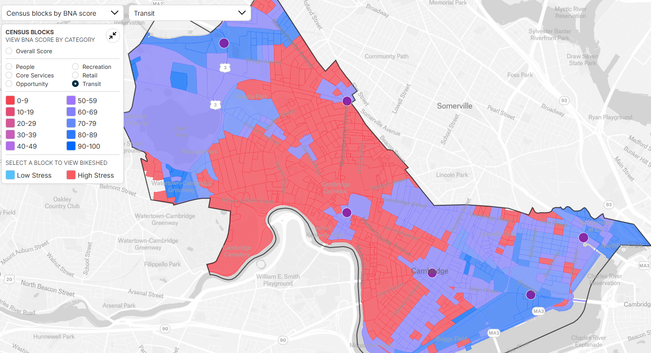
Problem #1: If we draw in the lines for those stations, you notice that most of them are on the same line. If you can bike to any Red Line station, you can get to them all low-stress, but Cambridge is losing points here.

(This is ignoring that there are Somerville stations that maybe you could get to stress free that are ignored)

#People4Bikes

But there are 2 major things that are negatively affecting the scores, but first let's explain the scoring system:

You get 60 points for being able to get to 1 station, and the other 40 points are the % of other stations within 1.7mi are completely low-stress to get to.

#People4Bikes

Cambridge is rated pretty poorly on transit (35/100), which is interesting because it has some of the best transit service in the US

Looking at the transit coverage view of the map, you can see that Transit=T stops (plus if you zoom into Lechmere the Charles Riverboat "ferry terminal", which is just a sightseeing boat, but that is an issue with OSM tagging)

#People4Bikes

Back to diving in deep on the methodology, using Cambridge as an example (follow along here https://bna.peopleforbikes.org/cities/United%20States/Massachusetts/Cambridge)

#People4Bikes

PeopleForBikes Bicycle Network Analysis (BNA) - PeopleForBikes Bicycle Network Analysis (BNA)

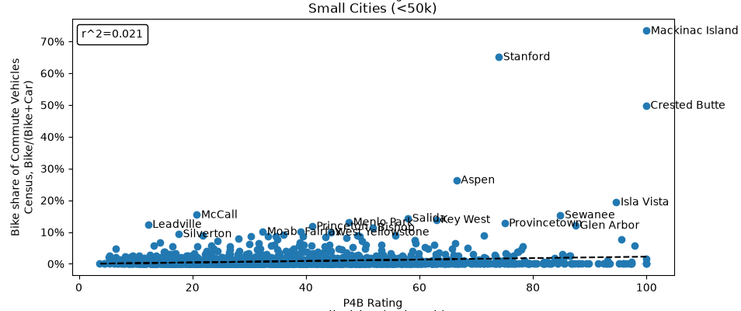
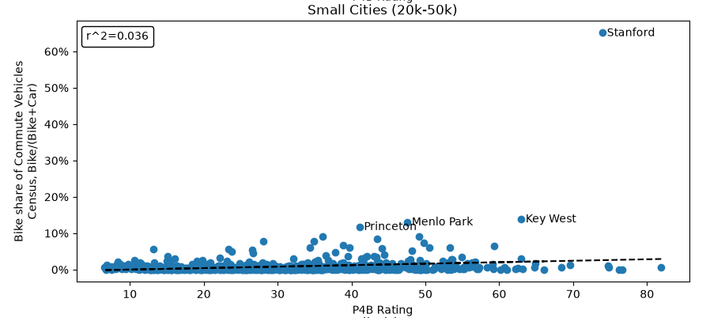
Small cities are where this rating system really breaks down. There is basically no relationship between the rating and the biking rate.

P4B shouldn't exclude most of the categories that are excluded in small towns in the current system. I suspect that those lack of destinations are actually what is hurting the biking in these towns and leading to unusually high ratings that I laughed at way up in the thread, even when the stress map is mostly high stress roads.

#People4Bikes

Rochester Hills, MI and Anchorage, AK are the next highest rated medium cities.

Rochester Hills is a Detroit suburb that definitely has some regional effects (look up its boundary enclosing Rochester), but otherwise I don't know much about it to talk about learnings from its score.

Anchorage is a cool town to bike a little in (saw a moose within a few minutes when I did), but also being suppressed on biking kinda makes sense being in Alaska and all.

#People4Bikes