#People4Bikes just released their 2026 city rankings

https://www.peopleforbikes.org/news/2026s-best-places-to-bike

This is a really cool project that tries to estimate the biking stress level of every street in a city, and calculate how likely you can get to where you want to go on low stress streets.

However, taking a look at how #CambridgeMA and #SomervilleMA are rated, I have some questions and thoughts.

Let's dive in! 🧵
#BikeTooter #BikeBoston

2026’s Best Places to Bike | PeopleForBikes

Our annual City Ratings is a data-driven approach to evaluate, compare, and celebrate the best cities for biking in the U.S. Based on data from PeopleForBikes’ Bicycle Network Analysis (BNA), each city receives a City Ratings score on a scale of 0-100.

PeopleForBikes

To start with, let's take a look at how #CambridgeMA and #Somerville scores have changed (graph from https://cityratings.peopleforbikes.org/cities/cambridge-ma)

👀

Somehow when P4B updated their methodology this year, Cambridge and Somerville specifically were massively negatively affected. I can confidently say that both cities have made biking improvements over the last year, so there is something else going on.

#People4Bikes #BikeTooter

Let's take a look at the #Massachusetts top 10

👀

#1: P-Town - sure, small town that you could bike everywhere in town easily enough

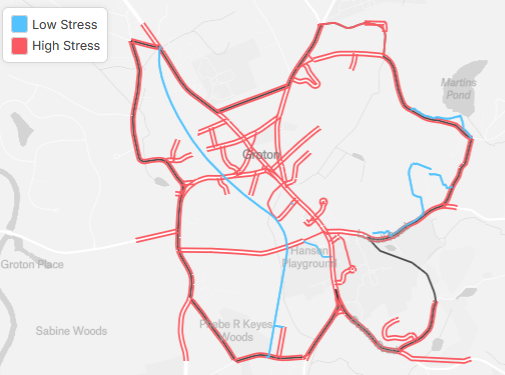
#2: Groton - ??? Take a look at that map and tell me you can reasonably travel throughout town on low-stress streets

#5: Sturbridge - LOL

#6: Cambridge - Yeah, I can confidently say the low-stress network here is much better than basically all those other towns

#BikeTooter #BikeBoston #People4Bikes

Somerville is down at #32, below such biking havens as Bedford, Hopkinton, Lynnfield, and Acton

#Massachusetts #BikeTooter #BikeBoston #People4Bikes

To be clear, I actually have a pretty good understanding of how hard a problem P4B are trying to solve. Using #OSM data to estimate biking stress is exactly how our @bikeboston.bsky.social Stress Map (https://labs.bostoncyclistsunion.org/stressmap/) is created.

I know more than most the limitations to this type of project. But I don't think their stress map is off, its how they rate cities after creating the stress map.

#BikeTooter #BikeBoston #People4Bikes

Bike Stress Map - BCU Labs

I alluded to it before, but P4B did make a major change to their methodology this year. You can read about the changes and rationale here: https://www.peopleforbikes.org/news/2026-city-ratings-methodology.

#BikeTooter #BikeBoston #People4Bikes

2026 City Ratings Methodology Updates: What Is Changing and Why It Matters | PeopleForBikes

Every year, PeopleForBikes uses the Bicycle Network Analysis (BNA) to produce our annual City Ratings, a data-driven measure of how well a city’s bike network connects people to the places they want to go. This program helps cities identify gaps in their bike networks, highlights opportunities to improve, and benchmarks progress over time.

PeopleForBikes

From their description of the methodology updates:

"These updates have steadily improved the accuracy with which City Ratings reflect real-world bike networks."

"In previous versions of City Ratings, the Bicycle Network Analysis included some roads and destinations just beyond city limits — typically within one to two miles — as part of a city’s score. In some cases, that meant scores were influenced by infrastructure outside a city’s control."

#BikeTooter #BikeBoston #People4Bikes

I am pretty sure the exclusion of routes outside the city lines is the primary culprit for both Somerville and Cambridge ratings tanking.

However, the statement that cities have no control outside their borders isn't fully accurate.

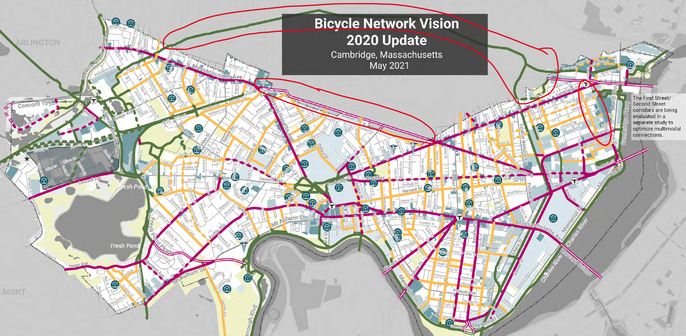
Just taking a look at Cambridge's 2020 Bike Plan you can see that Seomerville's Somerville Ave, Beacon Street, and Community Path (with Extension) are included!

https://www.cambridgema.gov/departments/communitydevelopment/2020bikeplanupdate

#BikeTooter #BikeBoston #People4Bikes

The Community Path is part of 2 major trails (MCRT, Minuteman) that go through Cambridge, and Cambridge has co-signed letters to the state/feds about completing the CPX and MCRT. They have direct influence here!

#BikeTooter #BikeBoston #People4Bikes

Neighboring cities also work closely together on projects. Beacon going into Inman had a ton of collaboration. Somerville building better bike lanes on Washington St is pushing Cambridge to make Kirkland better. Huron bike lanes are being extended to Belmont's Grove St as coinciding with their project.

#BikeTooter #BikeBoston #People4Bikes

In cities like Cambridge and Boston, paying attention to streets just outside respective borders is critical to understand the bike network! The Beacon/Hampshire route is one of the most important routes for both cities, but P4B analysis changes actually punishes both cities because of that.

How does a network analysis that excludes Brookline understand Boston?

#BikeTooter #BikeBoston #People4Bikes

Again, this isn't an idle complaint about looking at networks in isolation by municipal border. The experience of Boston is that it is reasonable to go in a straight line on a commute and experience 5 jurisdictions in 5 miles, including exiting and re-entering the same city (I've personally had this commute).

Viewing the region as a whole is a driving feature of @bikeboston.bsky.social BCU Labs (https://labs.bostoncyclistsunion.org/)

#BikeTooter #BikeBoston #People4Bikes

BCU Labs

OK, so P4B should find a compromise solution from all streets within 2 miles of their borders and only looking at what's within a city's borders. But that isn't the only problem that leads to small towns getting outsized ratings, while the cities in the country with the most people biking are systematically under appreciated. Let's dive deep into the methodology!

#BikeTooter #BikeBoston #People4Bikes

P4B basically tries to see what each census block can reach within 1.67 miles, with categories for People, Jobs/Education, Core Services (Medical/Dental, Supermarkets, Social Services), Recreation, Retail, Transit.

https://cityratings.peopleforbikes.org/about/methodology

#BikeTooter #BikeBoston #People4Bikes

Methodology | PeopleForBikes 2025 City Ratings

Learn how PeopleForBikes establishes a City Rating Score

PeopleForBikes

The tricky decision they have to make is what to do when a town doesn't have any of a given category.

For all cases, they chose to exclude the subcategory if it doesn't exist in a town.

BUT!!! for some things, if you can't bike to it because it's out of town, then the bike network isn't sufficient! If you can't bike to groceries, then THAT is a gap in the network.

#BikeTooter #BikeBoston #People4Bikes

This is a major flaw in P4B analysis! They likely are trying to focus on bike lanes, but that is just an aspect of land use that affects bike-ability and biking rates. But if they don't want to wade into land use discussions, then they shouldn't include destinations.

However, towns very much have control over zoning and other land use decisions, so it would be valuable to call this out directly.

#People4Bikes

P4B are claiming that these ratings are valuable for city planners, so let's talk about what actually gets people on bikes!

"This program helps cities identify gaps in their bike networks, highlights opportunities to improve, and benchmarks progress over time."

#People4Bikes

If we want to make a national rating system that can help cities improve biking and get more people on bikes, then we should start by looking at who is actually achieving that goal.

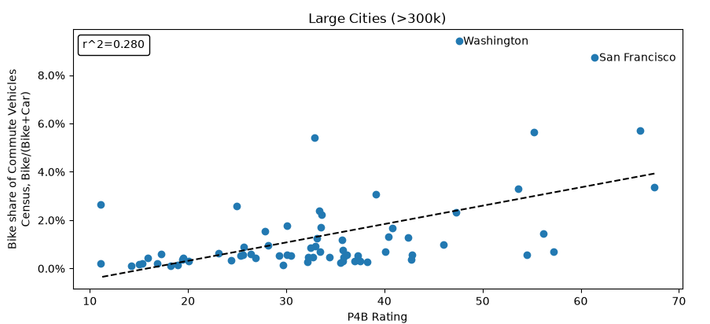
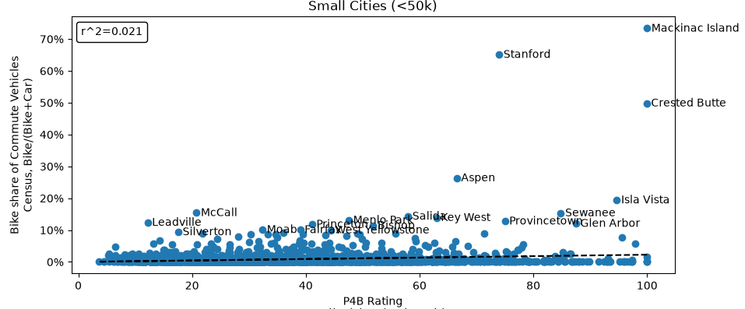
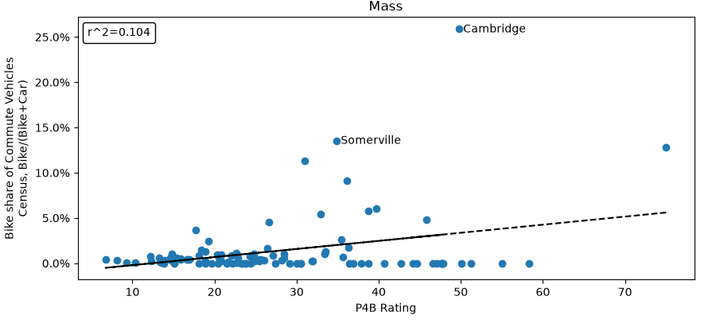
Let's start by looking at how well P4B ratings line up with bike mode share. (Named cities are 3σ outliers from the linear trend line.)

(sadly Census data only has commute trips)

#People4Bikes

Large cities the system seems to actually work pretty reasonably for. A pretty reasonable r^2 of 0.28 (by far the highest) and only 2 outliers.

Good bet that most big cities don't have any excluded categories (and are well mapped in OSM). Just sticking with large cities, I'd probably not really complain about the methodology choices.

#People4Bikes

Medium cities are interesting! Cambridge, Brookline, and Somerville all are outliers surrounding Boston! Validating the above complaints about the regional nature of Boston

It's interesting that basically all of the outliers are college towns of some sort. What is missing in the analysis to capture what's different in these places? Why aren't these rated higher and why are cities with <5% mode share rated so high?

#People4Bikes

Hoboken, NJ is the highest rated Mid-Sized city but <5% bike share. If this was an outlier, that'd be reasonable. Over 2x people commute by transit over car, so there is a good argument that transit use is eating into bike share. And back to regional effects, a significant % of commuters are going into NYC, which bike is probably not that easy for most people. (This is a good example of the weakness of commute data, where 80% of trips are ignored)

#People4Bikes

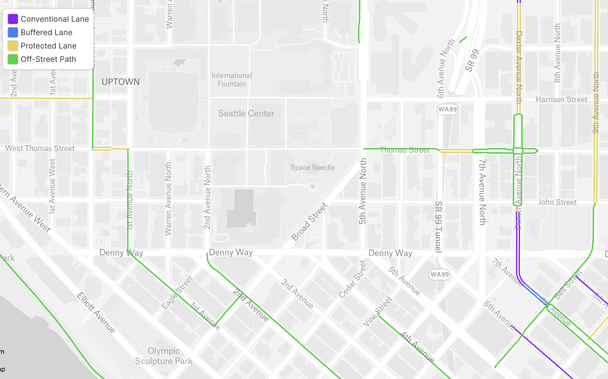
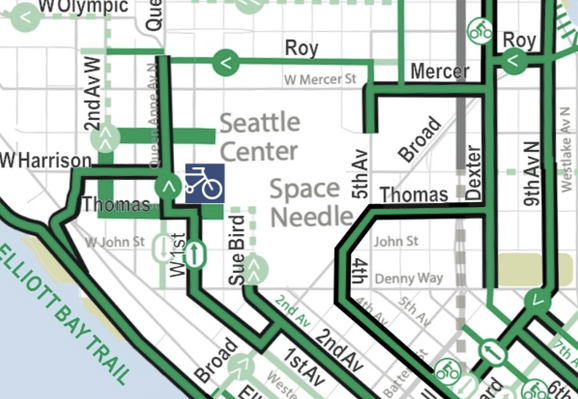
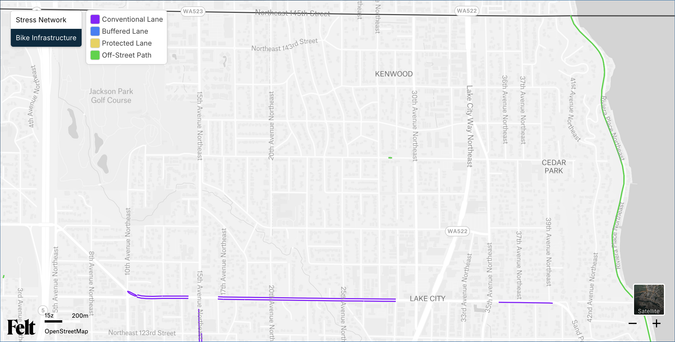
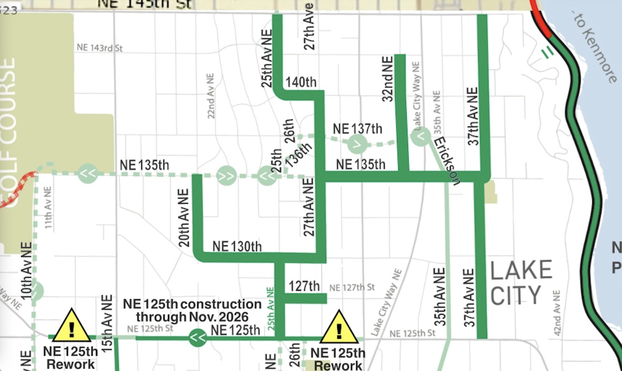
@BostonBikeData @bikeboston.bsky.social I do think their stress map is off for Seattle in some areas I know, and I _know_ their infrastructure map is off. Wildly so, even. Not just because we have entire categories of infrastructure that is valid but not "bike lanes," but also because they either don't know things they _do_ understand are there, or they've miscategorised it.

(I'm not even including issues like "all our transit is also bike infrastructure." Which it is.)

I sent in some rather specific criticisms the last time I noticed them missing big swaths of data. I never heard back.

Here are a couple of areas I'm particularly familiar with as examples. One's up in northeast Seattle, one's around the Space Needle.

@BostonBikeData @bikeboston.bsky.social We similarly have the jurisdiction issue you describe. It's not as bad as Boston, I don't think, but along the Northshore / North end area, it's five cities _if_ you stay entirely within King County, and more like... 10 or 11? counting unincorporated areas of Snohomish County like Esperance? And that's all areas which are very much Greater Seattle.

@BostonBikeData @bikeboston.bsky.social And I'm like... _as a bike infrastructure map maker_, I understand _directly_ that their task is severely difficult. But when I check areas I know particularly well and find them _so_ divergent from what I know on the ground, it's really hard to know how seriously I can take any of it.

And I have to think the cities they're trying to talk to will see similar issues and have similar reactions.

@moira I don't know Seattle well enough to dig in, but some of what you describe is likely the state of OSM being inaccurate.

A few years ago I fixed up Cambridge posted speed limits and the rating jumped considerably. They wrote an article that year about the success in Cambridge and talked about all the good stuff the city has been doing, but it was only recognized because OSM got fixed.

@moira Converting from OSM to stress is HARD. Specifically, the official LTS tables are based on car speed and volume, neither of which are or should be tagged in OSM.

So you end up guessing based on road classification and characteristics for volume, and signed speed limit or citywide default speed limit for speed. These can easily be off for the real experience of a street. But this is where I'm pretty generous on their execution. They do a pretty good job with what they have.

@moira but their choice to make it a simple binary really isn't how people experience streets and obscures some nuance that I think is valuable. The LTS scale does too, but at 4 levels, you can see the differences between "I only see young riders" and "no shit no one bikes here"