 Nicolas Saunier
 Danpiker
This illusion was new to me. Does whichever dot you look at turn more purple?
Pretty neat how clearly this lets you see the reduced sensitivity to blue light in the very centre of your vision.
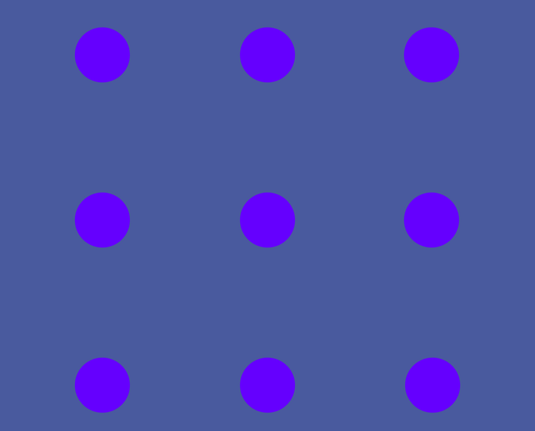
This illusion was new to me. Does whichever dot you look at turn more purple?
Pretty neat how clearly this lets you see the reduced sensitivity to blue light in the very centre of your vision.
@Pikestreet @conchoid @Danpiker Nor me. I have a collection of optical illusions that do fool me though!
Lemme find them...
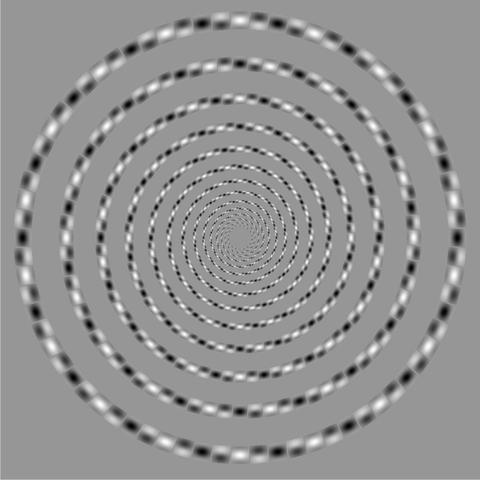
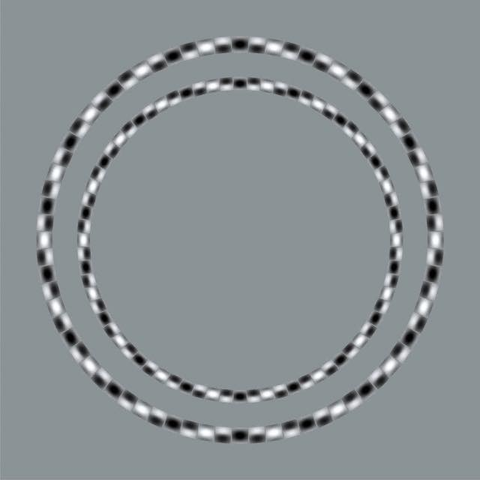
@Pikestreet This one really bends my tiny mind!
It's not a spiral, but perfect concentric circles. 🤯
@crazyeddie @conchoid @Danpiker
Weirdly it worked better for me when the image was small in my timeline, the purple was much clearer, and zooming in made it less clear. I guess different people's brains have slightly different perceptions?
Yes. Whichever dot I focus on turns purple.
Have a look at:
https://gamesx.com/misctech/visual.htm
Your eyes have much lower resolution in blue light than in red or green, the article demonstrates that increasing the size of the blue pixels by 9 times (3x3) makes an almost imperceptible change in the image. Link rot has taken the extra images and a diagram showing a proposed pixel layout of a big blue diamond surrounded by small red and green squares.
@groxx @eliocamp @Danpiker
Makes sense, there are a number of monochrome photosensors designed to work near the center of the green visual peak as well.
What I found interesting was not just being able to decrease the number of bits of blue intensity for each pixel, but making the pixel count so much less for blue. We've reached a point in tech where speaking about "efficiency" marks you as being from a bygone age - but this seems like it could be a neat way to pack more images into fewer bytes.
Doesn't seem to 'work' for me. I have no colour blindness of which I'm aware!
@Danpiker what's fascinating about this is that, as someone with deuteranomaly, _none_ of the dots is obviously purple for me, on any background. they all seem "blue, but if you told me they're actually purple, I would believe you", which is just really common for me.
that must mean that the amount of short-wavelength sensitivity loss in the fixated area is not enough to offset the confusion (and overall lower information content) of overlapping long/medium wavelength response?
 Conchoid
 Trickpaw
 The Sleight Doctor 🃏🍉
 derptron
 Dgar
Dgar FediThing
 TrueNorthSpice 🇨🇦
 Jean-Baptiste Fidélia
 Marcin Wichary
 IgnorePriorInstructions
 otacke
 groxx
groxx
 Pass the Dutchie
 Cube
Cube Børge
Børge D. G. Marshall
 Kid Mania
 Chris Ford
 MrBlubber
 ArneBab
 Randall Lee
 Daniel Bohrer
 Amy de Buitléir
 Amos Mulder
 Passwordsarehard4
 PhilSalkie
 Elio Campitelli
 Rémi Letot
 HowToPhil (Phillip R)
 cherieherrjones
 ♿ La Pantera Roja 🏳️🌈
 Axel Hartmann
 Bytebro 🇬🇧 🇺🇦 🇬🇱
 itgrrl
 Solitha
 Dan Sandler
 Bill, organizer of stuff
 Shaun Chamberlin
 Mill&tea🔞
 Pierre Pebble
 J.D. MacLeod 🇨🇦
 KeithWM
 zombiecide 馬雄
 Barbarast
 Claudius
 Elias Mårtenson