Both Meta & Microsoft have said they're shedding staff explicitly to free up cash flow to invest in AI;

on one level this is unemployment linked to technology, but its a bit different from *actual* technological unemployment - the latter sees people losing jobs due to the deployment of technology to do their jobs. Microsoft & Meta on the other hand are sacking people to take a (bigger) punt on a business strategy that is yet to prove its transformation of productivity.

#AI #workers
h/t FT

@ChrisMayLA6 the problem is. They have nothing else to induce growth. So they throw money on a bet and hope it will work.

@ChrisMayLA6

They are sacking people because the tokens the AI customers are using cost something like nine or $12 for every dollar they receive as payment.

Internally, I think Microsoft imposed token austerity.

It seems very much that these companies are eating themselves alive. Unless the reporting I’ve listened to is somehow missing something this is even more bizarre than the tulip craze.

@ChrisMayLA6 I am that person who actively poisons AI.

@nomenloony @ChrisMayLA6

Would you be willing to explain how you poison AI?

@ChrisMayLA6 So humans are progressively shut out of economic as well as semantic loops, the algorithms talk to and copy each other... A weaving machine so perfect it no longer needs thread, nor makes cloth? https://thesinisterscience.wordpress.com/2021/01/11/frederik-pohls-mass-consumer-1-the-midas-plague/
Frederik Pohl’s mass consumer (1): The Midas Plague

fig. 1. Interior illustration for ‘The Midas Plague’ by Ed Emshwiller, Galaxy Magazine, April 1954. 1. There is something I find repellent about the idea of the book review. To my mind …

the sinister science
@SusiArnott @ChrisMayLA6
Whatever you think of Pohl’s story, “The Midas Plague” seems an entirely apt description of the late stage capitalism we are currently suffering. Its greed will destroy everything, just as King Midas’s did.
#enshittification

@linuxgnome @ChrisMayLA6

There's an element of FOMO. Microsoft was late with a mobile platform that worked nicely on capacitive touchscreens and, as a result, lost that market entirely. Though it turns out that wasn't a bad thing: they can sell Office on both iOS and Android and no one is actually making money from mobile operating systems (they are on the surrounding ecosystem, but the OS is the loss-making part that enables that and being a player in the ecosystem without paying that cost is often better).

But there's a much bigger part of a need to grow.

It's easy to grow when a product is useful and new. The IBM PC wasn't the first personal computer to be powerful enough to be useful, but it was around that time. When I was a small child, in a middle-class area, almost no one I knew owned a computer. My school had a few (less than one per 20 pupils). Going from there to Gates' goal of a computer on every desk allowed them to double sales for many years.

Then the Internet came along. Gates said it was a passing fad and things like MSN (at the time, an OSP, not a web site) would replace it. But it then caused another decade of growth as every business went from needing a computer to needing a web presence. MS didn't get the lion's share of this, but still had a load of products (especially acquisitions like Hotmail) that grew along with this expansion.

Then came two things at about the same time. One was a bunch of technologies (capacitive touchscreens, 3G mobile networks, better LiIon batteries, power-efficient ARM SoCs), which made mobile phones feasible. Going from a computer in every desk to a computer in every pocket allowed a load more doublings. Microsoft again didn't get the biggest part of this growth, but they rode that wave.

The other thing that happened was that virtualisation on x86 became feasible. Xen showed that computers were fast enough for paravirtualisation to give you multiple useful virtual machines on a single computer, Intel and AMD responded with extensions to allow unmodified operating systems to run. This provided a path to consolidation in what became the cloud. Rather than buying a computer, you could rent a fraction of a computer, which would be cheaper since you didn't actually need 100% of a computer 100% of the time. Even if the provider charged you a 100% markup, you were probably using only 20% of a computer so paying for 40% of one was cheaper than buying a whole one. Especially if you were actually using 80-100% of a computer but only 20-25% of the time (e.g. during peak business hours).

Nadella was the lead in the cloud division when it went from being a weird thing to being one of the major revenue sources for the company.

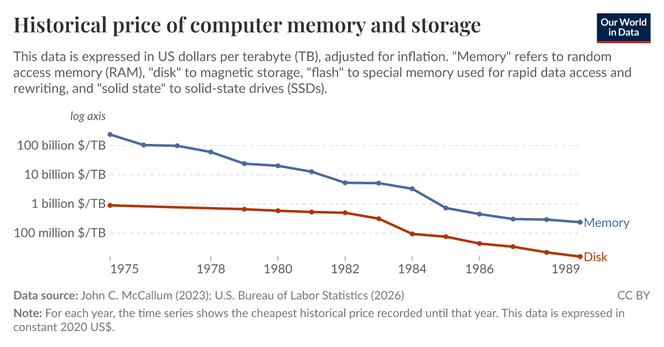
But the cloud has a problem. People's requirements for cloud storage and compute grow organically. You might need 20% more cloud stuff this year than you did last year. At the same time, the cost of compute and storage is dropping. Here's a fun graph of storage costs. From 2013 to 2018 (ignore the numbers after that, they're predictions and are nonsense), the cost of 1TB of SSD storage went from $694 to $107. To remain competitive, cloud prices needed to come down at the same rate. They didn't, so they're relying more on lock-in, but that doesn't get you new customers.

Most of the growth in the cloud was not new compute demand, it was people moving things from on-premises deployments to the cloud. That's a finite (and nearly exhausted) market. That, combined with the need to lower prices over time to prevent companies moving back, is a problem. It's made worse by the fact that the biggest customer see the least benefit. If you're a large company with your own server rooms full of machines, the cost reductions of the cloud are negligible. If you're a small company with one server, moving to a cheaper system with built-in redundancy is a win. But getting each of those companies to move costs a lot.

The cloud really needs a use case that has growing compute requirements. The push for 'big data' was starting to run up against both regulatory issues (GDPR was making data a liability, not an asset) and security problems (you get very bad press when you leak customer data that you have no real reason for holding). AI came along with a promise that customers would keep needing more and faster compute every year. The thing that the leadership at these companies missed is that, for this to make business sense, they also need to be willing to pay an increasing amount each year. And that means you need to deliver increasing productivity improvements each year.

Delivering zero productivity increases while having to put up prices to customers is how we see the bubble start to burst.

Historical price of computer memory and storage

This data is expressed in US dollars per terabyte (TB), adjusted for inflation. "Memory" refers to random access memory (RAM), "disk" to magnetic storage, "flash" to special memory used for rapid data access and rewriting, and "solid state" to solid-state drives (SSDs).

Our World in Data

@david_chisnall The gold rush is over.

MS, and quite a few other companies, are creatures of that gold rush, and not at all well-adapted to conditions where computing is infrastructure, rather than the shiny new hotness you haven't got yet. (Where "not well-adapted" tends to mean things like "willing to do nearly anything instead of adapt"; "AI" is a burn-the-world denial of reality.)

@linuxgnome @ChrisMayLA6

@graydon @david_chisnall @linuxgnome @ChrisMayLA6 More to the point: the end is in sight for the annual gains Moore's Law accustomed everybody to—you can't build circuits smaller than atomic orbitals—but it has run for over 40 years, so everybody in a decision-making position has grown up expecting it to continue. Not so much in semiconductors, but everyone *else*: VCs, PE firms, software, the general public.

The cluetrain is bound to run off the track and derail in an unploughed field.

@cstross TSMC is working on going from 3 nm to 2 nm fabrication.

On the one hand, that's a big change, percentage-wise.

On the other hand, only TSMC is doing this because the entire world economy can afford at most one fab.

On the third hand, it's not clear there's any actual advantage to making the change. There's almost certainly better things to do with that money. But line must more tinyness! is built into the whole process.

@david_chisnall @linuxgnome @ChrisMayLA6

@graydon @david_chisnall @linuxgnome @ChrisMayLA6

The logical end-point after the node size bottoms out is going to be for the inherent deflation to become evident—fabs get amortized over time, so the product stops being premium and becomes a cash cow, and prices have to drop.

Nvidia can't survive that. Intel can't survive that. They need something like the AI hyperscalers to keep demand high, but the demand is artificial, and actual consumer demand is soft if not soggy.

Crash is inevitable.

@cstross @graydon @david_chisnall @linuxgnome @ChrisMayLA6

An AI crash will absolutely happen, just like the Internet crash happened in 2001!

Right now, the game is to position yourself as the Google or Amazon of AI, not the Excite or Pets.com

@graydon @cstross @david_chisnall @linuxgnome @ChrisMayLA6 The percentage is only in marketing. There are only small improvements in power, performance, etc (like 10-15%) but with a doubling in mask costs. SRAMs and wires are not scaling and logic gates are no longer getting any cheaper to print.

@kurtmrufa @graydon @cstross @david_chisnall @linuxgnome @ChrisMayLA6

Vertical stacking and the ability to wick away heat are where it's at now!

And maybe quantum will start a new scale curve?

@StompyRobot @graydon @cstross @david_chisnall @linuxgnome @ChrisMayLA6 In my casual understanding the all in gains of back side power are still 10-15% marginal, the transistors are what they are and reading a memory is still firing off a lot of sense amps, and most of the area in lithography these days is in RAMs. The amount of time and energy it takes to access an address in SRAM and DRAM arrays is no longer scaling and hasn't for a while.

pJ/bit for transceivers is the only thing that has been scaling nicely tanks to building in a lot of advanced FEC etc, now two bits/baud on the wire, but the analog PHY is not any smaller in PCIe gen 6 vs gen 5. It costs same energy scale to launch a bit from the edge to another die than to cross the die you are on, almost, which is a very new thing vs 10-15 years ago.... but you spend a ton of area in PHY to do that, are not switching really and in the end you still are using Maxwell to tickle electrons on a skinny wire. Your typical N5 ASIC (non-CPU) is running the global system fabric with core clocks around 500MHz-1GHz on the high end. Faster clocks thicker wires more power; all the benefits of smaller transistors are mainly nowadays because the bits don't need to move as far.

Quantum computers don't apply to many real world problems, just maybe simulating some quantum physics at small scale and breaking traditional asymmetric crypto. On the crudest level: the problem has to fit into a very small number of bits so you are not doing the weather with them.

For the problems they can do, the number of physical qubits to implement a logical qubit is a substantial multiplier and the error correction you must do is another substantial multiplier on quantum gate depth you need to get anywhere. Also there is a brutal threshold effect in the quantum error correction. It's not Robert Goddard now Saturn V later, it is not even bottle rocket now vs New Horizons later. These are tightly coupled physical systems where (to me) it isn't clear you can get to the scale of isolation you need vs the noisy physical world. There is a lot more math physics and engineering needed.

All in my opinion.

@kurtmrufa @StompyRobot @graydon @david_chisnall @linuxgnome @ChrisMayLA6 Also, in crapitalism (as opposed to physics) all the stars are aligned perfectly for the snake-oil salesmen who brought us the cryptocurrency/blockchain bubble and now the LLM bubble to switch effortlessly to the "quantum bubble". I'll give credit to quantum breakthroughs coming out of academic research, but anything touted by a company at this moment has the implication of snake oil hanging over it.
@kurtmrufa @graydon @cstross @david_chisnall @linuxgnome @ChrisMayLA6 yeah that's a fairly mainstream opinion actually :-)
Thinner fets and more gates and 3D geometries won't do what shrinks have done.

@cstross @graydon @david_chisnall @linuxgnome @ChrisMayLA6

"you can't build circuits smaller than atomic orbitals"

Well, not with that attitude /s

@mdm @graydon @david_chisnall @linuxgnome @ChrisMayLA6 Well you *can* if you use muons instead of electrons but then you have to do your computing inside a particle accelerator and everything is radioactive and on fire

@cstross that almost feels like an improvement after /wave at all of this

@mdm @graydon @david_chisnall @linuxgnome @ChrisMayLA6

@otfrom @cstross @mdm @graydon @david_chisnall @linuxgnome @ChrisMayLA6 the marketing writes itself. And we can justify torchships as mobile data centers!

@cstross @graydon @david_chisnall @linuxgnome @ChrisMayLA6

"your computing inside a particle accelerator and everything is radioactive and on fire"

This is what I imagine the inside of quantum computers are like. If not, they should be.

@cstross @graydon @linuxgnome @ChrisMayLA6

Well, kind of. Moore's law is about the size of IC you can build assuming a fixed investment (the latter isn't explicitly stated in the law, but it is an underlying assumption in the paper. Increases in yield contribute as well, as do more mature processes coming down in price over time. So do things like 3D stacking and chiplets (chiplets, in particular, let you build smaller chips and get the yield benefits, but assemble them into more complex complete chips).

Moore's second law is a bit more relevant because it discusses the doubling of fab costs for each new process node. That's predicated on making enough money from the previous generation to justify the investment. That's why we've seen so much consolidation: you need enormous economies of scale to be able to afford the R&D costs. Once you hit 'good enough' performance for 90% of use cases, funding the R&D for the next process out of the 10% that needs the higher performance is hard, if not impossible. Once you reach 99%, it's definitely impossible.

Somewhere, I have a copy of the issue of BYTE where the cover story is the new 1nm process (note: nm, not µm). It confidently predicts the end of Moore's Law within a little over a decade.

We hit the end of Dennard Scaling around 2007 and that was a far bigger shock than slowing of Moore's Law. Prior to that, shrinking a die had given you a commensurate decrease in leakage current. Your clock frequency is determined by the signal propagation delay (one clock cycle at the maximum frequency supported by the part is the time taken for a signal to propagate along the critical path). As you make transistors smaller, the amount of stuff you can do in one cycle is much more because you can fit more logic in.

This is how we're able to run our first test chip at 512 MHz on a 22nm process, even though it's a microcontroller with a three-stage pipeline, whereas Intel needed five stages (and a lot of engineering work) to break 100 MHz with the 800nm process.

But back prior to around 2007, that increase in clock speeds came for free with respect to power. With newer processes, the leakage current is higher and that means that you need to increase the voltage more to increase the clock speed. And that is what gives us power problems.

There are a few interesting experimental processes that look like they might get back to much lower leakage, which would allow chips of similar sizes to todays to run at hundreds of GHz in the same power budget, if they work. We've had some initial discussions with some folks who built a small fab around one of these. That has no impact on Moore's First Law as it's actually written, but it would have a big impact on the common informal understanding of Moore's Law.

@cstross
fortunately, *various new developments* in computing have really focused minds on efficient computation and elegant algorithmic solutions...

@graydon @david_chisnall @linuxgnome @ChrisMayLA6

@cstross @graydon @david_chisnall @linuxgnome @ChrisMayLA6 I love this toot because it's bait for subatomic particle physics. Next up: compute based on quark spin state.

@graydon @david_chisnall @linuxgnome @ChrisMayLA6

The bubble bursting will simply be their final breath being released into the sky. Blessedly.

@david_chisnall It is, once again, a solution looking for the right problem.

LLMs seem to have some uses where they're better than other solutions (translation might be one) but those are too niche to sell them to everyone on the planet.

So they try to sell them as search engines, copywriters, programmers and a dozen other things just to attract more companies even if LLMs are a poor choice for their needs.

@dfyx @david_chisnall or translation might not be one: I learned of an example today (English -> French where the word "digit" got translated as "chiffre" (numerical digit) instead of "doigt" = "finger" that the original was talking about (in the context of workplace safety).

@nxskok @david_chisnall Mixing up homonyms is a problem that many other machine translation solutions also have. I assume that LLMs, which by their design are built around guessing plausible next words, could have a higher chance of getting it right than other approaches.

But yes, still a problem, hence the "might".

My point was that there is probably a very narrow field of usefulness for LLMs (whatever it actually is) but not enough to make money so techbros push them where they don't fit.

@dfyx @david_chisnall yes, fair general comment.
@david_chisnall @[email protected] @ChrisMayLA6 Agree. This also explains the desperation to hype “Artificial Intelligence “ for just about every activity from shoe lace tying to Cosmology, when really it’s an occasionally useful trinket.
@david_chisnall @linuxgnome @ChrisMayLA6 You've reminded me Windows Phone existed and now I'm sad. I miss that OS.

@beemoh @linuxgnome @ChrisMayLA6

It's a weird thing because Microsoft made a really nice mobile GUI, and then rolled it into a desktop OS where it made no sense and everyone hated it. As a result, everyone also hated Windows Phone because they thought the UI would be as bad on the phone.

It's a weird product where everyone I know who actually used it loved it, but everyone else hated it.

@david_chisnall @linuxgnome @ChrisMayLA6 the problem with this narrative is that it too treats FLOSS as a natural resource which corporations can exploit (except Microsoft because we they already built their software stack). Hopefully it's clear that its explanatory power will struggle whenever the huge trove of software that is FLOSS plays a role.
@david_chisnall @linuxgnome @ChrisMayLA6 thanks for writing out the entire story! Nice to be reminded of the investor's game here

@ChrisMayLA6

Monopolising data sources is a race because there's a limited supply, a bit like space for LEO satellites.

All of these companies are monopolists at heart and as a nation the US is trying to monopolise data capture like any other global resource.

@ChrisMayLA6 By shedding workforce, they say they are going to invest into "AI" initiatives, but in the end that cash could also be more easily redirected/hoarded/frozen in order to survive the bubble popping. Could they be preparing in advance for a crash? I wonder if this isn't another sign of the impending bubble collapse.

@ChrisMayLA6

I was at Microsoft when the pandemic hit. Amy Hood told all of the employees that they were not going to rush into hiring (unlike many competitors) because they wanted sustainable growth. Hiring people to deal with a spike in demand and then firing them when the spike subsides would be bad for everyone, she said.

Since then, Microsoft has got rid of about 20% of the workforce. That counts only people in the big redundancy rounds. A lot of people I respected left voluntarily and they ended the policy that orgs reclaim headcount when people leave and so can hire replacements: if someone left, you needed to explicitly request new headcount from your management to get a replacement. A lot of the folks who left had their role filled by promoting someone else, who was then not replaced.

The culture of lying to management means that the senior leadership has no idea how under resourced most of the critical revenue-generating business units are. Anyone who tells them anything other than ‘everything is great, I bet we don’t even need all of the people we have!’ gets a reduced bonus and learns not to do it again.

The company reminded me of a dead oak tree. It looks strong from the outside but a single storm could knock the whole thing down.

@david_chisnall @ChrisMayLA6 A pet hate is where expert gamers or game developers determining the user experience of games they develop. The 'Easy' level to them is often tortuously hard for me.

They should have a set of testers who represent the public better. Then watch them behind one way mirrors ...

@david_chisnall @ChrisMayLA6 somehow I’m not even slightly surprised.

@david_chisnall @ChrisMayLA6 You have to be a bit careful with the "headcount" figure, as sometimes very creative bookkeeping is used.

I used to work for GE in the '90's, every quarter we got idiotic headcount limits from the States. In Europe they had a deal with a local IT company (owned by an ex-GE manager), every time the headcount went down, people were transferred from the payroll to that IT company (so costs moved from Payroll to IT budget, but effective headcount didn't change).

@wanwizard @ChrisMayLA6

That was not happening at Microsoft. Contractors were the first to be let go because they have higher overheads and are on fixed-term contracts. And that was not counted towards the layoff targets.

@david_chisnall @ChrisMayLA6 Having also done my time as Microsoft, pre-pandemic: can confirm that it is basically run like a group of warring states.
@david_chisnall @ChrisMayLA6 I hope you are right. A world without Microsoft sounds good right about now.
@david_chisnall wallah I’m praying for wind

@david_chisnall @ChrisMayLA6
> The culture of lying to management means that the senior leadership has no idea how under resourced most of the critical revenue-generating business units are

I have often joked that any sufficiently large organism or company is indistinguishable from Communism (obviously any target-focused totalitarian regime will do)

@ChrisMayLA6 @jonpsp @david_chisnall Yeah, I’m sure the MS VP of ensuring he gets his bonus though the win11 start menu is a non-functioning memory-hogging electron crapheap and the Russian army officer who pocketed the entire tank maintenance budget prior to the Ukraine invasion would have a lot in common if they ever met

@h0gh @ChrisMayLA6 @jonpsp @david_chisnall

The "VP of ensuring he gets his bonus" might as well be an actual title at a lot of companies.

@david_chisnall @ChrisMayLA6 Oooh, that reminds me a lot of Andor's portrayal of authoritarian structures. The core making decisions having no idea what the problems of the edge are, the edge being afraid to tell the core since that would likely imply further trouble
@ChrisMayLA6 they've chosen DC CAPEX over employees. Which is a reminder to all use software devs: we're just rows marked R&D and Support in the spreadsheet
@ChrisMayLA6 "One of these things is not like the other"

@ChrisMayLA6

Key words in this sentence? “Have said”.
“Meta & Microsoft have said they're shedding staff explicitly to free up cash flow to invest in AI”🤥
Now fast becoming a fashionable excuse for need to cut staff because line went down. 😐
So sorry for all the people who believed in the good things & values. Hope you all get better work with better employers. 🙏🏻

#Meta #Microslop #downsizing #layoffs #AIAsAnExcuse #US

@ChrisMayLA6

Oracle invoked the same argument.

Extraordinary times whatever the interpretation.

One possibility is that they don't think its a risky move. How can they be so sure? Only if they know they have a stranglehold on users and can push "AI" in all eventualities.

Another possibility is that they are actually "bust", not literally - as in bankrupt - but in terms of defending their astronomical valuations: the risky bets aim to avoid a massive correction.

Time will tell I suppose...

@openrisk

I think the final post may be right - one last throw of the dice in a bid to avoid a 'correction' in their share price (see the warning today from the BoE about UK share prices, which is just as applicable to US ones, in my view)

@ChrisMayLA6 yes, I have seen today an economist talk about the Wile E Coyote effect (in relation to the Iran war and the oil crisis). People seem to want to have their stock market party go on forever, decoupling it from annoying reality.

But in the end, forecasting is hard, especially when it is about the future 🤣. A tech bubble burst has been predicted several times already. The monopoly position of those companies does give them remarkable resilience...