@linuxgnome @ChrisMayLA6
There's an element of FOMO. Microsoft was late with a mobile platform that worked nicely on capacitive touchscreens and, as a result, lost that market entirely. Though it turns out that wasn't a bad thing: they can sell Office on both iOS and Android and no one is actually making money from mobile operating systems (they are on the surrounding ecosystem, but the OS is the loss-making part that enables that and being a player in the ecosystem without paying that cost is often better).
But there's a much bigger part of a need to grow.
It's easy to grow when a product is useful and new. The IBM PC wasn't the first personal computer to be powerful enough to be useful, but it was around that time. When I was a small child, in a middle-class area, almost no one I knew owned a computer. My school had a few (less than one per 20 pupils). Going from there to Gates' goal of a computer on every desk allowed them to double sales for many years.
Then the Internet came along. Gates said it was a passing fad and things like MSN (at the time, an OSP, not a web site) would replace it. But it then caused another decade of growth as every business went from needing a computer to needing a web presence. MS didn't get the lion's share of this, but still had a load of products (especially acquisitions like Hotmail) that grew along with this expansion.
Then came two things at about the same time. One was a bunch of technologies (capacitive touchscreens, 3G mobile networks, better LiIon batteries, power-efficient ARM SoCs), which made mobile phones feasible. Going from a computer in every desk to a computer in every pocket allowed a load more doublings. Microsoft again didn't get the biggest part of this growth, but they rode that wave.
The other thing that happened was that virtualisation on x86 became feasible. Xen showed that computers were fast enough for paravirtualisation to give you multiple useful virtual machines on a single computer, Intel and AMD responded with extensions to allow unmodified operating systems to run. This provided a path to consolidation in what became the cloud. Rather than buying a computer, you could rent a fraction of a computer, which would be cheaper since you didn't actually need 100% of a computer 100% of the time. Even if the provider charged you a 100% markup, you were probably using only 20% of a computer so paying for 40% of one was cheaper than buying a whole one. Especially if you were actually using 80-100% of a computer but only 20-25% of the time (e.g. during peak business hours).
Nadella was the lead in the cloud division when it went from being a weird thing to being one of the major revenue sources for the company.
But the cloud has a problem. People's requirements for cloud storage and compute grow organically. You might need 20% more cloud stuff this year than you did last year. At the same time, the cost of compute and storage is dropping. Here's a fun graph of storage costs. From 2013 to 2018 (ignore the numbers after that, they're predictions and are nonsense), the cost of 1TB of SSD storage went from $694 to $107. To remain competitive, cloud prices needed to come down at the same rate. They didn't, so they're relying more on lock-in, but that doesn't get you new customers.
Most of the growth in the cloud was not new compute demand, it was people moving things from on-premises deployments to the cloud. That's a finite (and nearly exhausted) market. That, combined with the need to lower prices over time to prevent companies moving back, is a problem. It's made worse by the fact that the biggest customer see the least benefit. If you're a large company with your own server rooms full of machines, the cost reductions of the cloud are negligible. If you're a small company with one server, moving to a cheaper system with built-in redundancy is a win. But getting each of those companies to move costs a lot.
The cloud really needs a use case that has growing compute requirements. The push for 'big data' was starting to run up against both regulatory issues (GDPR was making data a liability, not an asset) and security problems (you get very bad press when you leak customer data that you have no real reason for holding). AI came along with a promise that customers would keep needing more and faster compute every year. The thing that the leadership at these companies missed is that, for this to make business sense, they also need to be willing to pay an increasing amount each year. And that means you need to deliver increasing productivity improvements each year.
Delivering zero productivity increases while having to put up prices to customers is how we see the bubble start to burst.
 Emeritus Prof Christopher May
 Wittgenstein's Poker 🇵🇸 ☮️
 David Chisnall (*Now with 50% more sarcasm!*)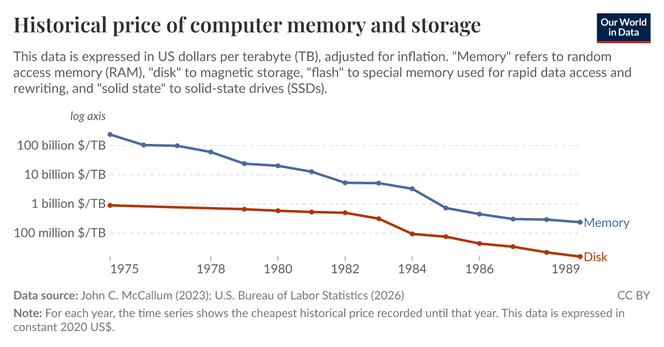
 DFYX
DFYX Ken Butler