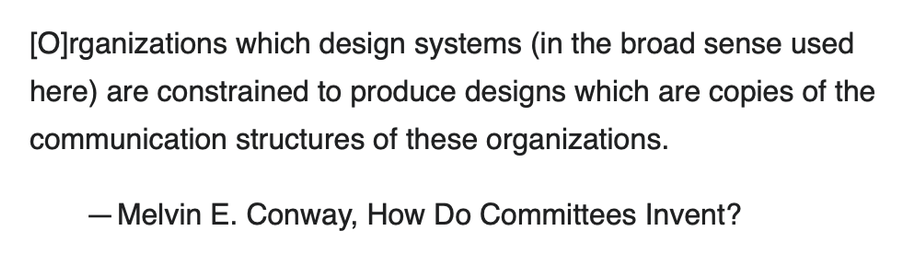
You shouldn't expect centralised organisations, be it companies or governments, to be good at implementing or even supporting decentralised solutions. That's just Conway's law [1] at work.

That's why decentralised solutions are shared, implemented bottom-up by communities of practice.

This is also why decentralised solutions are hard to monetise.

TL;DR: Decentralised solutions work best when they are open source, open hardware, run in cooperative ways.

[1] https://en.wikipedia.org/wiki/Conway%27s_law

The impact of Conway's law is often underestimated. It's a dilemma. On the one hand you want organisation, authority because it seems to be a good thing. But that always leads to centralisation.

But embracing the chaos, infighting and ego fights that unavoidably comes with decentralised, leaderless approaches feels unnatural. But trust me on this. In the end chaotic systems work better.

I know. It feels weird. Take your time. Let it sink in. Don't "yes, but" immediately, just this one time :)

So if you wonder why (centralised) electricity grids don't seem to be able to cope with (decentralised) solar and wind electricity, here's an important factor.

And that's just one example. You'll start to see the pattern at a lot of places.

And here's the real task. How do we find ways to productive coexistence? Where are the translators between these two very different worlds? Because cooperation beats confrontation. That was always my hope for the Open Source movement. To be that translator.

@jwildeboer

I think one skill we need to (re)learn is that we don't have to perfectly align to collaborate.

It is OK to have different but overlapping goals, it is OK to have different interests and priorities, And we can still collaborate with all that.

The wide open Internet gave us the opportunity to reach to many like-minded people, which is really cool. But it also gave us the way to too easily escape the need to cooperate with people who are not as like-minded.

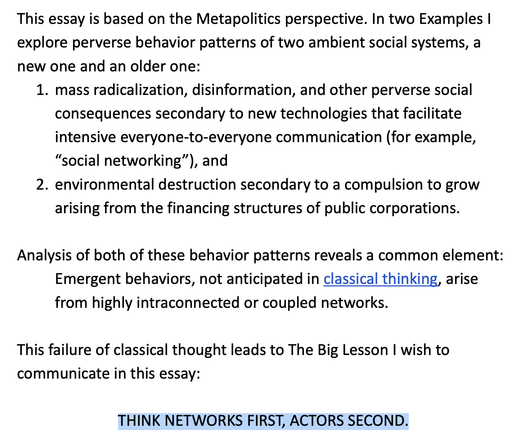
Conway has written an essay on the deeper mechanisms that do exist but we don't yet have the models and language for, or, to be more precise, where our current framing limits us in really grasping the understanding we need to find solutions. It's a tough read, but for me quite the eye-opener. It's 39 pages. I will read it a few times more and try to come up with a TL;DR.

https://melconway.com/Home/pdf/UbiquitousConnectivity.pdf

It looks at how the internet, the global possibilities of people and ideas to connect in ways that were not possible before, leads to the negative consequences we all see around us. Disinformation, radicalisation etc. He calls this Ubiquitous Connectivity. And explains how it doesn't fit into "classical" systems thinking and regulation and that's why we fail at finding the right answers right now.
The important thing is that Conway openly admits that he does not offer solutions. What he really wants is to start the discussion on how we find the tools, methods, language, models to deal with the questions that Ubiquitous Connectivity poses. So it's the start of a process.
My first hunch is one I have since many years. That in the digital space, with effectively zero cost for reproducing digital data (call it copying, pirating, distributing, technically it's all the same) the market model is inadequate, yet still the standard way of looking at everything. But markets need scarcity for price finding. Hence we created systems of artificial scarcity (Digital Rights Management, rate limiting etc) to somehow save the market principle. But it's the wrong pair of glasses
I'll stop here as I need more time to reflect and sort the various thoughts that have been wandering around in my brain since many years, trying to sort them in a coherent way, make them part of a thought model that is consistent and can be communicated without sounding too weird and inaccessible. So. More coffee and a long walk outside. And maybe, if you are interested, we can set up some sort of focused discussion forum/meetup to dive deeper.

But if you want a closing, provocative thought to dissect, ridicule, or just take with you to think about for yourself or discuss with peers, it currently is this:

We have perfected top-down approaches to destructive levels while we lost focus on building bottom-up solutions in better ways.

That'll be all from me for today :)

This thread has been extended and published as a blog post. Please continue the discussion as replies to https://social.wildeboer.net/@jwildeboer/116386106080903472 so that the discussion is visible under my blog post. Yes, I use ActivityPub as comment system and it works quite well :)

@jwildeboer I pondered the thread and the replies because these are issues that I think about a lot.

Again, while wanting decentralisation and cooperation I conclude that the issue, the root driver is scale.

Whether I look at pressure on resources that fosters competition and hierarchy, or the systems that arise due to that (trade, money, security through size and strength, stability from that which fosters ideas and technology), it comes down to too many humans in one area at the same time.

@jwildeboer I would be interested in participating in such a session.

@jwildeboer There is legit reasoning to limiting or providing some time-saving service (not just pay-gate or creating extra paperwork hoops as "service") and many things (not the DRM etc) have that weird mix of "both" which I think is the main reason why we still use / abuse a lot as there is mixed service and reasoning (as well as the forced "you must" do this / pay this).

Natural scarcity also exists.

And even in the copying still needs a ton of machinery / structure - so most is all excess.

@jwildeboer And we violently agree that Conway’s law is striking in its corrosiveness.
@jwildeboer Anarchism is inevitable. Messy, unordered, and difficult, but inevitable.

@jwildeboer If you're familiar with it - what are your thoughts on Arthur #Koestler and the concept of #holarchy?

I've had the opportunity to work with an enterprise that was organized based on this principle (as opposed to a hierarchical structure) and have been fascinated ever since.

https://www.panarchy.org/koestler/holon.1969.html

Arthur Koestler, Some general properties of self-regulating open hierarchic order (1969)

@jwildeboer @akosma I think you have to lean in to decentralisation if you want it to work. Especially when it seems the worst. I keep getting hit by planks when the mode is mixed.
@jwildeboer It’s tempting, but I am positive that centralization is not the root cause of systemic communication that mirrors the communication patterns of the humans in an organization. That’s a symptom of a range of things including unsupported structural assumptions. Fixing the systems that leaders rely on to support their critical decision making is probably a better place to start. And ironically, these systems are largely undiscussed and implicit.

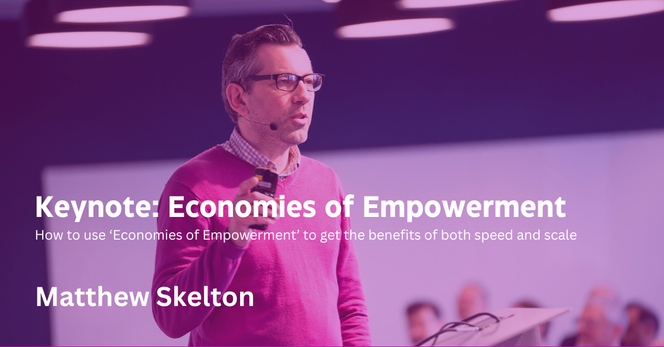
@fuzztech @jwildeboer this is why I now focus on the leadership, management, and practices needed for 'Economies of Empowerment' - it avoids the centralized/decentralized trap and zooms into the conditions needed for bounded autonomy.

The framing seems to help.

https://matthewskelton.com/keynote-talks/keynote-economies-of-empowerment

Keynote: How to use ‘Economies of Empowerment’ to get the benefits of both speed and scale — Matthew Skelton

How can organizations move beyond the pendulum swing of Economies of Speed versus Economies of Scale? Many organizations struggle to scale nimble ways of working as the organization or department grows, stifling innovation and delivery effectiveness. What worked at a small scale appears expensive

Matthew Skelton
@fuzztech Mostly agree. Centralisation as a symptom. But, in my opinion, an undesirable one. That is why I focus on more collaborative, cooperative approaches that in my opinion better reflect our human nature. I know, a rather naive thought, but it gives me a a more motivating framing. I strongly believe that the wisdom of crowds beats any genius leader in the mid to long term. It is from that fundamental perspective my thinking starts. Hope this helps.
@jwildeboer Oh I don’t think what you’re saying is wrong and the alleviation is important. As any firm in the throes of Conway will tell you, pain reduction is super valuable. I’m just obsessed with root cause management as enabling downstream scalable change. But like bolting information security on at the end, IMHO symptom management is perennially required until you cure the issue creating the symptom.
@jwildeboer See also: the Web, RSS and other early-ish community-made protocols.
@jwildeboer like ubisoft trying to sell nfts

@jwildeboer The comment on the wiki page about Conway's observation being being originally a sociological one has a "citation needed" mark against it, but I think that's right on the money. I think it extends beyond tech and what we normally think of when we think of "organisations." For example, we wouldn't think of LinkedIn users as being an organisation as such, yet there are definitely the outlines of organising mechanics, and these are most definitely and obviously coded into the language used.

#Sociology #Language #Semiotics #InGroups

@jwildeboer This got me thinking about decentralized spam filtering.

This is something that the fediverse could certainly use (and would be a good test-bed for the concept with its decentralized protocol), but personally I'm more interested in it for small email servers. De-centralizing control over RBLs.

I'm imagining something where your system automatically establishes trust with other moderators who moderate the same messages/accounts/servers the same way as you do.