
You shouldn't expect centralised organisations, be it companies or governments, to be good at implementing or even supporting decentralised solutions. That's just Conway's law [1] at work.

That's why decentralised solutions are shared, implemented bottom-up by communities of practice.

This is also why decentralised solutions are hard to monetise.

TL;DR: Decentralised solutions work best when they are open source, open hardware, run in cooperative ways.
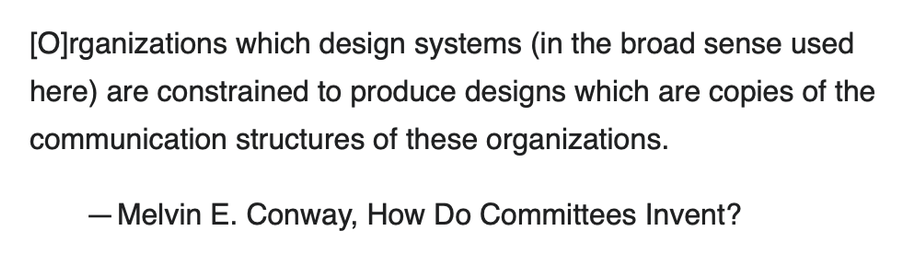
[1] https://en.wikipedia.org/wiki/Conway%27s_law

The impact of Conway's law is often underestimated. It's a dilemma. On the one hand you want organisation, authority because it seems to be a good thing. But that always leads to centralisation.

But embracing the chaos, infighting and ego fights that unavoidably comes with decentralised, leaderless approaches feels unnatural. But trust me on this. In the end chaotic systems work better.

I know. It feels weird. Take your time. Let it sink in. Don't "yes, but" immediately, just this one time :)

@jwildeboer It’s tempting, but I am positive that centralization is not the root cause of systemic communication that mirrors the communication patterns of the humans in an organization. That’s a symptom of a range of things including unsupported structural assumptions. Fixing the systems that leaders rely on to support their critical decision making is probably a better place to start. And ironically, these systems are largely undiscussed and implicit.
@fuzztech Mostly agree. Centralisation as a symptom. But, in my opinion, an undesirable one. That is why I focus on more collaborative, cooperative approaches that in my opinion better reflect our human nature. I know, a rather naive thought, but it gives me a a more motivating framing. I strongly believe that the wisdom of crowds beats any genius leader in the mid to long term. It is from that fundamental perspective my thinking starts. Hope this helps.
@jwildeboer Oh I don’t think what you’re saying is wrong and the alleviation is important. As any firm in the throes of Conway will tell you, pain reduction is super valuable. I’m just obsessed with root cause management as enabling downstream scalable change. But like bolting information security on at the end, IMHO symptom management is perennially required until you cure the issue creating the symptom.