
You shouldn't expect centralised organisations, be it companies or governments, to be good at implementing or even supporting decentralised solutions. That's just Conway's law [1] at work.

That's why decentralised solutions are shared, implemented bottom-up by communities of practice.

This is also why decentralised solutions are hard to monetise.

TL;DR: Decentralised solutions work best when they are open source, open hardware, run in cooperative ways.
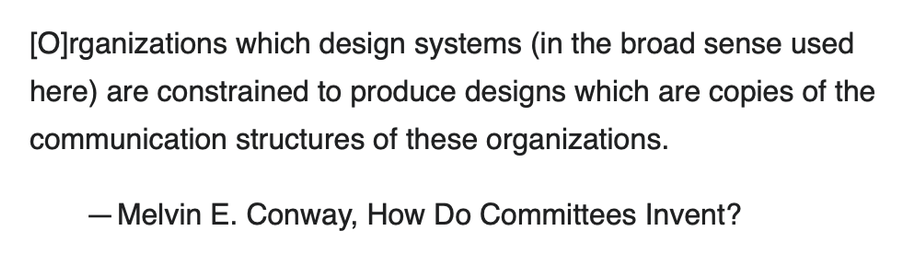
[1] https://en.wikipedia.org/wiki/Conway%27s_law

The impact of Conway's law is often underestimated. It's a dilemma. On the one hand you want organisation, authority because it seems to be a good thing. But that always leads to centralisation.

But embracing the chaos, infighting and ego fights that unavoidably comes with decentralised, leaderless approaches feels unnatural. But trust me on this. In the end chaotic systems work better.

I know. It feels weird. Take your time. Let it sink in. Don't "yes, but" immediately, just this one time :)

Conway has written an essay on the deeper mechanisms that do exist but we don't yet have the models and language for, or, to be more precise, where our current framing limits us in really grasping the understanding we need to find solutions. It's a tough read, but for me quite the eye-opener. It's 39 pages. I will read it a few times more and try to come up with a TL;DR.

https://melconway.com/Home/pdf/UbiquitousConnectivity.pdf

@jwildeboer And we violently agree that Conway’s law is striking in its corrosiveness.