
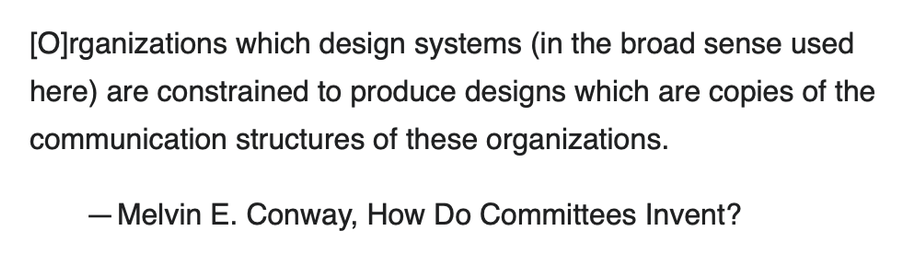
You shouldn't expect centralised organisations, be it companies or governments, to be good at implementing or even supporting decentralised solutions. That's just Conway's law [1] at work.

That's why decentralised solutions are shared, implemented bottom-up by communities of practice.

This is also why decentralised solutions are hard to monetise.

TL;DR: Decentralised solutions work best when they are open source, open hardware, run in cooperative ways.
[1] https://en.wikipedia.org/wiki/Conway%27s_law

The impact of Conway's law is often underestimated. It's a dilemma. On the one hand you want organisation, authority because it seems to be a good thing. But that always leads to centralisation.

But embracing the chaos, infighting and ego fights that unavoidably comes with decentralised, leaderless approaches feels unnatural. But trust me on this. In the end chaotic systems work better.

I know. It feels weird. Take your time. Let it sink in. Don't "yes, but" immediately, just this one time :)

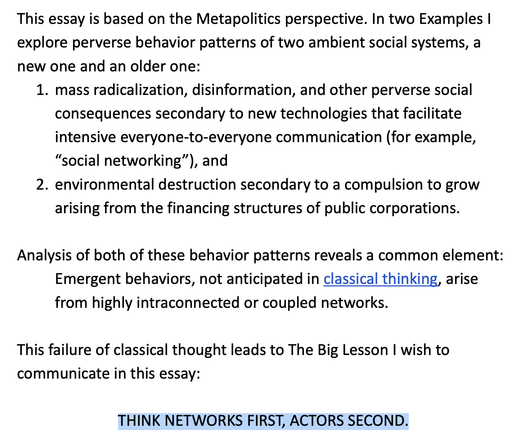
Conway has written an essay on the deeper mechanisms that do exist but we don't yet have the models and language for, or, to be more precise, where our current framing limits us in really grasping the understanding we need to find solutions. It's a tough read, but for me quite the eye-opener. It's 39 pages. I will read it a few times more and try to come up with a TL;DR.

https://melconway.com/Home/pdf/UbiquitousConnectivity.pdf

It looks at how the internet, the global possibilities of people and ideas to connect in ways that were not possible before, leads to the negative consequences we all see around us. Disinformation, radicalisation etc. He calls this Ubiquitous Connectivity. And explains how it doesn't fit into "classical" systems thinking and regulation and that's why we fail at finding the right answers right now.
The important thing is that Conway openly admits that he does not offer solutions. What he really wants is to start the discussion on how we find the tools, methods, language, models to deal with the questions that Ubiquitous Connectivity poses. So it's the start of a process.
My first hunch is one I have since many years. That in the digital space, with effectively zero cost for reproducing digital data (call it copying, pirating, distributing, technically it's all the same) the market model is inadequate, yet still the standard way of looking at everything. But markets need scarcity for price finding. Hence we created systems of artificial scarcity (Digital Rights Management, rate limiting etc) to somehow save the market principle. But it's the wrong pair of glasses
I'll stop here as I need more time to reflect and sort the various thoughts that have been wandering around in my brain since many years, trying to sort them in a coherent way, make them part of a thought model that is consistent and can be communicated without sounding too weird and inaccessible. So. More coffee and a long walk outside. And maybe, if you are interested, we can set up some sort of focused discussion forum/meetup to dive deeper.

But if you want a closing, provocative thought to dissect, ridicule, or just take with you to think about for yourself or discuss with peers, it currently is this:

We have perfected top-down approaches to destructive levels while we lost focus on building bottom-up solutions in better ways.

That'll be all from me for today :)

This thread has been extended and published as a blog post. Please continue the discussion as replies to https://social.wildeboer.net/@jwildeboer/116386106080903472 so that the discussion is visible under my blog post. Yes, I use ActivityPub as comment system and it works quite well :)