[Thread] So, the book #LimitsToGrowth is back in the news after the projections were updated. I've been doing a lot of reading and thinking about this topic (the preface of the book 1177BC, The Year Civilization Collapsed being the impetus).

My conclusion is that only #Degrowth and implementation of a lot of #SolarPunkSunday ideas (repairing stuff, building community, rewilding) will help us adapt to the coming changes. That's why I started SPS -- to highlight events, ideas and to build connections.

Yes, I am known for "Doomposting," but like with most things, I try and find solutions as well. Yeah, all the #Fascist BS isn't helping -- in fact, it's a symptom of the desperation of the elites to hold onto their #Capitalistic, #Colonial, #hierarchical ways. And, well, we all know where that leads.

We may not be able to fix the climate or all the other things that are going wrong right away, but we can try to adapt, and make sure by doing so, we aren't making the problems worse for all the beings that live here on planet Earth.

I'll be posting some quotes in this thread -- some with commentary, some just by themselves. Do humans have all the answers? Not sure (I know I don't)... But sticking our collective heads in the sand is NOT an option!

#ClimateChange #Adaptation #Collapse #Change #TheLimitsToGrowth #PlanetaryBoundaries

"According to Joseph Tainter, who literally wrote the book on the collapse of complex societies, 'collapse is fundamentally a sudden, pronounced loss of an established level of sociopolitical complexity.' That was exactly what happened back in 1177 BC."

- Eric Cline, "1177BC, The Year Civilization Collapsed," Preface to the revised edition, page xvii.

#ClimateChange #Collapse #Change #1177BC #BronzeAgeCollapse #HistoryRepeatingItself

More from 1177BC...

"There are only a few instances in history of such globalized world systems; the one in place during the Late Bronze age and the one in place today are two of the most obvious examples, and the parallels -- comparisons might be a better world -- between them are sometimes intriguing.

"To give just one illustration, Carol Bell, a British academician, has observed that 'the strategic importance of tin in the LBA [Late Bronze Age] ... was probably not far different from that of crude oil today. At that time, tin is thought to have been available in quantity only from specific mines in the Badakhshan region of Afghanistan and had to be brought overland all the way to sites in Mesopotamia (modern Iraq) and north Syria, from where it was distrbuted to points father north, south, or west, including onward across the sea to the Agean. Bell contianues, 'The availability of enough tin to produce ... weapons grade bronze must have exercised the minds of the Great King in Hattusa and the Pharaoh in Thebes the same way that supplying gasoline to the American SUV driver a reasonable cost preoccupies an American president today!"
- Eric Cline, "1177BC, The Year Civilization Collapsed," Preface to the revised edition, page xvii.

#ClimateChange #Collapse #Change #1177BC #BronzeAgeCollapse #HistoryRepeatingItself #Histodon #ExtractiveIndustries

Blog post from 2022: What a 50-year-old world model tells us about a way forward today

by Gaya Herrington, 17 May 2022

"My research went viral last summer. I found out via a friend’s text, jokingly accusing me of 'announcing the end of the world.' For several days, headlines on major US news pages declared that my research proved we are on the brink of collapse. A few days later, UK pages touted the same headlines. Then I saw my name popping up in languages I do not know, from Swedish, to Greek, to Chinese, to Sinhala.

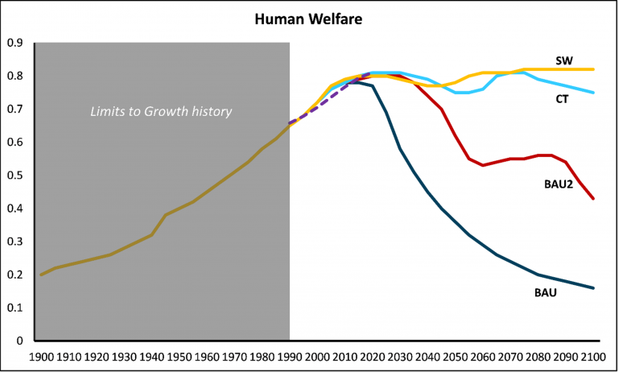
"It took me a bit by surprise. My research had been published months earlier, in November 2020. Also, it was a data comparison of a model from a book that was almost half a century old. Apart from the headlines being a simplistic version of my research’ message, they also gave the impression that the possibility of societal collapse suddenly had been revealed. But this warning was a key message of The #LimitsToGrowth (#LtG) book, which the authors Meadows, Meadows, Randers & Behrens, published back in 1972. In LtG, commissioned by the #ClubOfRome, the authors identified society’s relentless pursuit of growth not as the solution to, but the cause of, so many of the #environmental and social crises that plague humanity still today. Their analysis was based on a global model called World3. The authors created different scenarios by varying World3’s underlying assumptions. This scenario analysis helped them study global dynamics between variables including industrial output, resources, pollution, and living standards. In my research, I compared four LtG scenarios against a few decades of empirical data. Details about the scenarios methods and results, can be found in my article in Yale’s Journal of Industrial Ecology. An easier read with the gist of my findings was also published on the Club of Rome website. Here, I’ll just share my conclusions, illustrated by a graph of the variable people might be most concerned with: living standards (Figure 1). This graph is from my upcoming book Five Insights for Avoiding Global Collapse, soon available online under Creative Commons, which contains further research analysis and 2022 data update of my comparison."

The author goes on to explain the graph. I'm focusing on Herrington's scenarios, especially the "SW" scenario in my next post...

https://www.clubofrome.org/blog-post/herrington-ltg50/

#Degrowth #Extinction #ClimateCrisis #EnvironmentalCollapse #Ecocide #Warning

What a 50-year-old world model tells us about a way forward today - Club of Rome

17 May 2022 -

Club of Rome

Gaya Herrington's chart showing #HumanWelfare and the #LimitsToGrowth, beginning from 1900 to the future (2100).

The graph has 4 lines - SW (yellow), CT (blue), BAU2 (red), and BAU (dark blue). The yellow line dips down slightly, then is pretty even. All the other lines point downward, with BAU being the furthest down (indicating a very bad quality of life for humans).

"Here, I’ll just share my conclusions, illustrated by a graph of the variable people might be most concerned with: living standards (Figure 1). This graph is from my upcoming book Five Insights for Avoiding Global Collapse, soon available online under Creative Commons, which contains further research analysis and 2022 data update of my comparison.

"I found an overall close alignment of empirical data with the scenarios, for now, because they only diverge significantly after 2020. This accuracy decades into the future gives reason to take the #World3 dynamics seriously. If we do that, we unfortunately must conclude that the future holds risks of declines in welfare, among other things, and some of these declines are indeed steep enough to constitute a collapse. The scenario indicated with 'SW' shows no collapse and the highest living standards. However, empirical data aligned least closely to SW.

"I interpret all this as humanity having a now or never opportunity to change direction. Contrary to what my friend texted me, I did not predict the end of the world, just like #LtG didn’t at the time; I noticed #WarningSignals and voiced a call to action. Empirical data are not far from SW yet, and humankind can determine where future data points fall. How? Well, there is one key difference between SW and the other scenarios: in SW, humanity consciously lets go of growth as its goal. Under SW assumptions, society shifts priorities away from industrial output growth towards resource efficiency, #pollution abatement, and #health and #education services. We can do that in the real world too.

"Will we? Before you answer that question in your head, let’s frame it properly. Because this is not about whether we want to avoid collapse; it’s whether we want better. SW represents a redesign of society away from material consumption, around human and #ecological well-being. Yes, that would take a lot of effort. But we’d also be working on healing society, towards a future of thriving. Does that sound to you like something worth putting in work for?"

In other words, and end to #Capitalism and implementation of #Degrowth, with the goal being healthy, educated humans living on a planet that they are actively trying to clean-up!

Source:
https://www.clubofrome.org/blog-post/herrington-ltg50/

#SharingEconomy #SolarPunk #Warning #Extinction #ClimateCrisis
#EnvironmentalCollapse #Ecocide

So, yes, this is from MSN -- however, it drives in the point about a lot of stuff from the updated #LimitsToGrowth projections.

Slide 4 seems to echo the quotes from Cline's 1177BC regarding resource extraction (tin) and the #BronzeAgeCollapse.

"4. Resource extraction costs skyrocket as materials become exhausted.

"The era of cheap, easily extracted natural resources is ending as mining operations move to increasingly remote locations, tap lower-grade ores, and require more energy-intensive processes to extract the materials that support industrial civilization. This fundamental shift in resource economics creates inflationary pressures that compound across every sector of the economy, making previously profitable activities uneconomical and forcing societies to choose between maintaining current consumption levels and investing in future sustainability.

"Energy return on investment ratios for fossil fuel extraction have declined steadily over decades, requiring more energy input to extract each unit of usable fuel while alternative energy sources struggle to match the energy density and scalability of conventional #petroleum-based systems. The transition costs between energy systems create economic bottlenecks that can trigger the kind of systemic failures that characterize #SocietalCollapse, particularly when resource constraints coincide with other stresses like #ClimateChange, political instability, and demographic transitions."

https://www.msn.com/en-us/money/markets/mit-warns-society-could-collapse-by-2040-and-the-signs-are-already-here/ss-AA1LevRc?ocid=winp2fptaskbarhoverent&cvid=67506a067e5a4905be298b0a363777ec&ei=35#image=5

#Collapse #Change #TheLimitsToGrowth #PlanetaryBoundaries #HistoryRepeatingItself

MSN

So, something else that is a key element of ensuring #HumanWelfare remains in the SW range is to make sure folks are fed -- without destroying the environment! That's where #RegenerativeAgriculture , #SustainableAgriculture, #FoodForests, #CommunityGardens, etc., come into play. But #Rewilding and restoring key natural systems are also very important!

7. #Wildlife faces #extinction cascades as #ecosystems collapse.

"Vertebrate populations have declined by an average of 69 percent since 1970, with some regions experiencing losses exceeding 90 percent as habitat destruction, climate change, #pollution, and direct #exploitation combine to trigger ecosystem-wide collapse that eliminates the #biodiversity necessary to maintain stable #FoodWebs. Species extinction rates now exceed background levels by 100 to 1,000 times, representing a mass extinction event comparable to the asteroid impact that eliminated the dinosaurs but compressed into a timeframe measured in decades rather than millennia.

"The collapse of insect populations threatens #pollination services essential for agricultural production, while marine ecosystems face #acidification, warming, and #overfishing that eliminate entire trophic levels and destabilize ocean food chains supporting billions of people. Domestic animals face parallel threats as #IndustrialAgriculture concentrates genetic diversity into vulnerable #monocultures while climate change disrupts feed production and increases disease pressure on livestock populations already stressed by intensive production methods designed to maximize short-term yields rather than long-term #resilience."

https://www.msn.com/en-us/money/markets/mit-warns-society-could-collapse-by-2040-and-the-signs-are-already-here/ss-AA1LevRc?ocid=winp2fptaskbarhoverent&cvid=67506a067e5a4905be298b0a363777ec&ei=35#image=8

#Collapse #Change #TheLimitsToGrowth #PlanetaryBoundaries #WaterIsLife #NatureIsLife #Extinction

MSN

Something else I took away from the MSN slideshow was the importance of #BuildingCommunity and perhaps embracing #Anarchy (as in "No Rulers, No Kings"). These days, the ruling class are corporate executives and greedy politicians. Certainly, many who are currently in charge are failing us and the environment!

6. Political systems cannot coordinate responses to global crises.

"Democratic governance systems designed for gradual policy adjustments cannot process the rapid, fundamental changes required to address simultaneously occurring economic, #environmental, and social crises that demand coordinated international responses exceeding current institutional capabilities. Political polarization and short electoral cycles prevent the #LongTermPlanning and #ResourceAllocation necessary to navigate systemic challenges that span decades and require #SustainedCooperation across competing #national interests.

"#InternationalCooperation continues deteriorating as #ResourceScarcity and climate impacts intensify competition between nations, while domestic political systems fragment under the stress of managing declining living standards and increasing inequality that undermine social cohesion. The failure of governance systems to facilitate necessary changes creates the kind of institutional breakdown that characterizes the transition from complex societies to simpler, more localized forms of social organization that can better adapt to resource constraints and environmental instability."

https://www.msn.com/en-us/money/markets/mit-warns-society-could-collapse-by-2040-and-the-signs-are-already-here/ss-AA1LevRc?ocid=winp2fptaskbarhoverent&cvid=67506a067e5a4905be298b0a363777ec&ei=35#image=7

#Nationalism #Corporatocracy #NoKings #CorporateColonialism #ExtractiveIndustries #BadGovernance

MSN

Speaking of the ruling class, the master's thesis I read this morning about the #BronzeAgeCollapse was interesting, but far from complete. The author (Paul Golightly) is limited by older published studies (the paper is from 2014), and does include a reference to Eric Cline's "The Oxford Handbook of the Bronze Age Aegean" (from 2010), but does not have the depth and breadth of Cline's 1177 BC works cited.

I did find this quote, which I thought was relevant to my posts from yesterday:

"The Mycenaean Age was ruled by wa-na-ka from palaces that were spread across
Greece. Wa-na-ka is the Mycenaean word for #king or leader. With the fall of the Mycenaeans many things disappeared. Among these are luxury items such as gold, silver, ivory, and monumental stone architecture. The wa-na-ka and palaces controlled many aspects of Greek life
and, in many ways, without them one would know very little about the Mycenaeans. It was for the wa-na-ka that art and writing were used and after there were no more wa-na-ka the need an use of these disappeared. One of the most important things that defines a civilization and gives clues to how a people lived is their writing. In the case of the Mycenaeans it was the writing of
Linear B.6 As far as we know Linear B was written only by palace scribes for official business. When the wa-na-ka and the ruling class disappeared, killed in wars and fleeing to other parts of the world, one sees that writing completely disappeared. This proves that the illiteracy in Mycenaean Greece was prevalent. Only the palace and the scribes were able to read or write and the peasants were not able to do so.

"The wa-na-ka and ruling class also controlled luxury items in Mycenaean Greece and the peasants had no need for these items. So, when the wa-na-ka went by the wayside the luxury goods and art disappeared as well. Before the fall there were many examples of gold, silver, and fine art. After this time there is no evidence of these items, almost no graves with gold, gems, or objects of fine craftsmanship. It is assumed that when the wa-na-ka and all types of luxury
goods disappeared, the people who made these luxury goods disappeared. The population was severely depleted after the fall of the palaces.

"It was not only luxury items that were controlled by the wa-na-ka and palaces; they also controlled the economy and most of the excess food that was produced in the area. In fact, the palaces controlled a large portion of the Mycenaean Greek economy; both food and other items went through the palaces, as attested by the tablets found in storage places."

- Golightly, The Light of Dark-Age Athens: factors in the Surival of Athens After the Fall of Mycenaean Civilization, pages 8-9.

https://digital.library.unt.edu/ark:/67531/metadc799552/

#BronzeAgeCollapse #GreekDarkAges #SystemsCollapse #NoKings #NoRules

Apologies for the bad paragraph breaks. I am NOT editing that post (resisting the urge ain't easy)!

@DoomsdaysCW "alternative energy sources struggle to match the energy density and scalability of conventional petroleum-based systems"

I have my doubts about this sentence. It's mixed up with peak oil arguments, and they're not credible today.

At scale, electricity generation can become largely renewable fairly quickly, and this is happening in much of the world. Sure, there is significant investment needed to balance supply and demand, but it's doable, at least for the first 95% or so.

However later on it talks about "transition costs". Which is absolutely right.

In other areas, electrification is harder. Even long range shipping is possible if batteries are cheap enough, and we already see electric heavy plant for mining etc, so some of the usual peak oil arguments are problematic.

But replacing every single car with an EV would require a horrific amount of mining, which affects both ecosystems and humans in a big way. Practically speaking, without major state intervention, and an expansion of public transport, it will take far too long, at least from a climate change perspective.

And the situation with heating is even worse: heat pumps might slightly out-compete gas boilers depending on how the somewhat arbitrary electricity market is set up, but the payback time is *long*, unless there's a dramatic, sustained increase in gas prices.

Both problems are solvable provided there is substantial state investment and, in transport, a reduction in demand by the expansion of public transport. Which can happen remarkably quickly; 23% of buses globally are electric today, for instance.

Which is when we run into 1) austerity politics driven by neoliberal assumptions justified by "growth" (e.g. low taxes on rich people) and 2) the importance of the car industry to "growth", regardless of the enormous harms it causes, many of which are not solved by electrification.

It is far from clear to me whether the gradually increasing difficulty in extraction will prevent the move to electric vehicles. I haven't seen convincing data either way, and the usual assumptions about mining are fairly long term.

But certainly there are "economic bottlenecks", such as the need to replace absolutely every car, including those owned by drivers who rely on on-street parking (implying much more expensive charging) and who only buy cheap fourth-hand "old bangers" ...

This is primarily a climate issue. Unfortunately we have enough oil, coal, and gas to destroy ourselves many times over; I don't believe peak oil arguments are credible given where we are technologically today. Sure, if right wing governments make it harder, there may be a steeper cliff, but still, there's likely to be less demand for oil in the near future.

And I'm not even convinced we'll run out of lithium. But the impact of the "green growth" agenda is that 1) it takes far too long, resulting in higher short term emissions, and 2) it causes enormous harm to people and ecosystems.