RE: https://hachyderm.io/@thomasfuchs/116440570565467277

"These long-running, parallelized workflows can yield great value, but they have also challenged our infrastructure and pricing structure: it’s now common for a handful of requests to incur costs that exceed the plan price! These are our problems to solve. The actions we are taking today enable us to provide the best possible experience for existing users while we develop a more sustainable solution." — Joe Binder, VP of Product

If people are already _commonly_ exceeding set monthly quotas/costs with just a handful of requests, you all have got much bigger problems, customers/users too (i.e. becoming deeply dependent on externally controlled & rented infrastructure from day one of your project/startup, plus slowly damaging your own cognitive abilities and a fast growing maintenance nightmare)! And this all is just the beginning... 🍿

Keeping up with other news about growing mineral, energy & supply chain shortages, the illusion that this might just be very short term, and the resulting cost bumps needed to produce and provision all the outstanding data center capacities at the heart of the above decisions (and similar ones made by Anthropic just days ago), I really don't understand where this optimism of AI boosters/users is coming from or on what planet they're living on...

genAI/agenticAI is a shoddily implemented/managed/secured technology & mentality for a computing-illiterate consumerist society, for an age of infinite resource abundance with stable climate/politics, all of which we're leaving (or have never really been in)! And that departure is partially driven/accelerated by said tech...

Instead of funneling trillions into this particular tech, we need focus/investment into methods, infrastructure, research/education, relationships, and above all, a culture focused on how to make computing magnitudes more sustainable, accessible, independent and which allows us to do generally more with less. Or, at least not with magnitudes more, just for some dubious, unspecified (and meaningless) measure of improved "productivity gains"... With almost no one ever questioning what this supposed extra productivity is even good for...
#GitHub #AI #ResourceScarcity #Decomputing #HouseOfCards

Human conflicts trouble me. And I am not a subject matter expert. Yet, I have been reflecting on the dominant empirical patterns in human conflicts that I am aware of. At their core, these conflicts arise from hunger and existential threat. Over the past two centuries, economic desperation, scarcity of resources, and a lack of trust have consistently served as enabling conditions for war and major unrest. This lack of trust may appear as weakened social or political institutions, mutual suspicion among groups or nations, or institutional collapse. These factors often intertwine with power politics, ethnic divisions, nationalism, ideological struggles, and failures in governance.

Prosperity alone does not guarantee peace. However, populations that are well fed, economically secure, embedded in high-trust societies, and protected by functioning social contracts generally remain calm and non-violent. In contrast, desperation and distrust create conditions that make mobilization into conflict far more likely. Exceptions may exist, but this pattern holds broadly.

#Human #Security #Trust #Peace #ResourceScarcity #SocialContract #EconomicDesperation

The World Is Running Out of Fresh Water. What Happens If We Do?

India is the thirstiest user of groundwater in the world, sucking up more of this valuable resource than both the U.S. and China combined. Indeed, the country relies on groundwater (like lakes and rivers) to keep its crops irrigated, its industries running, and its people quenched. In some rural communities, as much as 85 percent of their drinking water is pumped from underground.

Source

This post has been syndicated from Truthout, where it was published under this address.

The World Is Running Out of Fresh Water. What Happens If We Do?

The pace of freshwater depletion is staggering. An area twice the size of California is drying up annually.

Truthout

Something else I took away from the MSN slideshow was the importance of #BuildingCommunity and perhaps embracing #Anarchy (as in "No Rulers, No Kings"). These days, the ruling class are corporate executives and greedy politicians. Certainly, many who are currently in charge are failing us and the environment!

6. Political systems cannot coordinate responses to global crises.

"Democratic governance systems designed for gradual policy adjustments cannot process the rapid, fundamental changes required to address simultaneously occurring economic, #environmental, and social crises that demand coordinated international responses exceeding current institutional capabilities. Political polarization and short electoral cycles prevent the #LongTermPlanning and #ResourceAllocation necessary to navigate systemic challenges that span decades and require #SustainedCooperation across competing #national interests.

"#InternationalCooperation continues deteriorating as #ResourceScarcity and climate impacts intensify competition between nations, while domestic political systems fragment under the stress of managing declining living standards and increasing inequality that undermine social cohesion. The failure of governance systems to facilitate necessary changes creates the kind of institutional breakdown that characterizes the transition from complex societies to simpler, more localized forms of social organization that can better adapt to resource constraints and environmental instability."

https://www.msn.com/en-us/money/markets/mit-warns-society-could-collapse-by-2040-and-the-signs-are-already-here/ss-AA1LevRc?ocid=winp2fptaskbarhoverent&cvid=67506a067e5a4905be298b0a363777ec&ei=35#image=7

#Nationalism #Corporatocracy #NoKings #CorporateColonialism #ExtractiveIndustries #BadGovernance

MSN

@thekrage @emenel Defining a "pure anarchist society" is complex. In theory, it’s just individuals—some benevolent, others chaotic. In reality, such a society would likely collapse quickly as people band together for safety, forming alliances and rules that lead to a tribal structure.

Anarcho-syndicalism introduces some organization while keeping power decentralized. However, it risks devolving into a proto-feudal system if individuals gain too much power. Resource scarcity poses a significant threat, as those controlling valuable resources will wield influence. Thus, while anarcho-syndicalism may be more stable than pure individualism, it remains vulnerable.

#Anarchism #AnarchoSyndicalism #PoliticalPhilosophy #Community #ResourceScarcity
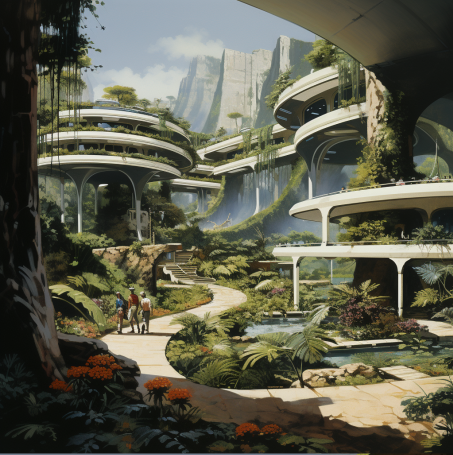
16/28 The construction of new towns by DACs could offer a new approach to resource usage. By embracing principles of circular economy and sustainability from the outset, DACs aim to reduce resource needs and waste. #DACs #ResourceScarcity #CircularEconomy
That was #ResearchComLab #6! 👋 Journalists and researchers from all over the world came together to discuss challenges of #ResourceScarcity. Congratulations to the four teams who received prizes for their amazing project ideas! #SciComm #IJP https://www.humboldt-foundation.de/en/explore/newsroom/news/comlab6-winners-chosen
ComLab#6: Winners chosen

On 20 January 2023, the four best projects from the sixth virtual Communication Lab on “Resource Scarcity” were honoured.