Another article made it through peer review (at #SpringerNature) with the false claim that all #OpenAccess journals charge #APCs.
https://link.springer.com/article/10.1007/s00381-023-05969-2

Reminder: Only a minority (≈ 31%) of OA journals charge APCs, even if a majority of articles pub'd in OA journals are in the APC-based variety.
https://fediscience.org/@petersuber/109344076065105780

#DiamondOA #GoldOA

Global trends, gaps, and future agenda in medulloblastoma research: a bibliometric analysis - Child's Nervous System

Background Medulloblastoma is the most common malignant primary pediatric brain tumor. Over the years, an increase in published research has been observed on this topic. However, there is a lack of analysis on the characteristics and trends and the socioeconomic indicators associated with medulloblastoma research productivity and impact. Methods The Scopus database was used to search all articles from inception to 2020. Bibliometric information was obtained from Scopus, and bibliometrics diagrams were created using VOSviewer software. Statistical analysis was performed using the GraphPad Prism software version 7. Results A total of 4058 research articles on medulloblastoma research worldwide were included in this study. There has been an increase in published articles, with a steep increase observed in the last decade. The country with the most publications is the USA, with St. Jude Children’s Research Hospital as the most productive institution in medulloblastoma research. The articles mainly focused on molecular biology, diagnosis, treatment, prognostic factors for medulloblastoma, and research on other pediatric tumors. The number of collaborations with other countries showed the strongest positive correlation with scientific productivity. Conclusion This analysis showed the trend and characteristics of published articles. The results of this study emphasized the need to increase funding for research, support for researchers and physicians, and promote more collaborations with countries and institutions engaged in medulloblastoma research.

SpringerLink

Update. Another piece made it through peer review (at the American Association of Hip and Knee Surgeons) with the false claim that #OpenAccess journal articles "require a fee from authors."
https://www.arthroplastyjournal.org/article/S0883-5403(23)00627-7/fulltext

One problem here is overlooking or denying the existence of no-APC (#DiamondOA) journals, which are more numerous than APC-based OA journals. Another is assuming that when journals do charge APCs, authors always or even usually pay them out of pocket.
https://suber.pubpub.org/pub/j1jk6hu9

#APCs

Update. Another piece made it through peer review despite the false assumption that all #OpenAccess journals charge #APCs.
https://annalsofglobalhealth.org/articles/10.5334/aogh.3904

It aims to compare methods for accessing medical research in the global #south. It covers subscription journals, APC-based OA journals, hybrid journals, green OA, and even Research4Life. But it doesn't cover no-APC or #DiamondOA journals and doesn't even mention their existence.

Open(ing) Access: Top Health Publication Availability to Researchers in Low- and Middle-Income Countries

Introduction: Improving access to information for health professionals and researchers in low- and middle-income countries (LMICs) is under-prioritized. This study examines publication policies that affect authors and readers from LMICs. Methods: We used the SHERPA RoMEO database and publicly available publishing protocols to evaluate open access (OA) policies, article processing charges (APCs), subscription costs, and availability of health literature relevant to authors and readers in LMICs. Categorical variables were summarized using frequencies with percentages. Continuous variables were reported with median and interquartile range (IQR). Hypothesis testing procedures were performed using Wilcoxon rank sum tests, Wilcoxon rank sum exact tests, and Kruskal-Wallis test. Results: A total of 55 journals were included; 6 (11%) were Gold OA (access to readers and large charge for authors), 2 (3.6%) were subscription (charge for readers and small/no charge for authors), 4 (7.3%) were delayed OA (reader access with no charge after embargo), and 43 (78%) were hybrid (author’s choice). There was no significant difference between median APC for life sciences, medical, and surgical journals ($4,850 [$3,500–$8,900] vs. $4,592 [$3,500–$5,000] vs. $3,550 [$3,200–$3,860]; p = 0.054). The median US individual subscription costs (USD/Year) were significantly different for life sciences, medical, and surgical journals ($259 [$209–$282] vs. $365 [$212–$744] vs. $455 [$365–$573]; p = 0.038), and similar for international readers. A total of seventeen journals (42%) had a subscription price that was higher for international readers than for US readers. Conclusions: Most journals offer hybrid access services. Authors may be forced to choose between high cost with greater reach through OA and low cost with less reach publishing under the subscription model under current policies. International readers face higher costs. Such hindrances may be mitigated by a greater awareness and liberal utilization of OA policies.

Update. Another piece made it through peer review w the false claims that most #OpenAccess journals charge #APCs & that #GreenOA must be embargoed. Also makes a new false claim I've never seen before, that journals always hold the #copyright to green OA articles. Tho trying to cover all the major options, it doesn't acknowledge the existence of no-APC or #DiamondOA journals. Same with #preprints. Please don't give this to "novice researchers" as an intro to publishing.
https://journals.ku.edu/kjm/article/view/21169/19219
View of Navigating the Path to Publication: A Guide for the Novice Researcher

Update. Here's a piece asserting that "#OpenAccess publishing is an alternative where authors pay the cost of publication." It's still undergoing peer review (Journal of the American Academy of Dermatology, #Elsevier).
https://www.jaad.org/article/S0190-9622(23)03240-1/pdf
(#paywalled)

We can hope that the journal corrects these errors during review. There are two: (1) the false assumption that all or most OA journals charge #APCs, and (2) the false assumption that all paid APCs are paid by authors.

Update. Here's another piece asserting that "Under #OpenAccess…the cost of publication is shifted from journal subscribers to research authors. On acceptance, an author pays…an article processing charge [#APC]."
https://journals.lww.com/greenjournal/fulltext/2024/01000/the_changing_winds_of_academic_publishing_and_o_g.1.aspx

As in so many other cases, there are two errors here: (1) the false assumption that all or most OA journals charge #APCs, and (2) the false assumption that all paid APCs are paid by authors.

It's an editorial and didn't go through peer review.

The Changing Winds of Academic Publishing and O&G Open : Obstetrics & Gynecology

An abstract is unavailable.

LWW

Update. Here's another piece asserting that "#OpenAccess publishing [makes] peer-reviewed papers free to read and reuse, but very expensive for scientists to publish."
https://cnr.ncsu.edu/geospatial/news/2023/12/01/open-science-equity/

It mentions APC discounts and read-and-publish agreements. But it doesn't mention no-APC (#DiamondOA) journals or the fact that most peer-reviewed OA journals (≈ 70%) are no-APC. Nor does it mention #GreenOA.

How Open Science Can Both Advance and Hinder Equity in Research

The new US government definition of open science emphasizes “fostering collaborations, reproducibility, and equity.” The monetary cost of open-access publishing and the underrecognized effort of open-source development, however, can disadvantage underprivileged scientists.

Center for Geospatial Analytics

Update. Here's another piece asserting that "In the #OpenAccess model, the individual researcher pays an article process charge (#APC)."
https://journals.sagepub.com/doi/10.1177/08465371231219666

Note the two common errors: (1) the false assumption that all or most OA journals charge #APCs and (2) the false assumption that all paid APCs are paid by authors.

Like so many similar pieces, it's an editorial that did not undergo #PeerReview.

Update. Here's another piece asserting "The 2022 [#OSTP or #Nelson] memo requires the publication model to transition to what’s called gold #OpenAccess [in which] the cost of publication is levied against the authors as article processing charges or #APCs."
https://www.asbmb.org/asbmb-today/policy/121423/can-science-publishing-be-both-open-and-equitable

It's wrong that all OA journals charge APCs, wrong that all paid APCs are paid by authors, and wrong that the #NelsonMemo requires journal-based or #GoldOA. It requires repository-based or #GreenOA.

#OAintheUSA

Can science publishing be both open and equitable?

An updated memo from the White House Office of Science and Technology Policy has researchers, funders and publishers looking ahead

Update. Here's another piece (letter to the editor, from a fellow editor) asserting that "the #OpenAccess business model requires authors to pay article-processing charges (#APCs)."
https://www.nature.com/articles/d41586-023-04056-5

Three common errors here: (1) the false assumption that all or most OA journals charge #APCs, (2) the false assumption that all paid APCs are paid by authors, (3) the false assumption that there's just one OA journal business model.

Devise an ethical open-access publishing model

Letter to the Editor

Update. From an editorial: "#OpenAccess publishing…while well intentioned…does result in a publishing landscape where quantity rather than quality is rewarded."
https://bpspubs.onlinelibrary.wiley.com/doi/10.1111/bcp.15952

PS: This claim is unargued. I think it's shorthand for this longer one: All or most OA journals charge #APCs, creating an incentive to accept low-quality work. The premise on APCs is false. But if restated to speak precisely about APC-based journals (not all or most OA journals), it would be worth confronting.

Update. This letter makes the good point that even authors from the global north are frequently unable to pay #APCs.
https://www.nature.com/articles/d41586-024-00116-6
(#paywalled)

Unfortunately it also repeats two common errors: (1) the false claim that all or most OA journals charge APCs and (2) the false claim that all paid APCs are paid by authors.

Authors from wealthy countries cannot all pay publishing fees

Letter to the Editor

Update. Here's another article that repeatedly refers to "OA publishing" when it means "#APC-based OA publishing". The trend it documents does not arise from no-APC OA (#DiamondOA) publishing.
https://link.springer.com/article/10.1007/s11192-023-04876-2

"OA publishing allows publishers to generate revenue during the production process…Large commercial publishing houses have gained increasing control over the OA publishing market, which is moving towards an oligopoly market."

#OpenAccess

The oligopoly of open access publishing - Scientometrics

Open access (OA) publishing is often viewed as a promising solution for the future of scholarly publishing, as it has the potential to reduce global inequalities in access to scientific literature by removing paywalls. However, the adoption of OA publishing may not necessarily lead to a decrease in the overall cost of knowledge dissemination, as Article Processing Charges (APCs) can create an additional financial burden for scholars, particularly those from developing countries. Despite being intended as a way to disrupt the scholarly publishing oligopoly, OA publishing has faced challenges in achieving this goal. These challenges were revealed through a comprehensive analysis of OA publishing from 2008 to 2020, as detailed in this study.

SpringerLink

Update. #Subscription #OBGYN journals that flip to #OpenAccess see an increase in citations. Those that charge #APCs also see a decline in submissions from the global #south.
https://obgyn.onlinelibrary.wiley.com/doi/10.1002/ijgo.15398

PS: These authors recognize that not all OA journals charge APCs (#DiamondOA). On the one hand, their data only show a decline in submissions from the south for APC-based OA journals. But their imprecise writing attributes it to OA as such.

#OpenAccessCitationAdvantage #OACA

Update. This new study concludes (in effect) that authors with less funding to pay #APCs are less likely to publish in APC-based #OpenAccess journals. But it words the conclusion this way: "Open access [without qualification] may become a barrier to the dissemination of work for researchers who have financial difficulty choosing open access."
"https://link.springer.com/article/10.1007/s12109-024-09978-0

PS: This is bad writing. APCs are the barrier, not OA. The article doesn't mention no-fee #GreenOA or #DiamondOA.

Choice of Open Access in Elsevier Hybrid Journals - Publishing Research Quarterly

Open access articles in hybrid journals have recently increased despite high article processing charges. This study investigated the impacts of grants and transformative agreements on authors’ choice of open and non-open access articles by comparing two article types. The samples were hybrid journals launched independently by Elsevier. The results revealed that the authors who received more grants in countries with transformative agreements were more likely to choose open access articles. By contrast, authors in developing countries were likely to publish non-open access articles. These findings imply that authors’ choices depend on the funding systems and open access policies in individual countries. Consequently, open access may become a barrier to the dissemination of work for researchers who have financial difficulty choosing open access, although it enables everyone to access articles free of charge.

SpringerLink

Update. Another article made it through peer review (at #Elsevier) asserting that all or most #OpenAccess journals charge #APCs. It also seems to deny the existence of #nonprofit #publishers.
https://doi.org/10.1016/j.jtos.2024.04.001

PS: But the article is #paywalled and I can only judge from the abstract.

"Publishing houses are not charitable organizations…Hence in open-access publishing, the cost of the publication and the loss of #subscription #profits are compensated by article processing charges."

Update. Here's another unrefereed editorial asserting that all #OpenAccess journals charge #APCs.
https://doi.org/10.1111/jmwh.13651

Update. Here's another unrefereed editorial criticizing #APCs (criticisms I join and support) as if all #OpenAccess journals charged APCs, or without realizing that most OA journals don't charge APCs.
https://journals.lww.com/annals-of-medicine-and-surgery/fulltext/2024/06000/neurosurgical_challenges_of_open_access_publishing.4.aspx

#DiamondOA

Update. Here's another piece (dialogue between a physician and journal editor) resting on the false assumption that #OpenAccess journals always or even usually charge #APCs.
https://www.medscape.com/viewarticle/this-journal-legit-open-access-and-predatory-publishers-2024a10009pv
Is This Journal Legit? Open Access and Predatory Publishers

Andrew Wilner, MD, interviews the editor in chief of the Neurology journals, Jose Merino, MD, on open-access publishing and the dangers of predatory journals.

Medscape
Update. Here's a piece making the true and important case that #APCs are obstacles to #OpenAccess for early career researchers (#ECR). Unlike other pieces in this thread, it acknowledges the existence of #GreenOA and #DiamondOA. But it limits its recommendations to various ways to find funding to pay #APCs — without offering any arguments against green or diamond OA.
https://link.springer.com/article/10.1007/s11606-024-08921-5
Open Access: Opening or Closing Doors for Junior Faculty? - Journal of General Internal Medicine

The Open Access movement has transformed the landscape of medical publishing. Federal regulations regarding Open Access have expanded in the USA, and journals have adapted by offering a variety of Open Access models that range widely in cost and accessibility. For junior faculty with little to no funding, navigating this ever-changing landscape while simultaneously balancing the pressures of publication and promotion may present a particular challenge. Open Access provides the opportunity to amplify the reach and impact of scientific research, yet it often comes at a cost that may not be universally affordable. In this perspective, we discuss the impact of Open Access through the lens of junior faculty in general internal medicine. We describe the potential benefits and pitfalls of Open Access on junior faculty with a focus on research dissemination and cost. Finally, we propose sustainable solutions at the individual and systems-level to help navigate the world of Open Access to promote career growth and development.

SpringerLink
Update. Here's a piece by the senior publisher at @ioppublishing (#IOPP) trying to entice authors to look beyond journal impact factors (#JIFs) when choosing a publisher. It pushes #OpenAccess as an important factor to consider. So far, so good. It mentions high #APCs as a potential barrier, but points to #waivers in mitigation. (IOPP offers waivers.) It never mentions #DiamondOA. (IOPP doesn't offer no-fee OA journals.) And of course it never mentions #GreenOA.
https://www.universityworldnews.com/post.php?story=20240726092407654
Choosing a publisher? It’s not all about the impact factor

As the academic publishing industry evolves, researchers have the opportunity to choose a publisher who is aligned with their own values. While the im...

University World News
Update. Here's a letter from a reader upset that the Annals of The Royal College of Surgeons is converting to #APC-based #OpenAccess. He doesn't like APCs and I don't blame him. But while criticizing the journal for adopting that model, he also criticizes OA journals as such, making the false assumption that all or even most of them use APCs.
https://publishing.rcseng.ac.uk/doi/10.1308/rcsann.2024.0055
Update. Here's another unrefereed editorial on #OpenAccess. Even after acknowledging the existence of no-fee OA journals (#DiamondOA) and no-fee #GreenOA, it asserts this howler: "OA also has certain disadvantages. First, OA is a paid service, and not all authors can face publication expenses, namely the #APC."
https://insightsimaging.springeropen.com/articles/10.1186/s13244-024-01794-6
Publishing in open access journals - Insights into Imaging

SpringerOpen
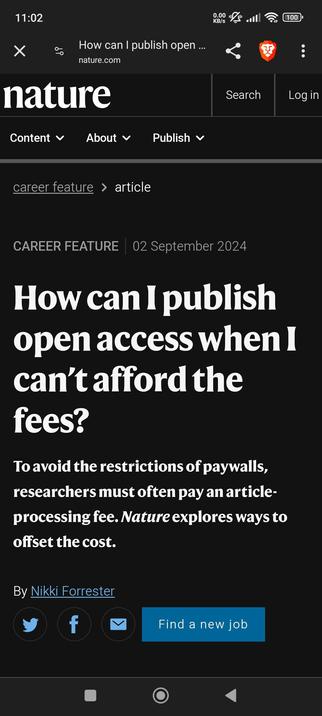
Update. Here's a letter to the editor of #Nature asking how to make an article #OpenAccess when one can't afford an #APC. Nature responds with ways to raise money or request waivers. It never mentions #DiamondOA or #GreenOA.
https://www.nature.com/articles/d41586-024-02849-w
How can I publish open access when I can’t afford the fees?

To avoid the restrictions of paywalls, researchers must often pay an article-processing fee. Nature explores ways to offset the cost.

Update. Here's a letter to the editor trying to answer objections to #APCs. It points out the benefits of #OpenAccess that APCs pay for. But it never mentions #DiamondOA or #GreenOA. The author seems unaware, and certainly leaves the naïve reader unaware, that that we can get the benefits of OA without APCs.
https://www.sciencedirect.com/science/article/pii/S1572100024003788
Open Access of Medical Journals: Friend or Foe?

Update. Here's another piece that made it through peer review (#Cureus / #SpringerNature) documenting the real problems of #APCs without mentioning the existence or prevalence of non-APC OA (#DiamondOA) journals.
https://www.cureus.com/articles/276986-increasing-importance-and-costs-associated-with-publishing-for-dermatology-residency-applicants#!/

The editors and peer reviewers also allowed this howler to stand: "The #GreenOA option does not charge an APC and is free for authors to publish but requires a subscription to the journal to read the article."

#OpenAccess

Increasing Importance and Costs Associated With Publishing for Dermatology Residency Applicants

The financial costs associated with publishing in academic journals have steadily risen in recent years, reflected by higher publishing fees and the emergence of open access (OA) publishing models. Research remains an essential part of academia and has special significance for residency applicants. Due to recent changes in some objective measures used to rank residency applicants, such as abandoning numerical United States Medical Licensing Examination (USMLE) Step 1 scores and transitioning pre-clinical grades to Pass/Fail, other objective measures have gained significance: in particular, the quality and quantity of research activities including manuscripts, abstracts, and presentations have become more important in residency applications. This has led to a significant increase in the reported number of research experiences and publications to more competitive specialties, including dermatology. Our study analyzes the current financial landscape of publishing in the field of dermatology and the financial burden placed on applicants as well as programs to meet the expected number of research experiences in order to successfully match into a dermatology residency. Through a comprehensive examination of 85 dermatology-based academic journals, we assess the costs and differences of publishing in OA and hybrid OA journals while also exploring potential avenues for mitigating the financial burden of publishing. Our findings indicate that while cost-effective options exist, the financial burden of article processing charges remains substantial.

Update. Here's another piece that made it through peer review (Oxford U Press) documenting real problems caused by #APCs but leaving the false impression that all or most #OpenAccess journals charge APCs. It's silent on the existence and prevalence of non-APC OA (#DiamondOA) journals.
https://academic.oup.com/ejcts/advance-article-abstract/doi/10.1093/ejcts/ezae447/7926881
(#paywalled)

Update. Here's another unrefereed editorial asserting that all #OpenAccess journals charge #APCs.
https://journals.lww.com/jgpt/fulltext/2025/01000/editor_s_message__pay_to_publish,_or_perish__.1.aspx

It never acknowledges the existence of no-APC (#DiamondOA) journals or the 20+ year old fact that they far outnumber APC-based OA journals.

Update. Here's yet another unrefereed editorial asserting that all #OpenAccess journals charge #APCs and failing to acknowledge the existence or prevalence of no-APC OA (#DiamondOA) journals.
https://www.arthroscopyjournal.org/article/S0749-8063(24)01080-6/fulltext
Update. Here's an unrefereed letter to the editor leaving the false impression that the UK #REF requires researchers to publish in #APC-based #OpenAccess journals. (It doesn't require publishing in OA journals; authors may choose #GreenOA instead; and when they do choose to publish in OA journals, they are free to choose no-APC or #DiamondOA journals.)
https://www.nature.com/articles/s41415-025-8398-8
Open access and peer review - why do I have to pay twice? - British Dental Journal

Nature
Update. Here's another unrefereed letter to the editor (this time at Physics Today) falsely asserting that all #OpenAccess journals charge #APCs, effectively denying the existence and prevalence of no-APC OA (#DiamondOA) journals , and failing to acknowledge the existence of OA repositories (#GreenOA).
https://pubs.aip.org/physicstoday/article/78/3/8/3337073/Open-access-for-reading-or-closed-access-for

Update. Here's another piece that made it through peer review (at Oxford UP) falsely assuming that all #OpenAccess journals charge #APCs.
https://doi.org/10.1093/ejcts/ezaf092

The author concludes that there is *not* too much OA, but only because APC discounts and waivers exist. Imagine how much she could have strengthened her argument by bringing in #DiamondOA and #GreenOA.

#ScholComm

Update. Here's a published article making a cluster of false claims about #OpenAccess journals: "In the OA model…costs are…covered by Article Processing Charges (#APCs) paid by the authors (#GoldOA); in relatively rare cases, some funders cover the full costs of a journal (#DiamondOA) to make it free for readers and authors alike."
https://www.ssph-journal.org/journals/international-journal-of-public-health/articles/10.3389/ijph.2025.1608614/full

1. It claims that most OA journals charge APCs and that diamond OA journals are rare. But most OA journals do NOT charge APCs and diamond OA journals predominate.

Today the #DOAJ (@DOAJ) lists 21,597 OA journals, of which 13,735 or 63.5% are diamond.
https://doaj.org/

2. It claims that at APC-based OA journals, APCs are (always) paid by authors. But while this tends to be true in the global south, even there it's only a tendency, not a universal truth. In the north, APCs are usually NOT paid by authors but by their funders or employers.
https://suber.pubpub.org/pub/j1jk6hu9

3. There are many ways to fund a diamond or non-APC OA journals, not just by having funders cover their costs.

BTW, this piece is called a "commentary" and might not have been peer-reviewed.

In the rest of the piece, the authors complain about misunderstandings of their journal.

SSPH+ | Conspiracies in Academia? Stand Up Against Defamations of Open Access Journals!

through subscriptions while also charging APCs to authors who opted to publish OA. This hybrid model is routinely criticized for using an unfair "double...

SSPH+
Update. Here's another journal editor saying (without peer review) that all #OpenAccess journals charge APCs.
https://aarontay.substack.com/p/my-reflection-on-my-journey-in-open
My reflection on my journey in open access or Can you be a librarian without being an open access advocate?

In honor of this year's Open Access Week, here's a personal reflection of my engagement with open access over the 10 years of my career in academic libraries.

Aaron Tay's Musings about Librarianship

Update. Here's another article that made it through peer review (at #WoltersKluwer) falsely asserting that all #OpenAccess journals charge #APCs.
http://dx.doi.org/10.1097/SAP.0000000000004612
(#paywalled)

General thesis: Paying APCs is a hardship (true) and the prices are going up (true). Therefore, to help medical students publish OA, medical schools should fund their APCs.

The article never mentions no-fee OA journals (#DiamondOA) or no-fee OA repositories (#GreenOA).

#ScholComm

Update. Here's another piece critical of #APCs (so far, so good), and reviewing other people's criticisms of APCs (even better). Yet it makes the wholly false assertion that all #OpenAccess journals charge APCs. ("In open access, instead of readers having to pay, the paper’s authors cover the expenses of publication.") It says this even though it also summarizes a position explicitly referring to #DiamondOA journals. It never mentions that most OA journals do not charge APCs.
https://undark.org/2026/01/07/apc-science-publishing/
In Scientific Publishing, Who Should Foot the Bill?

Publishers often charge authors to publish their publicly-funded research. Will a federal crackdown make a difference?

Undark Magazine

Update. Here's another article that made it through peer review (at #Elsevier) with the false claim that all #OpenAccess journals charge #APCs.
https://www.journalofsurgicalresearch.com/article/S0022-4804(26)00045-4/abstract

I only have access to the abstract, not the full text. If I learn that the article acknowledges that no-APC OA (#DiamondOA) journals exist, and even outnumber APC-based OA journals, then I'll correct this post. But I'll still criticize the authors and editors for publishing a false claim in the abstract, namely, "Open access (OA) publishing…requires article processing charges (APCs)."

Update. Here's an unrefereed letter to the editor protesting -- with justice -- that "top-ranked scientific publications [could] become the preserve of 'rich' groups." But it relies on the false assumption that all #OpenAccess journals charge #APCs. Hence, it doesn't even mention #DiamondOA solutions to this problem.
https://journals.asm.org/doi/10.1128/mbio.03659-25
@petersuber There are SO MANY of these that it's difficult to maintain my charitable interpretation that it's just a matter of ignorance. I feel now that a deliberate campaign of misinformation must be at the root of it.
@mike
I haven't decided what's going on. But I do think there's a strong thread of groupthink. Even if it's not deliberate conspiracy, these articles are written, refereed, and edited by people who share the same false beliefs, blind spots, provincial limitations, confirmation biases, and ... reluctance to look things up!
@petersuber I don’t have access either, but it may be that there are only apc/based gold journals in integrated plastic surgery (IPS)? It anyway they can make this clear in the abstract as well.
@petersuber It's the same in the article: "Yet OA comes at a price, and that price is borne not by readers, but by authors." The authors mention transformative agreements, APC discounts and waivers, but not a word about Diamond OA.
@petersuber what's the best way to find a list of diamond OA journals relevant to a particular field ?
@petersuber @DOAJ But the opposite is also true: Many people whose employers do not pay for them avoid #OA publishing, and this is especially a challenge among early career scholars who often lack funding but also want to reach the largest communities possible. Unfortunately, well-reputed non-OA journals are often more visible than OA journals. I think #DiamondOA is picking up --- but many diamond OA journals are arguably very niche and only known to absolute experts in a certain field.
@mob @DOAJ
True enough -- about some scholars avoiding OA journals. But many other scholars avoid OA journals because they believe the untruths published here, that (in effect) all OA journals charge APCs and all APCs must be paid by authors out of pocket. I wasn't trying to advise authors on where to publish. My point was that those who *publish about OA* should get their facts straight and stop promulgating harmful falsehoods.
@petersuber @DOAJ I understand & agree, but saying that (in the Global North) employers or funders mostly pay is also misleading. We have regular discussions about OA in my institution where we offer GoldOA options via deals with commercial publishers & extra funding for which people can apply, but it hardly covers the need. I have only been able to publish several peer-reviewed OA articles because I could split costs with co-authors. DiamondOA often has hidden editing & typesetting costs, too.
@petersuber Given that it was accepted 12 days after being submitted, I'd say it very likely wasn't peer-reviewed
@petersuber Do you know offhand the sort of breakdown between prominent open access journals that charge to publish and those that don't?
@joshisanonymous
Bracketing the problem of deciding which journals are "prominent", we have a good answer from the Directory of Open Access Journals (#DOAJ, @DOAJ). As of today, it lists 21,452 #OpenAccess journals, of which 13,712 are #DiamondOA or charge no #APCs. Hence. 63.9% (≈ 64%) of DOAJ-listed journals charge no APCs.
@petersuber Thanks for sharing this. Increasing awareness of #DiamondOA especially is so critical right now!
@petersuber per COPE, did they declare conflict of interest?
@petersuber btw, the article conveniently dodged the question by asking a very narrow question. Very bad journalism.

@egonw
#PostOfTheWeek (season 1):

Most scientific journals are transparent about their publishing fees, which are typically included in the author guidelines or stated on their website. “If a journal suddenly asks for payment” having not mentioned such a requirement initially, says Kit Magellan, an independent behavioural ecologist based in Siem Reap, Cambodia, “it is likely a predatory journal — run away!”

@petersuber Also, using country of residence as the basis is absurd when institutions and even individual projects vary in what funds are available to them.
@petersuber Given that this has been a misunderstanding for over a decade, perhaps what people mean is not "OA is problematic because all the OA journals charge APCs" but rather "all the OA journals I care about charge APCs". Quantitative arguments about the percentage of gold/green/diamond might be influential with policymakers or librarians, but this long-standing misunderstanding shows that these arguments don't reach researchers at all, right?

@williamgunn @petersuber

Bingo yes yes this perfectly matches the patterns I've seen of Boomers and Gen X researchers talking about OA and conflating it with APC.

@williamgunn
Yes, many people fit this description. But for 20+ yrs (since the birth of the APC model), I've run across people trying to characterize the landscape of #OpenAccess, not just their own frustrations. Many still believe that all OA journals charge APCs, not just their favorites (unaware of #DiamondOA). BTW, many of the same people believe that all OA is journal-based (unaware of #GreenOA). There are still deep veins of ignorance about the varieties of OA and biz models for OA.
@petersuber My theory is that the persistent confusion or misunderstanding is trying to tell you something. It implies a desired belief about the way things "should" be. Understand what the people want to believe and you'll be able to speak to them in a way that cuts through and finally reaches them.
@williamgunn @petersuber And MY theory is that the persistent confusion or misunderstanding has been sewn, successfully, by legacy publishers.

@mike @petersuber It would have been a clever devilish trick to have done so, but I didn't see it happening. All the publishers really had to do was just let the misunderstanding stand.

Publishers knew from continual surveys and conversations which journals researchers preferred, so they knew exhortations from green OA advocates to consider non-APC journals were going to go nowhere. It's just not how researchers think.

@mike @petersuber With the exception of distinguished gentlemen such as yourselves, the advocates have really always been outclassed, not only in financial resources, but also in the degree to which they really understand researchers and what motivates them. It's terribly unfortunate but a lot of it was really an own goal caused by focusing on what they wanted to be true vs engaging with what could be observed.

@williamgunn @petersuber Nothing clever about it. All they had to do — and all they did do — was continually lob misinformation over the wall. It didn't matter to them what stuck and what didn't, just so long as it muddied the conversation.

One example, this one from Elsevier's actual General Counsel: https://svpow.com/2013/09/20/plagiarism-is-nothing-to-do-with-copyright/

Plagiarism is nothing to do with copyright

I was astonished yesterday to read Understanding and addressing research misconduct, written by Linda Lavelle, Elsevier’s General Counsel, and apparently a specialist in publication ethics: W…

Sauropod Vertebra Picture of the Week
@williamgunn @petersuber it's always easier to destroy anything than to build it, and that goes for understanding just like it does for buildings. (The last decade of politics should have taught us this.)
@mike @petersuber Wow, that's awful. Is it possible it's just ignorance and not malice, though? My experience on the inside suggests the former shouldn't be discounted as a possibility.
@williamgunn @petersuber I am an adherent of Hanlon's Razor, and always prefer the explanation of incompetence when reasonable. In this case, though — Elsevier's senior legal counsel — it's very very hard for me to persuade myself that he genuinely didn't understand the difference between plagiarism and copyright violation.
@mike @petersuber It's not that hard for me to imagine a lawyer not understanding academic norms around plagiarism. I guess where I'm coming from is that I was literally in the communication department and in meetings with the academic relations group. If there were any attempts to scheme around misinformation, that's where it would have happened and I feel like I would have seen it. It's possible that secret meetings were held, but I was kept in the loop about a lot.
@williamgunn @petersuber It's nothing to do with "academic norms around" plagiarim; it's what plagiarism *is*. Can you genuinely imagine an IP lawyer not understanding that?
@mike @petersuber Plagiarism isn't a legal thing, as you discuss. I can certainly see a lawyer making a clumsy parallel with the closest legal concept.