Been perusing late 17th and early 18th century texts, as one is wont to do, when I came across this pronoun rant.
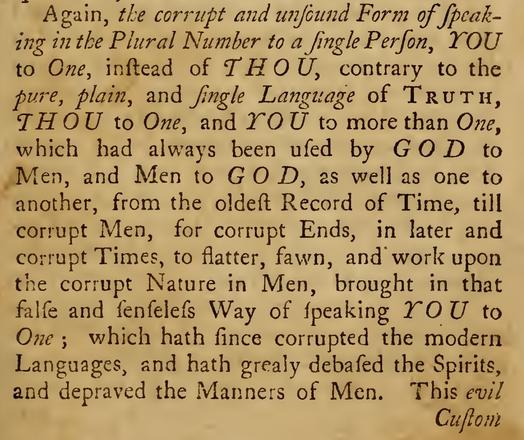
I've seen a similar quote before, but was surprised to actually come across it while reading.

#Quaker #Books

For those who wish to see what happens next, the text is available online:

https://archive.org/details/historyoflifeoft00ellw/page/24/mode/2up

The history of the life of Thomas Ellwood : Or, an account of his birth, education, &c. with divers observations on his life and manners when a youth: and how he came to be convinced of the truth; with his many sufferings and services for the same ; Also, several other remarkable passages and occurrences : Ellwood, Thomas, 1639-1713 : Free Download, Borrow, and Streaming : Internet Archive

448 p. ; 21 cm

Internet Archive

And, yes, early #Quakers were weird.

We're still weird, just in different ways.

@jetton Few people seem to get that, unlike modern pronoun rants, this was a rant *for* equality against the still newish practice of using ‘you’ to flatter social ‘superiors’. If ‘thou’ was good enough for God, it was good enough for me and thee.

Still, a fun rant to look back on.

@evan @jetton “Newish” is stretching it a bit. See https://en.wikipedia.org/wiki/T%E2%80%93V_distinction . You might also come across a quaint northern English phrase for putting people in their social places: “Tha’ll not tha all them that tha’s thee!”
T–V distinction - Wikipedia

@boredtownboy @evan

Yes, been around since late Middle English at least.

@boredtownboy @jetton Yes, it was a load-bearing ‘ish’ for the sake of brevity. A lot of prominent early Quakers, including George Fox came from the North of England and from families in trade. When they started travelling in ministry I’m guessing that they encountered places and sections of society where the more widespread use of ‘you’ sounded novel to them and grated on their ears all the more. And they had the KJV Bible to back them. Just a guess, though.
@evan @jetton It’s also nice to see pedantry thriving in that far-gone time, and also the use of block capitals when you’re having a rant. 😁
@boredtownboy @jetton Better than all caps, write a whole book about it citing the grammar of dozens of languages. George Fox’s ‘A battle-door for teachers & professors to learn singular & plural’ is a real treat of grumpy scholarship. I’m surprised that they had access to so many languages in 17th century England, to be honest. https://quod.lib.umich.edu/cgi/t/text/text-idx?c=eebo;idno=A40123.0001.001
A battle-door for teachers & professors to learn singular & plural you to many, and thou to one, singular one, thou, plural many, you : wherein is shewed ... how several nations and people have made a distinction between singular and plural, and first, in the former part of this book, called The English battle-door, may be seen how several people have spoken singular and plural...: also in this book is set forth examples of the singular and plural about thou, and you, in several languages, divided into distinct Battle-Doors, or formes, or examples; English Latine, Italian, Greek, Hebrew, Chaldee, Syriack, Arabick ... and how emperors and others have used the singular word to one, and how the word you came first from the Pope, likewise some examples, in the Polonian, Lithuanian, Irish and East-Indian, together with ... Swedish, Turkish ... tongues : in the latter part of this book are contained severall bad unsavory words, gathered forth of certain school-books, which have been taught boyes in Enland ... / George Fox, John Stubs, Benjamin Farley.

@evan @boredtownboy

I might give this a look.
Have to admit I find George Fox a hard read,
He really seems kind of a whack job.

@jetton @boredtownboy This is not the book to convince you otherwise. 😅
@evan @boredtownboy @jetton Were they not using the Geneva Bible? I’m more familiar with Puritans than Quakers.
@shannonkay @boredtownboy @jetton Good question and I’m certainly no expert (but interested to hear from those who are). From a quick look, the Quaker Bible index says ‘The Authorized (King James) Version was the most recent; several 16th-century translations – Geneva, Bishops’, and Tyndale – were still current, and Friends quoted all of them.’ https://qbi.earlham.edu/intro.htm
Quaker Bible Index: Introduction

@evan @shannonkay @boredtownboy

I'm also no expert, but of the early Friends' journals I've read, The King James Version was the most commonly quoted.

@evan Yes. Quakers believed one should make no distinction based based on "superiority" or "inferiority" on how they are to be addressed. A King should be addressed the same as a beggar.
Caused them a hell of a lot of problems.
Much of the first part of this book is about how his father kept beating him for saying "thou" to him.

@evan

A typical example a bit later in the book.

@jetton @evan It sounds like I might have something in common with Quakers. I believe if you were to search my post history, you'd find me saying on multiple occasions that I consider both POTUS and the beggar under the bridge to be my equals.

@jetton Someday I want know if there’s a rule for using long S vs curvy S

seems like there’s not

@notGordonAllport
Long s at the beginning of a word or in the middle. Short s at the end.
@jetton @notGordonAllport Also if there's a doubled 's', you would generally use short 's' for the second of the two, so for instance "possess" would usually be "poſseſs" rather than "poſſeſs". (This isn't consistent but it was general practice; it's just more readable).

@adrienne @notGordonAllport

Very good point. You are of course correct.

@jetton @notGordonAllport (I'm something of a typography nerd.)

@adrienne

The best type of nerd.

Edit: I hadn't even realized I made a pun...

@jetton @adrienne And for completeness, poſseſs can then become poßeß. As evidenced in the old German street signs. (They all end in -strasse, "street" - check alt text for details)
@skolima @jetton @adrienne Oh cool! There’s a sans serif version?! How do I access that?

@schardl8 The sans-serif font on the "Wattstraße" sign is probably

https://www.fontshop.com/families/ff-cst-berlin-west

As far as I'm aware, the west part of Berlin is the only place in Germany that uses this specific ß shape that makes the ligature visually obvious.

The font linked above also has an "East" variant with the normal round ß.

@skolima @jetton @adrienne

FF Cst Berlin West Font

FF Cst Berlin West is a typeface designed by Verena Gerlach and Ole Schäfer, and is available for Desktop, Web, App, Electronic Doc, and Web. Try, buy and download these fonts now!

FontShop
@adrienne @jetton @notGordonAllport I've seen a few of these, often with ligatures (even in typeface), so kinda like a modern German ß but with a tail.
@vometia @adrienne @jetton @notGordonAllport The German ß is often replaced by ss, rather than sz, which is what the ligature is (ſʒ) . Why is that? Just a matter of the pronunciation?
@villavelius @vometia @adrienne @jetton @notGordonAllport I didn't even know "sz" was an alternative rendering! (I studied German for three years at school, but I was not very good at it.)
@mike @villavelius @vometia @adrienne @jetton @notGordonAllport It’s literally called “sz”, but afaik, always considered to represent “ss”.
I’ve been told that the ß is retained because words like “mißstände” would be written “missstände”. Couldn’t it be “miszstände” instead?

@schardl8 @villavelius @vometia @adrienne @jetton @notGordonAllport Ha! I've often heard it being called an "ess-set", but never registered that the "set" part is the letter "z".

What a dummy.

@mike @vometia @adrienne @jetton @notGordonAllport
You'd be surprised how often 'sz' or 'ss' show up in the scientific literature as 'ß', as in ß-carotene and the like. Blame the Greeks for having the look-alike β. Look up 'ss-carotene' in PubMed 😉. Nightmare for machine-reading of scientific literature.
@mike @villavelius @adrienne @jetton @notGordonAllport I only had one year of being not very good at it so I'm not sure if that makes me better or worse. My German teacher was actually German, though.
@vometia @villavelius @adrienne @jetton @notGordonAllport So was mine. Didn't help. I think my problem was trying to learn French and German at the same time. All the vocab got filed in my brain under the single category "foreign".

@mike @villavelius @adrienne @jetton @notGordonAllport Accurate, tho'.

My cousin's German but sounds like a Geordie. Her mum sounds like a German speaking Geordie. Conversely, my attempts at German sound like a Geordie speaking mumble, with some swearing (the bits I could actually remember, strangely).

@mike @vometia @adrienne @jetton @notGordonAllport
German is not as easy for a native English speaker to learn as the Category I languages: Danish
Dutch
French
Italian
Norwegian
Portuguese
Romanian
Spanish (LatAm or Spain)
Swedish

German is a Category II language, needing about 50% more hours of practice than the ones above.

@jetton @notGordonAllport ... well except in Spirits, it appears (second last line).
@tobtobxx @notGordonAllport
I assume that's because it is capitalized. Maybe. I'm not sure orthographic and typographic consistency is his strong point.

@jetton

Also to be found on Project Gutenberg:

https://gutenberg.org/ebooks/6925

The History of Thomas Ellwood Written By Himself by Thomas Ellwood

Free kindle book and epub digitized and proofread by volunteers.

Project Gutenberg

@jgamble
Thanks for the link.

I'm not sure what it says about me that I find the original text easier to read than the modernized one.

@jetton a Counter-Blaste to Wokke
@hannah
I'm assuming that's pronounced like middle english?

@hannah

Whan that Aprille with his shoures soote
Me thynketh a Counter-Blaste to Wokke

@jetton
Full Alt text added.
Hey, did you know that Google Lens doesn't recognize the 'long S'?
*Edit: missed a long S in 'unsound'.
Alt text corrected 2033-11-10 14:35 UTC

@RealGene
Thank you.

No, I didn't, but am not surprised.

@RealGene @jetton

Google lens isn't sufficiently integrated (a little maths joke there - I'm here all week!)

@RealGene @jetton — Truly, the medial s, like the em ſpace, is treated unjuſtly by the whole typographic eſtabliſhment.
@RealGene @jetton neither does my brain apparently. Keep reading it as an f.
@RealGene @jetton Coincidence? I don't think so ...

@RealGene @jetton Lens would need a special OCR setting to recognize long-S

tesseract-ocr using the 'enm' (Middle English?) language picks up most of them, but correctly outputs Unicode with long-S: f'rinstance "ſenſeleſs".

(I am more amused than I should be that it renders "ſingle" as "jingle", though)

@RealGene @jetton ah, 'senseless', I was trying to figure out what fenseless meant…

@olive

fenseless means you have to watch to make sure your dog doesn't wander away.

@jetton
No, it means the wide blue sea belongs to both you and your friendly blue whale
@jetton best letter to the editor ever
@jetton omg YES. what's this from?
@jetton oh nm follow up. 🙃