Been perusing late 17th and early 18th century texts, as one is wont to do, when I came across this pronoun rant.
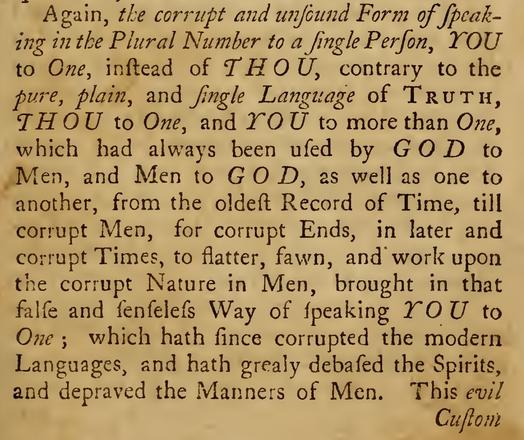
I've seen a similar quote before, but was surprised to actually come across it while reading.

#Quaker #Books

For those who wish to see what happens next, the text is available online:

https://archive.org/details/historyoflifeoft00ellw/page/24/mode/2up

The history of the life of Thomas Ellwood : Or, an account of his birth, education, &c. with divers observations on his life and manners when a youth: and how he came to be convinced of the truth; with his many sufferings and services for the same ; Also, several other remarkable passages and occurrences : Ellwood, Thomas, 1639-1713 : Free Download, Borrow, and Streaming : Internet Archive

448 p. ; 21 cm

Internet Archive

And, yes, early #Quakers were weird.

We're still weird, just in different ways.

@jetton Someday I want know if there’s a rule for using long S vs curvy S

seems like there’s not

@notGordonAllport
Long s at the beginning of a word or in the middle. Short s at the end.
@jetton @notGordonAllport Also if there's a doubled 's', you would generally use short 's' for the second of the two, so for instance "possess" would usually be "poſseſs" rather than "poſſeſs". (This isn't consistent but it was general practice; it's just more readable).

@adrienne @notGordonAllport

Very good point. You are of course correct.

@jetton @notGordonAllport (I'm something of a typography nerd.)

@adrienne

The best type of nerd.

Edit: I hadn't even realized I made a pun...

@jetton @adrienne And for completeness, poſseſs can then become poßeß. As evidenced in the old German street signs. (They all end in -strasse, "street" - check alt text for details)
@skolima @jetton @adrienne Oh cool! There’s a sans serif version?! How do I access that?

@schardl8 The sans-serif font on the "Wattstraße" sign is probably

https://www.fontshop.com/families/ff-cst-berlin-west

As far as I'm aware, the west part of Berlin is the only place in Germany that uses this specific ß shape that makes the ligature visually obvious.

The font linked above also has an "East" variant with the normal round ß.

@skolima @jetton @adrienne

FF Cst Berlin West Font

FF Cst Berlin West is a typeface designed by Verena Gerlach and Ole Schäfer, and is available for Desktop, Web, App, Electronic Doc, and Web. Try, buy and download these fonts now!

FontShop
@adrienne @jetton @notGordonAllport I've seen a few of these, often with ligatures (even in typeface), so kinda like a modern German ß but with a tail.
@vometia @adrienne @jetton @notGordonAllport The German ß is often replaced by ss, rather than sz, which is what the ligature is (ſʒ) . Why is that? Just a matter of the pronunciation?
@villavelius @vometia @adrienne @jetton @notGordonAllport I didn't even know "sz" was an alternative rendering! (I studied German for three years at school, but I was not very good at it.)
@mike @villavelius @vometia @adrienne @jetton @notGordonAllport It’s literally called “sz”, but afaik, always considered to represent “ss”.
I’ve been told that the ß is retained because words like “mißstände” would be written “missstände”. Couldn’t it be “miszstände” instead?

@schardl8 @villavelius @vometia @adrienne @jetton @notGordonAllport Ha! I've often heard it being called an "ess-set", but never registered that the "set" part is the letter "z".

What a dummy.

@mike @vometia @adrienne @jetton @notGordonAllport
You'd be surprised how often 'sz' or 'ss' show up in the scientific literature as 'ß', as in ß-carotene and the like. Blame the Greeks for having the look-alike β. Look up 'ss-carotene' in PubMed 😉. Nightmare for machine-reading of scientific literature.
@mike @villavelius @adrienne @jetton @notGordonAllport I only had one year of being not very good at it so I'm not sure if that makes me better or worse. My German teacher was actually German, though.
@vometia @villavelius @adrienne @jetton @notGordonAllport So was mine. Didn't help. I think my problem was trying to learn French and German at the same time. All the vocab got filed in my brain under the single category "foreign".

@mike @villavelius @adrienne @jetton @notGordonAllport Accurate, tho'.

My cousin's German but sounds like a Geordie. Her mum sounds like a German speaking Geordie. Conversely, my attempts at German sound like a Geordie speaking mumble, with some swearing (the bits I could actually remember, strangely).

@mike @vometia @adrienne @jetton @notGordonAllport
German is not as easy for a native English speaker to learn as the Category I languages: Danish
Dutch
French
Italian
Norwegian
Portuguese
Romanian
Spanish (LatAm or Spain)
Swedish

German is a Category II language, needing about 50% more hours of practice than the ones above.