
Been perusing late 17th and early 18th century texts, as one is wont to do, when I came across this pronoun rant.
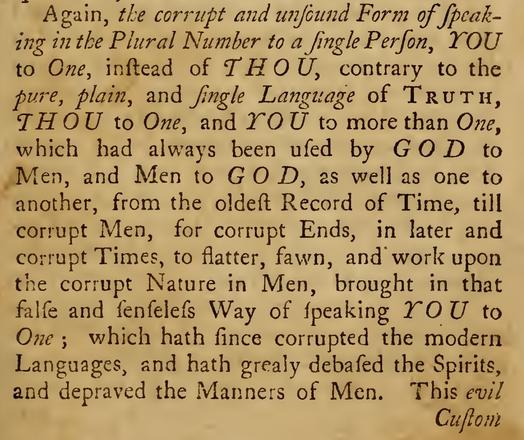
I've seen a similar quote before, but was surprised to actually come across it while reading.

#Quaker #Books

For those who wish to see what happens next, the text is available online:

https://archive.org/details/historyoflifeoft00ellw/page/24/mode/2up

The history of the life of Thomas Ellwood : Or, an account of his birth, education, &c. with divers observations on his life and manners when a youth: and how he came to be convinced of the truth; with his many sufferings and services for the same ; Also, several other remarkable passages and occurrences : Ellwood, Thomas, 1639-1713 : Free Download, Borrow, and Streaming : Internet Archive

448 p. ; 21 cm

Internet Archive

And, yes, early #Quakers were weird.

We're still weird, just in different ways.

@jetton Few people seem to get that, unlike modern pronoun rants, this was a rant *for* equality against the still newish practice of using ‘you’ to flatter social ‘superiors’. If ‘thou’ was good enough for God, it was good enough for me and thee.

Still, a fun rant to look back on.

@evan @jetton “Newish” is stretching it a bit. See https://en.wikipedia.org/wiki/T%E2%80%93V_distinction . You might also come across a quaint northern English phrase for putting people in their social places: “Tha’ll not tha all them that tha’s thee!”
T–V distinction - Wikipedia

@boredtownboy @jetton Yes, it was a load-bearing ‘ish’ for the sake of brevity. A lot of prominent early Quakers, including George Fox came from the North of England and from families in trade. When they started travelling in ministry I’m guessing that they encountered places and sections of society where the more widespread use of ‘you’ sounded novel to them and grated on their ears all the more. And they had the KJV Bible to back them. Just a guess, though.
@evan @jetton It’s also nice to see pedantry thriving in that far-gone time, and also the use of block capitals when you’re having a rant. 😁
@boredtownboy @jetton Better than all caps, write a whole book about it citing the grammar of dozens of languages. George Fox’s ‘A battle-door for teachers & professors to learn singular & plural’ is a real treat of grumpy scholarship. I’m surprised that they had access to so many languages in 17th century England, to be honest. https://quod.lib.umich.edu/cgi/t/text/text-idx?c=eebo;idno=A40123.0001.001
A battle-door for teachers & professors to learn singular & plural you to many, and thou to one, singular one, thou, plural many, you : wherein is shewed ... how several nations and people have made a distinction between singular and plural, and first, in the former part of this book, called The English battle-door, may be seen how several people have spoken singular and plural...: also in this book is set forth examples of the singular and plural about thou, and you, in several languages, divided into distinct Battle-Doors, or formes, or examples; English Latine, Italian, Greek, Hebrew, Chaldee, Syriack, Arabick ... and how emperors and others have used the singular word to one, and how the word you came first from the Pope, likewise some examples, in the Polonian, Lithuanian, Irish and East-Indian, together with ... Swedish, Turkish ... tongues : in the latter part of this book are contained severall bad unsavory words, gathered forth of certain school-books, which have been taught boyes in Enland ... / George Fox, John Stubs, Benjamin Farley.

@evan @boredtownboy

I might give this a look.
Have to admit I find George Fox a hard read,
He really seems kind of a whack job.

@jetton @boredtownboy This is not the book to convince you otherwise. 😅